Kirjojen hintavertailu. Mukana 12 390 323 kirjaa ja 12 kauppaa.

Kirjailija

Michel Janssen

Kirjat ja teokset yhdessä paikassa: 7 kirjaa, julkaisuja vuosilta 2019-2023, suosituimpien joukossa How Einstein Found His Field Equations. Vertaile teosten hintoja ja tarkista saatavuus suomalaisista kirjakaupoista.

7 kirjaa

Kirjojen julkaisuhaarukka 2019-2023.

Constructing Quantum Mechanics, Two-Volume Pack

Constructing Quantum Mechanics, Two-Volume Pack

Anthony Duncan; Michel Janssen

Oxford University Press
2023
muu
This two-volume book is on the genesis of quantum mechanics. The first volume covers the key developments in the period 1900-1923, which provided the scaffold on which the arch of modern quantum mechanics was built. This volume traces the early contributions by Planck, Einstein, and Bohr to the theories of black-body radiation, specific heats, and spectroscopy, all showing the need for drastic changes to the physics of their day. It examines the efforts by Sommerfeld and others to provide a new theory, now known as the old quantum theory. After some striking initial successes (explaining the fine structure of hydrogen, X-ray spectra, and the Stark effect), the old quantum theory ran into serious difficulties (failing to provide consistent models for helium and the Zeeman effect) and eventually gave way to matrix and wave mechanics. The second volume provides detailed analysis of the classic papers by Heisenberg, Born, Jordan, Dirac, De Broglie, Einstein, Schrödinger, von Neumann and other authors. Drawing on the correspondence of these and other physicists, their later reminiscences and the extensive secondary literature on the "quantum revolution," this volume places these papers in the context of the discussions out of which modern quantum mechanics emerged. It argues that the genesis of modern quantum mechanics can be seen as the construction of an arch on a scaffold provided by the old quantum theory, discarded once the arch could support itself.
Constructing Quantum Mechanics Volume Two

Constructing Quantum Mechanics Volume Two

Michel Janssen; Anthony Duncan

Oxford University Press
2023
sidottu
This is the second of two volumes on the genesis of quantum mechanics in the first quarter of the 20th century. It covers the period 1923-1927. After covering some of the difficulties the old quantum theory had run into by the early 1920s as well as the discovery of the exclusion principle and electron spin, it traces the emergence of two forms of the new quantum mechanics, matrix mechanics and wave mechanics, in the years 1923-27. It then shows how the new theory took care of some of the failures of the old theory and put its successes on a more solid basis. Finally, it shows how in 1927 the two forms of the new theory were unified, first through statistical transformation theory, then through the Hilbert space formalism. This volume provides a detailed analysis of the classic papers by Heisenberg, Born, Jordan, Dirac, De Broglie, Einstein, Schrödinger, von Neumann and other authors. Drawing on the correspondence of these and other physicists, their later reminiscences and the extensive secondary literature on the “quantum revolution”, this volume places these papers in the context of the discussions out of which modern quantum mechanics emerged. It argues that the genesis of modern quantum mechanics can be seen as the construction of an arch on a scaffold provided by the old quantum theory, discarded once the arch could support itself.
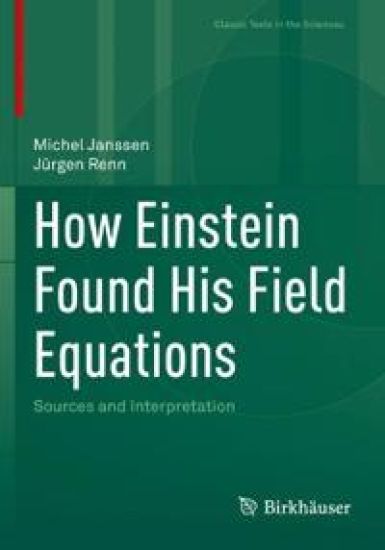
How Einstein Found His Field Equations

How Einstein Found His Field Equations

Michel Janssen; Jürgen Renn

Springer Nature Switzerland AG
2023
nidottu
Einstein's field equations of gravitation are a core element of his general theory of relativity. In four short communications to the Prussian Academy of Sciences in Berlin in November 1015, we can follow the final steps toward these equations and the resulting theory's spectacular success in accounting for the anomalous motion of Mercury's perihelion. This source book provides an expert guide to these four groundbreaking papers. Following an introductory essay placing these papers in the context of the development of Einstein's theory, it presents and analyzes, in addition to the four papers of November 1915, a careful selection of (critical excerpts from) papers, letters, and manuscripts documenting the path that early on led Einstein to the field equations of the first November 1915 paper, but then took a turn away from them only to lead back to them in the end. Drawing on extensive research at the Einstein Papers Project and the Max Planck Institute for History of Science, this volume traces the intricate interplay between considerations of physics and considerations of mathematics that guided Einstein along this path. It thus presents a concise yet authoritative account of how Einstein found his field equations, affording readers who are prepared to immerse themselves in these intricacies a unique glimpse of Einstein at work at the height of his creative prowess. Highlights of this journey in Einstein's footsteps include the crucial pages (with detailed annotation) from the Zurich Notebook, the record of Einstein's early search for field equation with his mathematician friend Marcel Grossmann, and the Einstein-Besso manuscript, documenting Einstein's attempts with his friend and confidant Michele Besso to explain the Mercury anomaly on the basis of the equations that he and Grossmann had eventually settled on in the Zurich Notebook.
Understanding Quantum Raffles

Understanding Quantum Raffles

Michael Janas; Michael E. Cuffaro; Michel Janssen; Jeffrey Bub

Springer Nature Switzerland AG
2022
nidottu
This book offers a thorough technical elaboration and philosophical defense of an objectivist informational interpretation of quantum mechanics according to which its novel content is located in its kinematical framework, that is, in how the theory describes systems independently of the specifics of their dynamics. It will be of interest to researchers and students in the philosophy of physics and in theoretical physics with an interest in the foundations of quantum mechanics. Additionally, parts of the book may be used as the basis for courses introducing non-physics majors to quantum mechanics, or for self-study by those outside of the university with an interest in quantum mechanics.With a Foreword by Jeffrey Bub. -- “Understanding Quantum Raffles is a wonderful book for both the specialists and those with curious minds. The elegance and the simplicity with which the 'three Mikes' explain some of the deepest aspects of quantum mechanics on the basis of probabilities and correlations are dazzling and delightful. The same elegance and simplicity also make the book ideal for any engaged reader who ever wondered what is so special about quantum mechanics. In our age of new quantum technologies, this is something anyone should read.” (Guido Bacciagaluppi, author of Quantum Theory at the Crossroads) “This book makes a sustained argument for an informational interpretation of quantum theory, blending an elegant mathematical characterisation of quantum correlations with incisive historical and philosophical analysis. A must-read for those interested in quantum foundations, and also a fertile source of teaching inspiration for quantum theory.” (Leah Henderson, Department of Theoretical Philosophy, University of Groningen) “This is one of the most fascinating and accessible presentations of the informational approach to quantum mechanics. What has so far been mostly restrictedto the theoretical physics community is here masterfully explained for a broader audience even without a physics background. Scholars, students, and laypeople alike will appreciate the clear, vivid, and yet deep discussion of what raffle tickets and correlation elliptopes can tell us about the physics and philosophy of the quantum world.” (Markus Müller, Institute for Quantum Optics and Quantum Information, Vienna)
How Einstein Found His Field Equations

How Einstein Found His Field Equations

Michel Janssen; Jürgen Renn

Springer Nature Switzerland AG
2022
sidottu
Einstein's field equations of gravitation are a core element of his general theory of relativity. In four short communications to the Prussian Academy of Sciences in Berlin in November 1015, we can follow the final steps toward these equations and the resulting theory's spectacular success in accounting for the anomalous motion of Mercury's perihelion. This source book provides an expert guide to these four groundbreaking papers. Following an introductory essay placing these papers in the context of the development of Einstein's theory, it presents and analyzes, in addition to the four papers of November 1915, a careful selection of (critical excerpts from) papers, letters, and manuscripts documenting the path that early on led Einstein to the field equations of the first November 1915 paper, but then took a turn away from them only to lead back to them in the end. Drawing on extensive research at the Einstein Papers Project and the Max Planck Institute for History of Science, this volume traces the intricate interplay between considerations of physics and considerations of mathematics that guided Einstein along this path. It thus presents a concise yet authoritative account of how Einstein found his field equations, affording readers who are prepared to immerse themselves in these intricacies a unique glimpse of Einstein at work at the height of his creative prowess. Highlights of this journey in Einstein's footsteps include the crucial pages (with detailed annotation) from the Zurich Notebook, the record of Einstein's early search for field equation with his mathematician friend Marcel Grossmann, and the Einstein-Besso manuscript, documenting Einstein's attempts with his friend and confidant Michele Besso to explain the Mercury anomaly on the basis of the equations that he and Grossmann had eventually settled on in the Zurich Notebook.
Understanding Quantum Raffles

Understanding Quantum Raffles

Michael Janas; Michael E. Cuffaro; Michel Janssen; Jeffrey Bub

Springer Nature Switzerland AG
2021
sidottu
This book offers a thorough technical elaboration and philosophical defense of an objectivist informational interpretation of quantum mechanics according to which its novel content is located in its kinematical framework, that is, in how the theory describes systems independently of the specifics of their dynamics. It will be of interest to researchers and students in the philosophy of physics and in theoretical physics with an interest in the foundations of quantum mechanics. Additionally, parts of the book may be used as the basis for courses introducing non-physics majors to quantum mechanics, or for self-study by those outside of the university with an interest in quantum mechanics.With a Foreword by Jeffrey Bub. -- “Understanding Quantum Raffles is a wonderful book for both the specialists and those with curious minds. The elegance and the simplicity with which the 'three Mikes' explain some of the deepest aspects of quantum mechanics on the basis of probabilities and correlations are dazzling and delightful. The same elegance and simplicity also make the book ideal for any engaged reader who ever wondered what is so special about quantum mechanics. In our age of new quantum technologies, this is something anyone should read.” (Guido Bacciagaluppi, author of Quantum Theory at the Crossroads) “This book makes a sustained argument for an informational interpretation of quantum theory, blending an elegant mathematical characterisation of quantum correlations with incisive historical and philosophical analysis. A must-read for those interested in quantum foundations, and also a fertile source of teaching inspiration for quantum theory.” (Leah Henderson, Department of Theoretical Philosophy, University of Groningen) “This is one of the most fascinating and accessible presentations of the informational approach to quantum mechanics. What has so far been mostly restrictedto the theoretical physics community is here masterfully explained for a broader audience even without a physics background. Scholars, students, and laypeople alike will appreciate the clear, vivid, and yet deep discussion of what raffle tickets and correlation elliptopes can tell us about the physics and philosophy of the quantum world.” (Markus Müller, Institute for Quantum Optics and Quantum Information, Vienna)
Constructing Quantum Mechanics

Constructing Quantum Mechanics

Anthony Duncan; Michel Janssen

Oxford University Press
2019
sidottu
Constructing Quantum Mechanics is the first of two volumes on the genesis of quantum mechanics. This volume traces the early contributions by Planck, Einstein, and Bohr, all showing the need for drastic changes to the physics of their day. It examines the efforts by Sommerfeld and others to develop a new theory, now known as the old quantum theory. After some striking successes, this theory ran into serious difficulties and ended up serving as the scaffold on which the arch of modern quantum mechanics was built. This volume breaks new ground, both in its treatment of the work of Sommerfeld and his associates, and by offering new perspectives on classic papers by Planck, Einstein, Bohr, and others. Paying close attention to both primary and secondary sources, Constructing Quantum Mechanics provides an in-depth analysis of the heroic struggle to come to terms with the wealth of mostly spectroscopic data that eventually gave us modern quantum mechanics.