Kirjojen hintavertailu. Mukana 12 330 074 kirjaa ja 12 kauppaa.

Kirjailija

Michele Zappavigna

Kirjat ja teokset yhdessä paikassa: 20 kirjaa, julkaisuja vuosilta 2012-2025, suosituimpien joukossa Discourse and Diversionary Justice. Vertaile teosten hintoja ja tarkista saatavuus suomalaisista kirjakaupoista.

20 kirjaa

Kirjojen julkaisuhaarukka 2012-2025.

Negotiating Social Relations

Negotiating Social Relations

Y.J. Doran; J.R. Martin; Michele Zappavigna

UNIVERSITY OF TORONTO PRESS
2025
pokkari
Every day we negotiate our social relations. This may involve small, seemingly inconsequential chats with friends, families, and colleagues that perform our relationships. Or they may involve large, communal events that bring us together or tear us apart. In all cases, we negotiate these social relations through the language, paralanguage, and related systems of meaning that we use. This book introduces a new model for analysing how people negotiate social relations through the framework of Systemic Functional Linguistics (SFL). It focuses on SFL’s conception of social context and in particular on the interpersonal component of context known as tenor. Drawing on decades of SFL research, tenor is reworked as a resource for meaning – with the aim of describing in some detail how we go about building and maintaining sociality. The book begins by considering how language varies in relation to social context and the different perspectives we can take to explore this variation. It then introduces our model of tenor as a resource for negotiating social relations. The model comprises three main systems. Positioning considers how people put forward meanings, react to them, and position each other when we talk. Orienting looks at the nature of the meanings we negotiate, attending to the vast background of shared values that underpin our talk, help us build communities, and hold them together. Tuning deals with how we raise or lower the stakes of what is being said, how we broaden or narrow the scope of what it applies to, and how we vary the spirit in which the meanings are being put forward. Taken together, these systems provide us with resources for enacting social relations as we align and disalign with people and communities of various kinds. Examples focus in particular on a range of meanings associated with motherhood, including language and paralanguage (both gesture and emoji) in spoken, written, and social media texts.
Negotiating Social Relations

Negotiating Social Relations

Y.J. Doran; J.R. Martin; Michele Zappavigna

UNIVERSITY OF TORONTO PRESS
2025
sidottu
Every day we negotiate our social relations. This may involve small, seemingly inconsequential chats with friends, families, and colleagues that perform our relationships. Or they may involve large, communal events that bring us together or tear us apart. In all cases, we negotiate these social relations through the language, paralanguage, and related systems of meaning that we use. This book introduces a new model for analysing how people negotiate social relations through the framework of Systemic Functional Linguistics (SFL). It focuses on SFL’s conception of social context and in particular on the interpersonal component of context known as tenor. Drawing on decades of SFL research, tenor is reworked as a resource for meaning – with the aim of describing in some detail how we go about building and maintaining sociality. The book begins by considering how language varies in relation to social context and the different perspectives we can take to explore this variation. It then introduces our model of tenor as a resource for negotiating social relations. The model comprises three main systems. Positioning considers how people put forward meanings, react to them, and position each other when we talk. Orienting looks at the nature of the meanings we negotiate, attending to the vast background of shared values that underpin our talk, help us build communities, and hold them together. Tuning deals with how we raise or lower the stakes of what is being said, how we broaden or narrow the scope of what it applies to, and how we vary the spirit in which the meanings are being put forward. Taken together, these systems provide us with resources for enacting social relations as we align and disalign with people and communities of various kinds. Examples focus in particular on a range of meanings associated with motherhood, including language and paralanguage (both gesture and emoji) in spoken, written, and social media texts.

Negotiating Social Relations

Negotiating Social Relations

Y J Doran; J R Martin; Michele Zappavigna

EQUINOX PUBLISHING LTD
2025
sidottu
Every day we negotiate our social relations. This may involve small, seemingly inconsequential chats with friends, families and colleagues that perform our relationships. Or they may involve large, communal events that bring us together or tear us apart. In all cases, we negotiate these social relations through the language, paralanguage and related systems of meaning that we use. This book introduces a new model for analysing how people negotiate social relations through the framework of Systemic Functional Linguistics (SFL). It focuses on SFL's conception of social context and in particular on the interpersonal component of context known as tenor. Drawing on decades of SFL research, tenor is reworked as a resource for meaning - with the aim of describing in some detail how we go about building and maintaining sociality. The book begins by considering how language varies in relation to social context and the different perspectives we can take to explore this variation. It then introduces our model of tenor as a resource for negotiating social relations. The model comprises three main systems. POSITIONING considers how people put forward meanings, react to them and position each other when we talk. ORIENTING looks at the nature of the meanings we negotiate, attending to the vast background of shared values that underpin our talk, help us build communities and hold them together. TUNING deals with how we raise or lower the stakes of what is being said, how we broaden or narrow the scope of what it applies to, and how we vary the spirit in which the meanings are being put forward. Taken together these systems provide us with resources for enacting social relations as we align and disalign with people and communities of various kinds. Examples focus in particular on a range of meanings associated with motherhood, including language and paralanguage (both gesture and emoji) in spoken, written and social media texts.
Innovations and Challenges in Social Media Discourse Analysis

Innovations and Challenges in Social Media Discourse Analysis

Michele Zappavigna; Andrew S. Ross

TAYLOR FRANCIS LTD
2024
sidottu
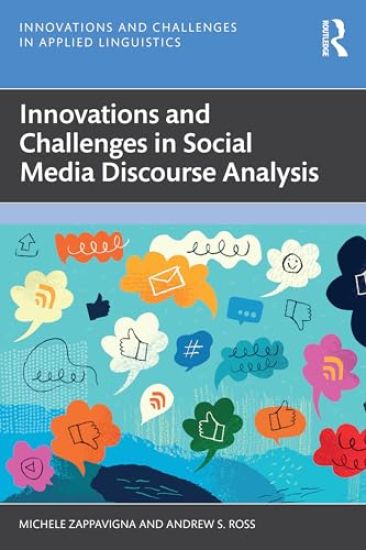
Innovations and Challenges in Social Media Discourse Analysis provides a key introduction to the analysis of everyday discourse on social media platforms.Outlining the challenges involved in the study of social media discourse that includes social interaction, relationality, intersubjectivity, and intermodality, this book takes a social semiotic approach to offer a useful reconceptualisation of existing tools and introduces new methodologies to help those studying in this area.Drawing on a range of corpora that feature tweets, Instagram photos, YouTube comments, and emoji, this book is essential reading for students studying modules on discourse analysis and language and media.
Innovations and Challenges in Social Media Discourse Analysis

Innovations and Challenges in Social Media Discourse Analysis

Michele Zappavigna; Andrew S. Ross

TAYLOR FRANCIS LTD
2024
nidottu
Innovations and Challenges in Social Media Discourse Analysis provides a key introduction to the analysis of everyday discourse on social media platforms.Outlining the challenges involved in the study of social media discourse that includes social interaction, relationality, intersubjectivity, and intermodality, this book takes a social semiotic approach to offer a useful reconceptualisation of existing tools and introduces new methodologies to help those studying in this area.Drawing on a range of corpora that feature tweets, Instagram photos, YouTube comments, and emoji, this book is essential reading for students studying modules on discourse analysis and language and media.
Emoji and Social Media Paralanguage

Emoji and Social Media Paralanguage

Michele Zappavigna; Lorenzo Logi

Cambridge University Press
2024
sidottu
Emoji are now ubiquitous in our interactions on social media. But how do we use them to convey meaning? And how do they function in social bonding? This unique book provides a comprehensive framework for analysing how emoji contribute to meaning-making in social media discourse, alongside language. Presenting emoji as a visual paralanguage, it features extensive worked examples of emoji analysis, using corpora derived from social media such as Twitter and TikTok, to explore how emoji interact with their linguistic co-text. It also draws on the author's extensive work on social media affiliation to consider how emoji function in social bonding. The framework for analysing emoji is explained in an accessible way, and a glossary is included, detailing each system and feature from the system networks used as the schemas for undertaking the analysis. It is essential reading for anyone wishing to investigate the role of emoji in digital communication.
Emoji and Social Media Paralanguage

Emoji and Social Media Paralanguage

Michele Zappavigna; Lorenzo Logi

Cambridge University Press
2024
pokkari
Emoji are now ubiquitous in our interactions on social media. But how do we use them to convey meaning? And how do they function in social bonding? This unique book provides a comprehensive framework for analysing how emoji contribute to meaning-making in social media discourse, alongside language. Presenting emoji as a visual paralanguage, it features extensive worked examples of emoji analysis, using corpora derived from social media such as Twitter and TikTok, to explore how emoji interact with their linguistic co-text. It also draws on the author's extensive work on social media affiliation to consider how emoji function in social bonding. The framework for analysing emoji is explained in an accessible way, and a glossary is included, detailing each system and feature from the system networks used as the schemas for undertaking the analysis. It is essential reading for anyone wishing to investigate the role of emoji in digital communication.
Modelling Paralanguage Using Systemic Functional Semiotics

Modelling Paralanguage Using Systemic Functional Semiotics

Thu Ngo; Susan Hood; J. R. Martin; Clare Painter; Bradley A. Smith; Michele Zappavigna

BLOOMSBURY PUBLISHING PLC
2023
nidottu
Winner of the ASFLA (Australian Systemic Functional Linguistics Association) M. A. K. Halliday Prize 2023This book is the first comprehensive account of 'body language' as 'paralanguage' informed by Systemic Functional Semiotics (SFS). It brings together the collaborative work of internationally renowned academics and emerging scholars to offer a fresh linguistic perspective on gesture, body orientation, body movement, facial expression and voice quality resources that support all spoken language. The authors create a framework for distinguishing non-semiotic behaviour from paralanguage, and provide a comprehensive modelling of paralanguage in each of the three metafunctions of meaning (ideational, interpersonal and textual). Illustrations of the application of this new model for multimodal discourse analysis draw on a range of contexts, from social media vlogs, to animated children’s narratives, to face-to-face teaching. Modelling Paralanguage Using Systemic Functional Semiotics offers an innovative way for dealing with culture-specific and context specific paralanguage.
Researching Language and Social Media

Researching Language and Social Media

Ruth Page; David Barton; Carmen Lee; Johann Wolfgang Unger; Michele Zappavigna

TAYLOR FRANCIS LTD
2022
nidottu
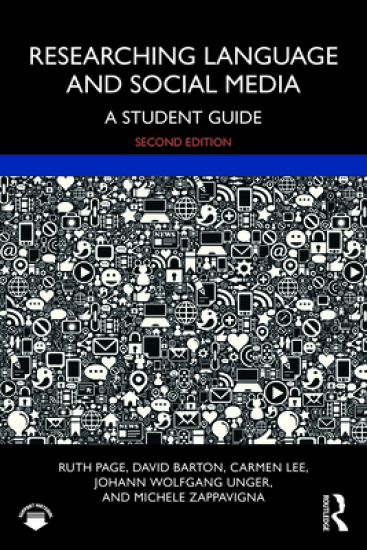
Researching Language and Social Media: A Student Guide introduces the linguistic frameworks currently used to analyse language found in social media contexts. This highly accessible guidebook outlines the practical steps and ethical guidelines entailed when gathering linguistic data from social media sites and platforms. In this new edition, the authors update the range of social media interactions used as examples and draw attention to important developments such as “fake news” and new areas of debate such as hate speech. Expanding the geographical and multilingual aspects, this edition also includes examples from Asia and the Arabic-speaking world. With updated methods that help students study the language of social media from a multimodal perspective, the recent uptake in image sharing, video-chat, and graphicons will also be addressed. Each chapter begins with a clear summary of the topics covered and also suggests sources for further reading to supplement the initial discussion and case studies.This timely book is an essential guide for students of English language and linguistics, media, and communication studies.
Researching Language and Social Media

Researching Language and Social Media

Ruth Page; David Barton; Carmen Lee; Johann Wolfgang Unger; Michele Zappavigna

TAYLOR FRANCIS LTD
2022
sidottu
Researching Language and Social Media: A Student Guide introduces the linguistic frameworks currently used to analyse language found in social media contexts. This highly accessible guidebook outlines the practical steps and ethical guidelines entailed when gathering linguistic data from social media sites and platforms. In this new edition, the authors update the range of social media interactions used as examples and draw attention to important developments such as “fake news” and new areas of debate such as hate speech. Expanding the geographical and multilingual aspects, this edition also includes examples from Asia and the Arabic-speaking world. With updated methods that help students study the language of social media from a multimodal perspective, the recent uptake in image sharing, video-chat, and graphicons will also be addressed. Each chapter begins with a clear summary of the topics covered and also suggests sources for further reading to supplement the initial discussion and case studies.This timely book is an essential guide for students of English language and linguistics, media, and communication studies.
Modelling Paralanguage Using Systemic Functional Semiotics

Modelling Paralanguage Using Systemic Functional Semiotics

Thu Ngo; Susan Hood; J. R. Martin; Clare Painter; Bradley A. Smith; Michele Zappavigna

Bloomsbury Academic
2021
sidottu
Winner of the ASFLA (Australian Systemic Functional Linguistics Association) M. A. K. Halliday Prize 2023This book is the first comprehensive account of 'body language' as 'paralanguage' informed by Systemic Functional Semiotics (SFS). It brings together the collaborative work of internationally renowned academics and emerging scholars to offer a fresh linguistic perspective on gesture, body orientation, body movement, facial expression and voice quality resources that support all spoken language. The authors create a framework for distinguishing non-semiotic behaviour from paralanguage, and provide a comprehensive modelling of paralanguage in each of the three metafunctions of meaning (ideational, interpersonal and textual). Illustrations of the application of this new model for multimodal discourse analysis draw on a range of contexts, from social media vlogs, to animated children’s narratives, to face-to-face teaching. Modelling Paralanguage Using Systemic Functional Semiotics offers an innovative way for dealing with culture-specific and context specific paralanguage.
Negotiating Social Relations

Negotiating Social Relations

Y.J. Doran; J.R. Martin; Michele Zappavigna

UNIVERSITY OF TORONTO PRESS
2021
sidottu
Every day we negotiate our social relations. This may involve small, seemingly inconsequential chats with friends, families, and colleagues that perform our relationships. Or they may involve large, communal events that bring us together or tear us apart. In all cases, we negotiate these social relations through the language, paralanguage, and related systems of meaning that we use. This book introduces a new model for analysing how people negotiate social relations through the framework of Systemic Functional Linguistics (SFL). It focuses on SFL’s conception of social context and in particular on the interpersonal component of context known as tenor. Drawing on decades of SFL research, tenor is reworked as a resource for meaning – with the aim of describing in some detail how we go about building and maintaining sociality. The book begins by considering how language varies in relation to social context and the different perspectives we can take to explore this variation. It then introduces our model of tenor as a resource for negotiating social relations. The model comprises three main systems. Positioning considers how people put forward meanings, react to them, and position each other when we talk. Orienting looks at the nature of the meanings we negotiate, attending to the vast background of shared values that underpin our talk, help us build communities, and hold them together. Tuning deals with how we raise or lower the stakes of what is being said, how we broaden or narrow the scope of what it applies to, and how we vary the spirit in which the meanings are being put forward. Taken together, these systems provide us with resources for enacting social relations as we align and disalign with people and communities of various kinds. Examples focus in particular on a range of meanings associated with motherhood, including language and paralanguage (both gesture and emoji) in spoken, written, and social media texts.

Discourse and Diversionary Justice

Discourse and Diversionary Justice

Michele Zappavigna; JR Martin

Springer International Publishing AG
2018
nidottu
This book analyses the Youth Justice Conferencing Program in New South Wales, Australia. Exploring this form of diversionary justice from the perspectives of functional linguistics and performance studies, the authors combine close textual analysis with ethnographic research methodologies. They examine how participants use the discourse semantic resources available to them to achieve such outcomes as reparation for the victim, reintegration of the offender into the community, and reconciliation between the various parties. This uniquely-researched work is sure to be of interest to students and scholars of applied linguistics, sociolinguistics and discourse analysis.
Searchable Talk

Searchable Talk

Michele Zappavigna

Bloomsbury Academic
2018
sidottu
Metadata such as the hashtag is an important dimension of social media communication. Despite its important role in practices such as curating, tagging, and searching content, there has been little research into how meanings are made with social metadata. This book considers how hashtags have expanded their reach from an information-locating resource to an interpersonal resource for coordinating social relationships and expressing solidarity, affinity, and affiliation. It adopts a social semiotic perspective to investigate the communicative functions of hashtags in relation to both language and images. This book is a follow up to Zappavigna’s 2012 model of ambient affiliation, providing an extended analytical framework for exploring how affiliation occurs, bond by bond, in online discourse. It focuses in particular on the communing function of hashtags in metacommentary and ridicule, using recent Twitter discourse about US President Donald Trump as a case study. It is essential reading for researchers as well as undergraduates studying social media on any academic course.
Searchable Talk

Searchable Talk

Michele Zappavigna

Bloomsbury Academic
2018
nidottu
Metadata such as the hashtag is an important dimension of social media communication. Despite its important role in practices such as curating, tagging, and searching content, there has been little research into how meanings are made with social metadata. This book considers how hashtags have expanded their reach from an information-locating resource to an interpersonal resource for coordinating social relationships and expressing solidarity, affinity, and affiliation. It adopts a social semiotic perspective to investigate the communicative functions of hashtags in relation to both language and images. This book is a follow up to Zappavigna’s 2012 model of ambient affiliation, providing an extended analytical framework for exploring how affiliation occurs, bond by bond, in online discourse. It focuses in particular on the communing function of hashtags in metacommentary and ridicule, using recent Twitter discourse about US President Donald Trump as a case study. It is essential reading for researchers as well as undergraduates studying social media on any academic course.
Discourse and Diversionary Justice

Discourse and Diversionary Justice

Michele Zappavigna; JR Martin

Springer International Publishing AG
2017
sidottu
This book analyses the Youth Justice Conferencing Program in New South Wales, Australia. Exploring this form of diversionary justice from the perspectives of functional linguistics and performance studies, the authors combine close textual analysis with ethnographic research methodologies. They examine how participants use the discourse semantic resources available to them to achieve such outcomes as reparation for the victim, reintegration of the offender into the community, and reconciliation between the various parties. This uniquely-researched work is sure to be of interest to students and scholars of applied linguistics, sociolinguistics and discourse analysis.
Tacit Knowledge and Spoken Discourse

Tacit Knowledge and Spoken Discourse

Michele Zappavigna

Bloomsbury Academic
2014
nidottu
Professional Linguistics is an emergent area of study within applied linguistics, using discourse analysis to assist people working in professional domains. This book examines tacit knowledge - that expertise that is considered to be lost when skilled practitioners leave an institution. Traditionally it has been argued that some aspects practical knowledge cannot be articulated. However, the premise of Polyani's theory of Tacit Knowing ("we know more than we can tell") does not account for latent patterns that linguists can uncover in spoken language. Understanding these discourse patterns provides a way to explore the assumptions people invoke, but do not make explicit in their work and working relationships.This book demonstrates an interview method grounded in systemic functional linguistics that probes the spoken discourse of IT professionals, through three field studies with actual corporations. It argues that 'we tell more than we know' and this 'telling more' resides in the taken-as-given patters of grammar and semantics, making meaning in ways which speakers themselves may not be attuned to.
Discourse of Twitter and Social Media

Discourse of Twitter and Social Media

Michele Zappavigna

Bloomsbury Academic
2013
nidottu
Social media such as microblogging services and social networking sites are changing the way people interact online and search for information and opinions. This book investigates linguistic patterns in electronic discourse,looking at online evaluative language, Internet slang, memes and ambient affiliation using a large Twitter corpus (over 100 million tweets) alongside specialized case studies. The author argues that we are currently witnessing a cultural movement from online conversation to what can be termed 'searchable talk' - online talk where people affiliate by making their discourse findable (for example, via metadata such as Twitter hashtags) by others holding similar interests. This cutting edge text will be of interest to all scholars and students dealing with electronically mediated discourse.
Tacit Knowledge and Spoken Discourse

Tacit Knowledge and Spoken Discourse

Michele Zappavigna

Bloomsbury Academic USA
2012
sidottu
Professional Linguistics is an emergent area of study within applied linguistics, using discourse analysis to assist people working in professional domains. This book examines tacit knowledge - that expertise that is considered to be lost when skilled practitioners leave an institution. Traditionally it has been argued that some aspects practical knowledge cannot be articulated. However, the premise of Polyani's theory of Tacit Knowing ("we know more than we can tell") does not account for latent patterns that linguists can uncover in spoken language. Understanding these discourse patterns provides a way to explore the assumptions people invoke, but do not make explicit in their work and working relationships.This book demonstrates an interview method grounded in systemic functional linguistics that probes the spoken discourse of IT professionals, through three field studies with actual corporations. It argues that 'we tell more than we know' and this 'telling more' resides in the taken-as-given patters of grammar and semantics, making meaning in ways which speakers themselves may not be attuned to.
Discourse of Twitter and Social Media

Discourse of Twitter and Social Media

Michele Zappavigna

Continuum Publishing Corporation
2012
sidottu
Social media such as microblogging services and social networking sites are changing the way people interact online and search for information and opinions. This book investigates linguistic patterns in electronic discourse, looking at online evaluative language, Internet slang, memes and ambient affiliation using a large Twitter corpus (over 100 million tweets) alongside specialized case studies. The author argues that we are currently witnessing a cultural movement from online conversation to what can be termed searchable talk - online talk where people affiliate by making their discourse findable (for example, via metadata such as Twitter hashtags) by others holding similar interests. This cutting edge text will be of interest to all scholars and students dealing with electronically mediated discourse.