Kirjojen hintavertailu. Mukana 12 595 353 kirjaa ja 12 kauppaa.

Kirjailija

Michelle M. Taylor-Robinson

Kirjat ja teokset yhdessä paikassa: 3 kirjaa, julkaisuja vuosilta 2010-2016, suosituimpien joukossa Women in Presidential Cabinets. Vertaile teosten hintoja ja tarkista saatavuus suomalaisista kirjakaupoista.

Mukana myös kirjoitusasut: Michelle M. Taylor-Robinson

3 kirjaa

Kirjojen julkaisuhaarukka 2010-2016.

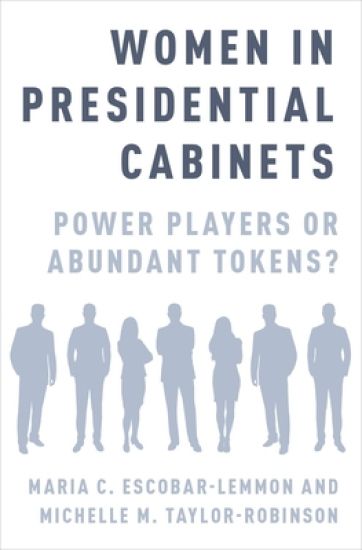
Women in Presidential Cabinets

Women in Presidential Cabinets

Maria C. Escobar-Lemmon; Michelle M. Taylor-Robinson

Oxford University Press Inc
2016
sidottu
Though parity is still rare, presidential cabinets contain more women than ever before. Who are these women and what types of political capital resources do they bring to the administration? Are they new types of political players or very much like the men who have traditionally run the government? And once they gain office, are they treated equally in the cabinet? Do they have the capacity to be as effective as their male counterparts? Drawing on data from five presidential democracies -- Argentina, Chile, Colombia, Costa Rica, and the United States -- Women in Presidential Cabinets examines the backgrounds, connections and credentials of all full-rank cabinet ministers in presidential administrations over the course of two decades to determine if women and men bring similar numbers and diversity of political capital resources to the administration. Maria C. Escobar-Lemmon and Michelle M. Taylor-Robinson find that, with a few notable exceptions, presidents select men and women with similar work and education backgrounds, political experience, and linkages to related interest groups. There are, however, differences across types of posts and countries. They evaluate the treatment and effectiveness of similarly credentialed male and female ministers on four benchmarks. Specifically, they examine whether women with equal qualifications can really obtain all posts or whether glass ceilings persist in some areas. They then turn to the ability of women to hold onto a post, considering the nature and circumstances surrounding their departures from office and how long they remain in office. In doing so, they uncover evidence that female ministers in Latin America stand on an unequal playing field when it comes to the ability to enact policy through legislation. Ultimately, Escobar-Lemmon and Taylor-Robinson show conclusively that while women lack numerical equality, they are no longer tokens, instead appearing positioned to exercise power at the highest levels within the executive branch.
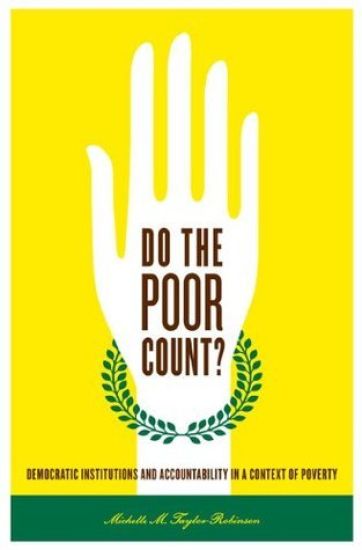
Do the Poor Count?

Do the Poor Count?

Michelle M. Taylor-Robinson

Pennsylvania State University Press
2011
pokkari
Latin America’s flirtation with neoliberal economic restructuring in the 1980s and 1990s (the so-called Washington Consensus strategy) had the effect of increasing income inequality throughout the region. The aim of this economic policy was in part to create the conditions for stable democracy by ensuring efficient economic use of resources, both human and capital, but the widening gap between rich and poor threatened to undermine political stability. At the heart of the dilemma faced by these new democracies is the question of accountability: Are all citizens equally capable of holding the government accountable if it does not represent their interests? In this book, Michelle Taylor-Robinson investigates both the formal institutions of democracy (such as electoral rules and the design of the legislative and executive branches) and informal institutions (such as the nomination procedures of political parties and patron-client relationships) to see what incentives legislators have to pay attention to the needs of poor people and thereby adequately represent their interests.
Do the Poor Count?

Do the Poor Count?

Michelle M. Taylor-Robinson

Pennsylvania State University Press
2010
sidottu
Latin America’s flirtation with neoliberal economic restructuring in the 1980s and 1990s (the so-called Washington Consensus strategy) had the effect of increasing income inequality throughout the region. The aim of this economic policy was in part to create the conditions for stable democracy by ensuring efficient economic use of resources, both human and capital, but the widening gap between rich and poor threatened to undermine political stability. At the heart of the dilemma faced by these new democracies is the question of accountability: Are all citizens equally capable of holding the government accountable if it does not represent their interests? In this book, Michelle Taylor-Robinson investigates both the formal institutions of democracy (such as electoral rules and the design of the legislative and executive branches) and informal institutions (such as the nomination procedures of political parties and patron-client relationships) to see what incentives legislators have to pay attention to the needs of poor people and thereby adequately represent their interests.