Kirjojen hintavertailu. Mukana 12 303 890 kirjaa ja 12 kauppaa.
Kirjailija
Michelle Sheehan
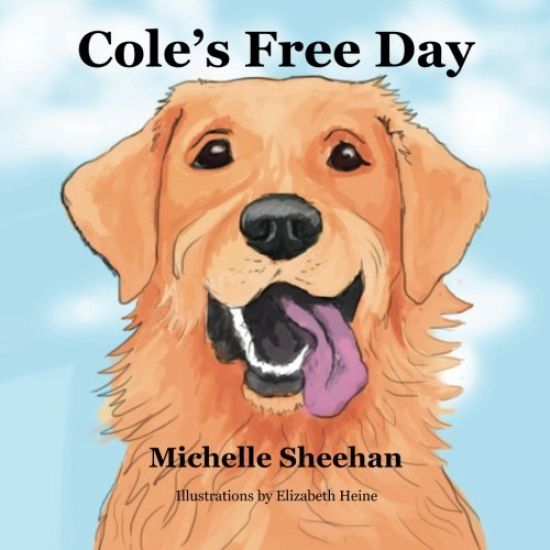
Kirjat ja teokset yhdessä paikassa: 10 kirjaa, julkaisuja vuosilta 2009-2020, suosituimpien joukossa Cole's Free Day. Vertaile teosten hintoja ja tarkista saatavuus suomalaisista kirjakaupoista.
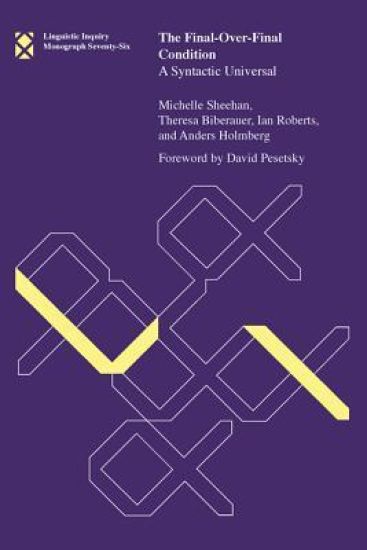
An examination of the evidence for and the theoretical implications of a universal word order constraint, with data from a wide range of languages.This book presents evidence for a universal word order constraint, the Final-over-Final Condition (FOFC), and discusses the theoretical implications of this phenomenon. FOFC is a syntactic condition that disallows structures where a head-initial phrase is contained in a head-final phrase in the same extended projection/domain. The authors argue that FOFC is a linguistic universal, not just a strong tendency, and not a constraint on processing. They discuss the effects of the universal in various domains, including the noun phrase, the adjective phrase, the verb phrase, and the clause. The book draws on data from a wide range of languages, including Hindi, Turkish, Basque, Finnish, Afrikaans, German, Hungarian, French, English, Italian, Romanian, Arabic, Hebrew, Mandarin, Pontic Greek, Bagirmi, Dholuo, and Thai. FOFC, the authors argue, is important because it is the only known example of a word order asymmetry pertaining to the order of heads. As such, it has significant repercussions for theories connecting the narrow syntax to linear order.
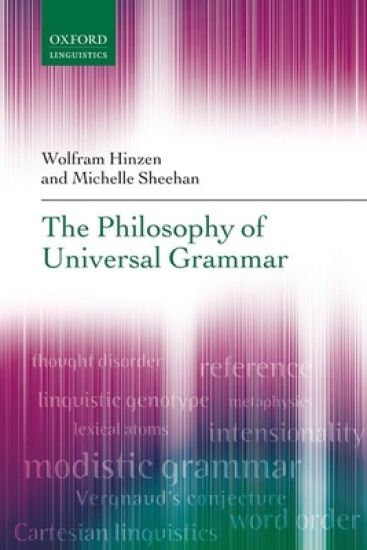
What is grammar? Why does it exist? What difference, if any, does it make to the organization of meaning? This book seeks to give principled answers to these questions. Its topic is 'universal' grammar, in the sense that grammar is universal to human populations. But while modern generative grammar stands in the tradition of 'Cartesian linguistics' as emerging in the 17th century, this book re-addresses the question of the grammatical in a broader historical frame, taking inspiration from Modistic and Ancient Indian philosopher-linguists to formulate a different and 'Un-Cartesian' programme in linguistic theory. Its core claim is that the organization of the grammar is not distinct from the organization of human thought. This sapiens-specific mode of thought is uniquely propositional: grammar, therefore, organizes propositional forms of reference and makes knowledge possible. Such a claim has explanatory power as well: the grammaticalization of the hominin brain is critical to the emergence of our mind and our speciation. A thoroughly interdisciplinary endeavour, the book seeks to systematically integrate the philosophy of language and linguistic theory. It casts a fresh look at core issues that any philosophy of (universal) grammar will need to address, such as the distinction between lexical and grammatical meaning, the significance of part of speech distinctions, the grammar of reference and deixis, the relation between language and reality, and the dimensions of cross-linguistic and bio-linguistic variation.
What is grammar? Why does it exist? What difference, if any, does it make to the organization of meaning? This book seeks to give principled answers to these questions. Its topic is 'universal' grammar, in the sense that grammar is universal to human populations. But while modern generative grammar stands in the tradition of 'Cartesian linguistics' as emerging in the 17th century, this book re-addresses the question of the grammatical in a broader historical frame, taking inspiration from Modistic and Ancient Indian philosopher-linguists to formulate a different and 'Un-Cartesian' programme in linguistic theory. Its core claim is that the organization of the grammar is not distinct from the organization of human thought. This sapiens-specific mode of thought is uniquely propositional: grammar, therefore, organizes propositional forms of reference and makes knowledge possible. Such a claim has explanatory power as well: the grammaticalization of the hominin brain is critical to the emergence of our mind and our speciation. A thoroughly interdisciplinary endeavour, the book seeks to systematically integrate the philosophy of language and linguistic theory. It casts a fresh look at core issues that any philosophy of (universal) grammar will need to address, such as the distinction between lexical and grammatical meaning, the significance of part of speech distinctions, the grammar of reference and deixis, the relation between language and reality, and the dimensions of cross-linguistic and bio-linguistic variation.
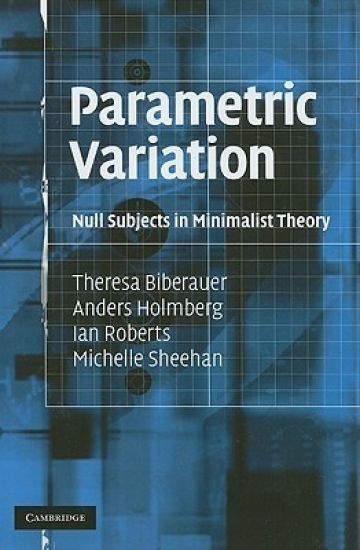
Parametric variation in linguistic theory refers to the systematic grammatical variation permitted by the human language faculty. Although still widely assumed, the parametric theory of variation has in recent years been subject to re-evaluation and critique. The Null Subject Parameter, which determines among other things whether or not a language allows the suppression of subject pronouns, is one of the best-known and most widely discussed examples of a parameter. Nevertheless its status in current syntactic theory is highly controversial. This book is a defence of the parametric approach to linguistic variation, set within the framework of the Minimalist Program. It discusses syntactic variation in the light of recent developments in linguistic theory, focusing on issues such as the formal nature of minimalist parameters, the typology of null-subject language systems and the way in which parametric choices can be seen to underlie the synchronic and diachronic patterns observed in natural languages.