Kirjojen hintavertailu. Mukana 12 390 323 kirjaa ja 12 kauppaa.

Kirjailija

Miguel A. Sierra

Kirjat ja teokset yhdessä paikassa: 4 kirjaa, julkaisuja vuosilta 2003-2014, suosituimpien joukossa More Dead Ends and Detours. Vertaile teosten hintoja ja tarkista saatavuus suomalaisista kirjakaupoista.

4 kirjaa

Kirjojen julkaisuhaarukka 2003-2014.

More Dead Ends and Detours

More Dead Ends and Detours

Miguel A. Sierra; Maria C. de la Torre; Fernando P. Cossio; Roald Hoffmann

Wiley-VCH Verlag GmbH
2013
nidottu
Success comes in many forms and in synthesis it can be a failure that results in their ultimate successful solutions. This long-awaited sequel to "Dead Ends and Detours" retains the proven concept while featuring over 20 new case studies of failed strategies and their (successful) solutions in natural product total synthesis. Additionally, computational models are used to discuss the problem in much more detail and to provide readers with additional information not found in the primary literature. The topics range from classic synthetic reactions (e.g. Diels Alder reaction), metal-mediated coupling reactions, metathesis, and asymmetric catalysis to the importance of protecting and activating groups. This book will benefit not only graduate students in organic chemistry but also advanced researchers as they gain knowledge derived from the step-by-step analysis of mistakes made in the past and, thus be able to improve their own chemical reaction planning. With its coverage of the most commonly applied reaction types, the book perfectly complements its predecessor, which focuses on general aspects, such as reactivity and selectivity.
Organic Reaction Mechanisms

Organic Reaction Mechanisms

Mar Gómez Gallego; Miguel A. Sierra

Springer-Verlag Berlin and Heidelberg GmbH Co. K
2014
nidottu
Organic Reaction Mechanisms shows readers how to interpret the experimental data obtained from an organic reaction, and specifically how an organic reaction mechanism can be considered or rejected based on the analysis of the experimental evidence. Examining a series of selected examples of mechanisms, Organic Reaction Mechanisms focuses on real cases and discusses them in detail, following the same methodology: introduction, experimental data and discussion. The examples are arranged to elucidate key aspects of organic reaction mechanisms. The authors employ all the types of information that the authors of the original work considered useful and necessary, including kinetic and thermodynamic data, isotopic labelling and organic reactivity. The book makes an excellent primer for advanced undergraduates in chemistry who are preparing for exams and is also useful for graduate students and instructors.
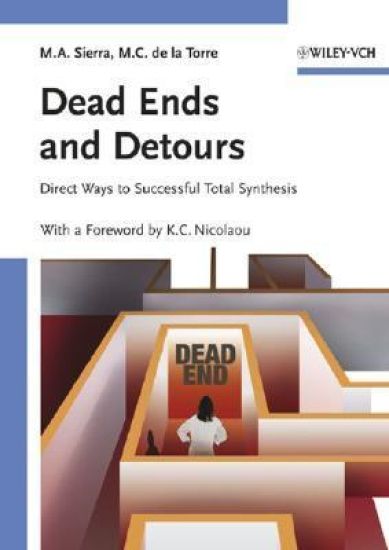
Dead Ends and Detours

Dead Ends and Detours

Miguel A. Sierra; Maria C. de la Torre; K. C. Nicolaou

Wiley-VCH Verlag GmbH
2004
nidottu
A plethora of publications provide valuable information for the organic chemist, yet the results are almost always based on successful reactions. However, a chemist's life is unfortunately not that easy. On the contrary, trial and error is still one of the most commonly used methods. Thus it would be useful to have access to those syntheses that do not work, since they also provide important results of great importance for further synthesis. This long-awaited book by M. A. Sierra and M. C. de la Torre fills just such a gap. Using major total syntheses they explain the most varied problems and recommend ways out of such dilemmas: Problems at the start and end of a synthesis, difficult and unexpected reactivities of functional groups, problems due to steric properties and much more. The result is a true wealth of information for any organic chemist. The essential tool for successful total synthesis.
Organic Reaction Mechanisms

Organic Reaction Mechanisms

Mar Gómez Gallego; Miguel A. Sierra

Springer-Verlag Berlin and Heidelberg GmbH Co. K
2003
sidottu
Organic Reaction Mechanisms shows readers how to interpret the experimental data obtained from an organic reaction, and specifically how an organic reaction mechanism can be considered or rejected based on the analysis of the experimental evidence. Examining a series of selected examples of mechanisms, Organic Reaction Mechanisms focuses on real cases and discusses them in detail, following the same methodology: introduction, experimental data and discussion. The examples are arranged to elucidate key aspects of organic reaction mechanisms. The authors employ all the types of information that the authors of the original work considered useful and necessary, including kinetic and thermodynamic data, isotopic labelling and organic reactivity. The book makes an excellent primer for advanced undergraduates in chemistry who are preparing for exams and is also useful for graduate students and instructors.