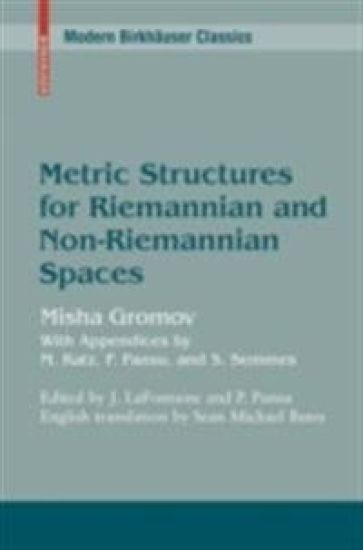
Metric Structures for Riemannian and Non-Riemannian Spaces
Mikhail Gromov
Birkhauser Boston Inc
2006
nidottu
Metric theory has undergone a dramatic phase transition in the last decades when its focus moved from the foundations of real analysis to Riemannian geometry and algebraic topology, to the theory of infinite groups and probability theory. The new wave began with seminal papers by Svarc and Milnor on the growth of groups and the spectacular proof of the rigidity of lattices by Mostow. This progress was followed by the creation of the asymptotic metric theory of infinite groups by Gromov. The structural metric approach to the Riemannian category, tracing back to Cheeger's thesis, pivots around the notion of the Gromov–Hausdorff distance between Riemannian manifolds. This distance organizes Riemannian manifolds of all possible topological types into a single connected moduli space, where convergence allows the collapse of dimension with unexpectedly rich geometry, as revealed in the work of Cheeger, Fukaya, Gromov and Perelman. Also, Gromov found metric structure within homotopy theory and thus introduced new invariants controlling combinatorial complexity of maps and spaces, such as the simplicial volume, which is responsible for degrees of maps between manifolds. During the same period, Banach spaces and probability theory underwent a geometric metamorphosis, stimulated by the Levy–Milman concentration phenomenon, encompassing the law of large numbers for metric spaces with measures and dimensions going to infinity. The first stages of the new developments were presented in Gromov's course in Paris, which turned into the famous "Green Book" by Lafontaine and Pansu (1979). The present English translation of that work has been enriched and expanded with new material to reflect recent progress. Additionally, four appendices – by Gromov on Levy's inequality, by Pansu on "quasiconvex" domains, by Katz on systoles of Riemannian manifolds, and by Semmes overviewing analysis on metric spaces with measures – as well as an extensive bibliographyand index round out this unique and beautiful book.