Kirjojen hintavertailu. Mukana 12 595 353 kirjaa ja 12 kauppaa.

Kirjailija

Mikhail Ju. Moshkov

Kirjat ja teokset yhdessä paikassa: 4 kirjaa, julkaisuja vuosilta 2008-2010, suosituimpien joukossa Partial Covers, Reducts and Decision Rules in Rough Sets. Vertaile teosten hintoja ja tarkista saatavuus suomalaisista kirjakaupoista.

4 kirjaa

Kirjojen julkaisuhaarukka 2008-2010.

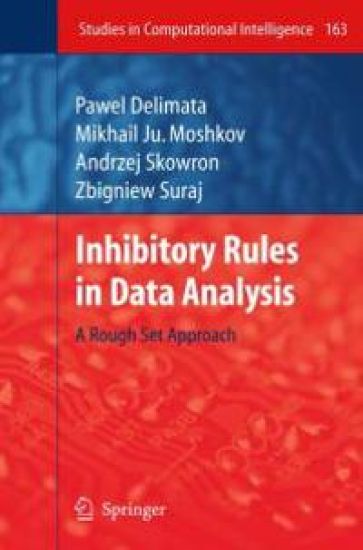
Inhibitory Rules in Data Analysis

Inhibitory Rules in Data Analysis

Pawel Delimata; Mikhail Ju. Moshkov; Zbigniew Suraj

Springer-Verlag Berlin and Heidelberg GmbH Co. K
2010
nidottu
This monograph is devoted to theoretical and experimental study of inhibitory decision and association rules. Inhibitory rules contain on the right-hand side a relation of the kind “attribut = value”. The use of inhibitory rules instead of deterministic (standard) ones allows us to describe more completely infor- tion encoded in decision or information systems and to design classi?ers of high quality. The mostimportantfeatureofthis monographis thatit includesanadvanced mathematical analysis of problems on inhibitory rules. We consider algorithms for construction of inhibitory rules, bounds on minimal complexity of inhibitory rules, and algorithms for construction of the set of all minimal inhibitory rules. We also discuss results of experiments with standard and lazy classi?ers based on inhibitory rules. These results show that inhibitory decision and association rules can be used in data mining and knowledge discovery both for knowledge representation and for prediction. Inhibitory rules can be also used under the analysis and design of concurrent systems. The results obtained in the monograph can be useful for researchers in such areas as machine learning, data mining and knowledge discovery, especially for those who are working in rough set theory, test theory, and logical analysis of data (LAD). The monograph can be used under the creation of courses for graduate students and for Ph.D. studies. TheauthorsofthisbookextendanexpressionofgratitudetoProfessorJanusz Kacprzyk, to Dr. Thomas Ditzinger and to the Studies in Computational Int- ligence sta? at Springer for their support in making this book possible.
Partial Covers, Reducts and Decision Rules in Rough Sets

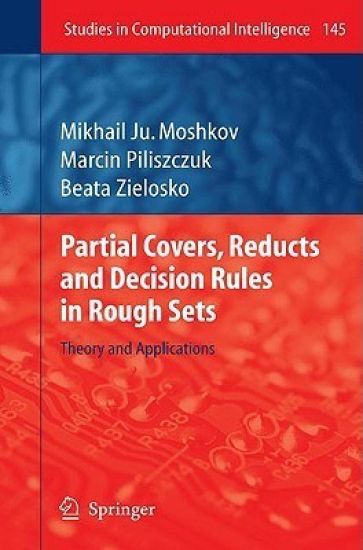
Partial Covers, Reducts and Decision Rules in Rough Sets

Mikhail Ju. Moshkov; Marcin Piliszczuk; Beata Zielosko

Springer-Verlag Berlin and Heidelberg GmbH Co. K
2010
nidottu
This monograph is devoted to theoretical and experimental study of partial reductsandpartialdecisionrulesonthebasisofthestudyofpartialcovers. The use of partial (approximate) reducts and decision rules instead of exact ones allowsustoobtainmorecompactdescriptionofknowledgecontainedindecision tables,andtodesignmorepreciseclassi?ers. Weconsideralgorithmsforconstructionofpartialreductsandpartialdecision rules,boundsonminimalcomplexityofpartialreductsanddecisionrules,and algorithms for construction of the set of all partial reducts and the set of all irreducible partial decision rules. We discuss results of numerous experiments with randomly generated and real-life decision tables. These results show that partial reducts and decision rules can be used in data mining and knowledge discoverybothforknowledgerepresentationandforprediction. Theresultsobtainedinthe monographcanbe usefulforresearchersinsuch areasasmachinelearning,dataminingandknowledgediscovery,especiallyfor thosewhoareworkinginroughsettheory,testtheoryandLAD(LogicalAnalysis ofData). The monographcan be usedunder the creationofcoursesforgraduates- dentsandforPh. D. studies. An essential part of software used in experiments will be accessible soon in RSES-RoughSetExplorationSystem(InstituteofMathematics,WarsawU- versity,headofproject-ProfessorAndrzejSkowron). We are greatly indebted to Professor Andrzej Skowron for stimulated d- cussionsand varioussupportof ourwork. We aregratefulto ProfessorJanusz Kacprzykforhelpfulsuggestions. Sosnowiec,Poland MikhailJu. Moshkov April2008 MarcinPiliszczuk BeataZielosko Contents Introduction...1 1 PartialCovers,ReductsandDecisionRules ...7 1. 1 PartialCovers...8 1. 1. 1 MainNotions...8 1. 1. 2 Known Results...9 1. 1. 3 PolynomialApproximateAlgorithms...10 1. 1. 4 Bounds on C (?)Based on Information about min GreedyAlgorithm Work...13 1. 1. 5 UpperBoundon C (?)...17 greedy 1. 1. 6 Covers fortheMostPartofSetCoverProblems...18 1. 2 PartialTests and Reducts...22 1. 2. 1 MainNotions...22 1. 2. 2Relationships betweenPartialCovers and Partial Tests...23 1. 2. 3 PrecisionofGreedyAlgorithm...24 1. 2. 4 PolynomialApproximateAlgorithms...25 1. 2. 5 Bounds on R (?)Based on Information about min GreedyAlgorithm Work...26 1. 2. 6 UpperBoundon R (?)...28 greedy 1. 2. 7 Tests fortheMostPartofBinaryDecisionTables...29 1. 3 PartialDecision Rules...
Partial Covers, Reducts and Decision Rules in Rough Sets

Partial Covers, Reducts and Decision Rules in Rough Sets

Mikhail Ju. Moshkov; Marcin Piliszczuk; Beata Zielosko

Springer-Verlag Berlin and Heidelberg GmbH Co. K
2009
sidottu
This monograph is devoted to theoretical and experimental study of partial reductsandpartialdecisionrulesonthebasisofthestudyofpartialcovers. The use of partial (approximate) reducts and decision rules instead of exact ones allowsustoobtainmorecompactdescriptionofknowledgecontainedindecision tables,andtodesignmorepreciseclassi?ers. Weconsideralgorithmsforconstructionofpartialreductsandpartialdecision rules,boundsonminimalcomplexityofpartialreductsanddecisionrules,and algorithms for construction of the set of all partial reducts and the set of all irreducible partial decision rules. We discuss results of numerous experiments with randomly generated and real-life decision tables. These results show that partial reducts and decision rules can be used in data mining and knowledge discoverybothforknowledgerepresentationandforprediction. Theresultsobtainedinthe monographcanbe usefulforresearchersinsuch areasasmachinelearning,dataminingandknowledgediscovery,especiallyfor thosewhoareworkinginroughsettheory,testtheoryandLAD(LogicalAnalysis ofData). The monographcan be usedunder the creationofcoursesforgraduates- dentsandforPh. D. studies. An essential part of software used in experiments will be accessible soon in RSES-RoughSetExplorationSystem(InstituteofMathematics,WarsawU- versity,headofproject-ProfessorAndrzejSkowron). We are greatly indebted to Professor Andrzej Skowron for stimulated d- cussionsand varioussupportof ourwork. We aregratefulto ProfessorJanusz Kacprzykforhelpfulsuggestions. Sosnowiec,Poland MikhailJu. Moshkov April2008 MarcinPiliszczuk BeataZielosko Contents Introduction...1 1 PartialCovers,ReductsandDecisionRules ...7 1. 1 PartialCovers...8 1. 1. 1 MainNotions...8 1. 1. 2 Known Results...9 1. 1. 3 PolynomialApproximateAlgorithms...10 1. 1. 4 Bounds on C (?)Based on Information about min GreedyAlgorithm Work...13 1. 1. 5 UpperBoundon C (?)...17 greedy 1. 1. 6 Covers fortheMostPartofSetCoverProblems...18 1. 2 PartialTests and Reducts...22 1. 2. 1 MainNotions...22 1. 2. 2Relationships betweenPartialCovers and Partial Tests...23 1. 2. 3 PrecisionofGreedyAlgorithm...24 1. 2. 4 PolynomialApproximateAlgorithms...25 1. 2. 5 Bounds on R (?)Based on Information about min GreedyAlgorithm Work...26 1. 2. 6 UpperBoundon R (?)...28 greedy 1. 2. 7 Tests fortheMostPartofBinaryDecisionTables...29 1. 3 PartialDecision Rules...
Inhibitory Rules in Data Analysis

Inhibitory Rules in Data Analysis

Pawel Delimata; Mikhail Ju. Moshkov; Zbigniew Suraj

Springer-Verlag Berlin and Heidelberg GmbH Co. K
2008
sidottu
This monograph is devoted to theoretical and experimental study of inhibitory decision and association rules. Inhibitory rules contain on the right-hand side a relation of the kind “attribut = value”. The use of inhibitory rules instead of deterministic (standard) ones allows us to describe more completely infor- tion encoded in decision or information systems and to design classi?ers of high quality. The mostimportantfeatureofthis monographis thatit includesanadvanced mathematical analysis of problems on inhibitory rules. We consider algorithms for construction of inhibitory rules, bounds on minimal complexity of inhibitory rules, and algorithms for construction of the set of all minimal inhibitory rules. We also discuss results of experiments with standard and lazy classi?ers based on inhibitory rules. These results show that inhibitory decision and association rules can be used in data mining and knowledge discovery both for knowledge representation and for prediction. Inhibitory rules can be also used under the analysis and design of concurrent systems. The results obtained in the monograph can be useful for researchers in such areas as machine learning, data mining and knowledge discovery, especially for those who are working in rough set theory, test theory, and logical analysis of data (LAD). The monograph can be used under the creation of courses for graduate students and for Ph.D. studies. TheauthorsofthisbookextendanexpressionofgratitudetoProfessorJanusz Kacprzyk, to Dr. Thomas Ditzinger and to the Studies in Computational Int- ligence sta? at Springer for their support in making this book possible.