Kirjojen hintavertailu. Mukana 12 595 353 kirjaa ja 12 kauppaa.

Kirjailija

Milos Sipos

Kirjat ja teokset yhdessä paikassa: 7 kirjaa, julkaisuja vuosilta 2019-2025, suosituimpien joukossa Wings of Iraq Volume 1. Vertaile teosten hintoja ja tarkista saatavuus suomalaisista kirjakaupoista.

7 kirjaa

Kirjojen julkaisuhaarukka 2019-2025.

Fitters in the Middle East

Fitters in the Middle East

Tom Cooper; Milos Sipos

HELION COMPANY
2025
pokkari
Frequently overshadowed by rival designs of the Mikoyan i Gurevich Design Bureau, the family of fighter-bombers of the aircraft design bureau headed by Pavel O. Sukhoi and developed in the 1950s, 1960s, and 1970s are far less-well-known in the West. Reestablished in the early 1950s, the Sukhoi Design Bureau initially followed the same path as its primary competitor and designed two fighters, one equipped with swept wing, and the other with delta-wing. In the West, they became known under the ASCC/NATO-codename 'Fitter'.Through the 1960s, and unlike MiG, Sukhoi continued developing its 'Fitters', resulting in an entire family of airframes, equipped with ever better avionics and more powerful engines. Its Su-7BMKs (ASCC/NATO-codename 'Fitter-A') entered service with Egypt in 1966, Syria and Iraq in 1967, followed by Algeria a year later. In 1972-1973, Su-17, and then Su-20 - the second generation of this design, and the first equipped with variable-sweep wing - entered service in Egypt, followed by Iraq and Syria. Finally, in 1978-1979, the third and final generation - including variants such as the Su-22, Su-22M, Su-22M-3, and Su-22M-4 (ASCC/NATO-codenames 'Fitter F/G/J/K', respectively) - entered service in Iraq, followed by Libya, Syria, and Yemen. Highly appreciated - and often outright beloved - by their pilots and ground crews alike, they formed the backbone of the fighter-bomber fleets of these six air forces, and saw action in about a dozen different wars.Richly illustrated with a host of exclusive photographs and custom-drawn color profiles, Fitters of the Middle East is the first title ever offering a comprehensive and inclusive operational history of 'Fitters' with six major air forces. As such it is an indispensable single-point source of reference.
War in Ukraine Volume 7

War in Ukraine Volume 7

Tom Cooper; Adrien Fontanellaz; Milos Sipos

HELION COMPANY
2025
nidottu
Volume 7 of War in Ukraine provides a detailed account of the air war as it developed during 2023, a period in which Russia made extensive use of Tu-95 and Tu-22 bombers and their missiles to bring about the collapse of the power supply system in Ukraine.The second year of the War in Ukraine began with the Russian attempt to collapse the power supply and power grid of Ukraine through an offensive with ballistic- and cruise missiles. Lasting months, this operation saw the sustained deployment of Tu-95 and Tu-22 bombers and their missiles, combined with tactical precision guided munitions and Iranian-made Shahed unmanned aerial vehicles (UAVs). Highly promising, early on, the offensive failed because of last-minute deliveries of advanced air defence systems and a large number of power generators from the West: even then, it was a close call, with the government in Kyiv almost making the decision to evacuate the capital. Hard on the heels of this episode, the USA and Germany rushed PAC-2/3 Patriot air defence systems to Ukraine, which Russia attempted to knock out with its Kinzhal hypersonic missiles. Around the same time, the Russians also began deploying MPK/UMPK glide bombs to strike targets along the frontline from outside the range of Ukrainian air defences.War In Ukraine: Volume 7, Air War, January - December 2023 continues the detailed military history of this ongoing conflict, the largest in Europe since the end of the Second World War in 1945. This volume is illustrated throughout with original color photographs and includes specially commissioned color artworks.
War in Ukraine Volume 6

War in Ukraine Volume 6

Tom Cooper; Adrien Fontanellaz; Milos Sipos

HELION COMPANY
2024
nidottu
On 24 February 2022, the armed forces of the Russian Federation initiated an invasion of Ukraine. Thus began the biggest and longest air war fought in Europe since 1945, and a conflict that saw the deployment of full spectrum of the Russian air power: strategic bombers deployed hundreds of cruise missiles combined with strikes by tactical ballistic missiles; the Russian Air-Space Force deployed its tactical and helicopter aviation into large-scale airborne and heliborne operations deep into Ukraine, while the Ukrainian Air Force fought back with its interceptors and attack helicopters.Taking place after the Russian invasion of eastern Ukraine and illegal annexation of Crimea of 2014-2015, and eight years of low-scale warfare in Donbas, as well as countless incidents on the ground and at sea, cyberwarfare, and political tensions, the onslaught was expected by many Western and Russian intelligence services to quickly topple the democratically elected government in Kyiv, and overrun and disarm the Ukrainian armed forces - with help of collaborators - in just three to 14 days.Despite the realisation of a full-scale Russian assault and invasion coming as a surprise to many, the Ukrainian Air Force (PSU) offered fierce resistance. The result was weeks of high-intensity air warfare, which ended only once the ground-based air defences of both sides were deployed in force to block the airspace for tactical aircraft of both sides.Richly illustrated and providing a detailed study of the participating air forces, and the fighting in the air during the Russian invasion, War in Ukraine, Volume 6 is the first concise and inclusive military history of this drama.
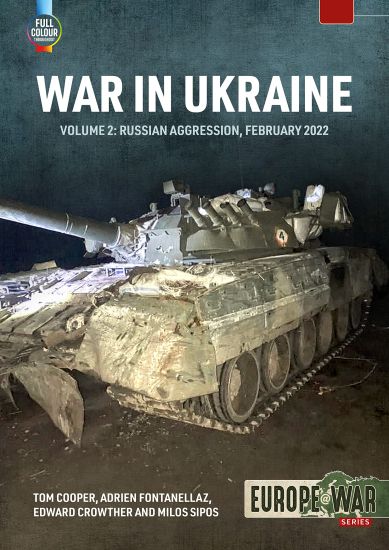
War in Ukraine Volume 2

War in Ukraine Volume 2

Tom Cooper; Adrien Fontanellaz; Edward Crowther; Milos Sipos

HELION COMPANY
2023
pokkari
On 24 February 2022, President of the Russian Federation Vladimir Putin ordered a full-scale invasion of neighboring Ukraine. Taking place after the Russian invasion of eastern Ukraine and illegal annexation of Crimea of 2014-2015, and eight years of low-scale warfare in Donbas, as well as countless incidents on the ground and the sea, cyberwarfare, and political tensions, the onslaught was expected - both by multiple Western and multiple Russian intelligence services - to quickly topple the democratically elected government in Kyiv, and overrun and disarm the Ukrainian armed forces with help of collaborationists in a matter of between 3 and 14 days.Early on 24 February, Armed Forces of the Russian Federation (VSRF) launched a series of missile and artillery strikes on main air bases and dozens of military facilities in Ukraine. Immediately afterwards, VSRF launched ground invasion, with its forces advancing on (clockwise) Kyiv, Chernihiv, Kharkiv, Mariupol, Melitopol, and Kherson. Although following a build-up that began already in April 2021, and expected by many, the onslaught still came as a major surprise - for the Ukrainian government, for Ukrainian armed forces, for its allies in the West, but also for the mass of officers and other ranks of the VSRF. Moreover, the deeper the Russians rolled into Ukraine, the more resistance they have encountered: while some Russian units performed as expected, entire armies began falling apart while ordered to advance at maximum possible speed - and that without the necessary fire and logistic support. After suffering catastrophic losses while failing to reach the downtown Kyiv, and failing to reach and enter Chernihiv and Kharkiv, the war in northern and north-eastern Ukraine quickly settled down into a bloody stalemate. However, in the south, the Russians initially advanced at amazing rate, taking Melitopol already during the first day of their invasion, and Kherson only few days later. Indeed, it was only once President Putin attempted to accelerate the rate of advance through heliborne operations deeper into Ukraine, that the VSRF suffered a severe blow in the fighting for Voznesensk and Mykolaiv, and its advance in this part of the country came to an end.Richly illustrated, providing a detailed study of the involved armed forces, and the fighting in northern and southern Ukraine during the first two weeks of the Russian invasion in February 2022, War in Ukraine, Volume 2 is the first concise military history of this drama.
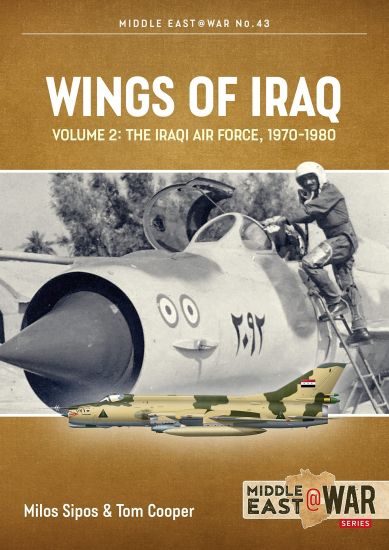
Wings of Iraq Volume 2

Wings of Iraq Volume 2

Tom Cooper; Milos Sipos

Helion Company
2022
nidottu
Officially established on 22 April 1931, around a core of 5 pilots and 32 aircraft mechanics, the Royal Iraqi Air Force was the first military flying service in any Arab country. Coming into being with the task of supporting the Iraqi armed forces and the British against revolts by local tribes, it saw extensive combat and gradually grew into a potent force. During the Anglo-Iraqi War of 1941, it became involved in its first conventional campaign in support of an anti-British coup but was destroyed as a fighting force. It was still recovering when deployed in combat again, this time against Israel in the course of the Palestine War of 1948-1949. During the relatively quiet decade of the 1950s, the air force experienced a rapid growth, further intensified once the monarchy was toppled during the 14 Tammuz Revolution in 1958, and once again, after two additional coups in 1963. During all of these affairs, a dozen additional coup attempts in the 1960s, and then during the long and bitter war against a Kurdish insurgency in the north, and the next clash with Israel in 1967, the Iraqi Air Force continued playing a dominant role in the fate of the country. The situation changed only little following the coup of 1968 that brought the Ba'ath Party to power. What did instrument a major change was the air force's involvement in the October 1973 Arab-Israeli War, and then the showdown with the Iranian-supported Kurdish insurgency in northern Iraq in 1974-1975. These two affairs taught the Iraqis that numbers alone did not make an air force. Correspondingly, during the second half of the 1970s, Baghdad embarked on a project based on full technology transfer from France, which was intended to result in preparing the IrAF for the 21st century. This process hardly began when the new ruler in Baghdad, Saddam Hussein at-Tikriti, led his country into an invasion of neighbouring Iran, embroiling it in a ruinous, eight-year-long war. Amazingly enough, for the first few years of that conflict, the IrAF still continued planning and growing as if there was no conflict to fight, although frequently suffering heavy losses while - due to the micromanagement from the government - de-facto fighting with one hand tied to its backs. It was only the experience of facing sustained and massive Iranian offensives of the 1984-1986 period that prompted Baghdad into unleashing the air force into an all-out campaign against the Iranian economy that effected a turn-around in the war. Almost unexpectedly, the IrAF emerged from the eight years of Iran stronger, better equipped and better trained, and more experienced than ever before. However, Saddam Hussein took care to remove all of its top commanders, and replace them with his favourites, thus de-facto castrating the most powerful branch of the Iraqi armed forces shortly before embarking upon his ultimate adventure: the invasion of Kuwait in 1990. The resulting Second Persian Gulf War of 1991 left the IrAF in tatters: mauled by sustained air strikes on its air bases, and cut off from its former sources of equipment and training, it was never to recover again, and rather vegetated for the last years of existence, pending its ultimate destruction during the US-led invasion of 2003. Although virtually 'born in battle', collecting precious combat experience and playing an important role in so many internal and external conflicts, the Iraqi Air Force remains one of the least known and most misinterpreted military services in the Middle East. Richly illustrated, Wings over Iraq provides a uniquely compact yet comprehensive guide to its operational history, its crucial officers and aircraft, and its major operations.
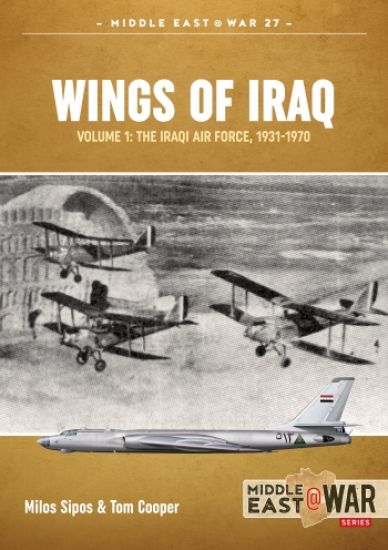
Wings of Iraq Volume 1

Wings of Iraq Volume 1

Tom Cooper; Milos Sipos

Helion Company
2020
nidottu
Officially established on 22 April 1931, around a core of 5 pilots and 32 aircraft mechanics, the Royal Iraqi Air Force was the first military flying service in any Arab country. Coming into being with the task of supporting the Iraqi armed forces and the British against revolts by local tribes, it saw extensive combat and gradually grew into a potent force. During the Anglo-Iraqi War of 1941, it became involved in its first conventional campaign in support of an anti-British coup but was destroyed as a fighting force. It was still recovering when deployed in combat again, this time against Israel in the course of the Palestine War of 1948-1949. During the 1950s, the Royal Iraqi Force experienced a phase of unprecedented growth: after acquiring several batches of Hawker Fury piston-engined fighter-bombers, Bristol Freighter transports and its first helicopters, it entered the jet-age through the acquisition of de Havilland Vampires and Venoms, and Hawker Hunters in quick succession. The 14 Tammuz Revolution of 1958 toppled the British-imposed monarchy and cut the ties to London. For the next five years, the Iraqi Air Force (IrAF) maintained close links to the Union of Soviet Socialist Republics and became the first Arab air force to operate types like the MiG-19 and MiG-21, and also the first equipped with Tupolev Tu-16 medium jet bombers. Through the 1960s, the IrAF played a dominant role in Iraq’s inner politics, determining the fate of the nation to an unprecedented degree. It not only became involved in combat against Kurdish insurgents in the north of the country: its officers staged multiple coups d’état in 1963, 1965 and 1966, served as Ministers of Defence and Prime Ministers of the Iraqi government, became involved in the June 1967 War with Israel, and were instrumental in the putsch of 1968 that brought the Ba’ath Party to power. Although subjected to the tight control of the Ba’ath and the Army, the IrAF continued growing through the 1970s and reached its zenith during the Iran-Iraq War of 1980-1988, when it flew some of the most advanced combat aircraft available world-wide, became the air force with most combat- and flying experience on the MiG-25 and the first true multi-role combat aircraft ever – the Mirage F.1 - and played the crucial role in forcing Tehran to accept a cease-fire. In 1990, the IrAF took part in the invasion of Kuwait. Decimated during the 1991 Gulf War against the US-led coalition, it became involved in the suppression of the uprisings in northern and southern Iraq, and subsequently continued fighting a decade-long no-fly zone maintained by the USA and Great Britain. Although virtually ‘born in battle’, collecting precious combat experience and playing an important role in so many internal and external conflicts, the Iraqi Air Force remains one of the least known and most misinterpreted military services in the Middle East. Richly illustrated, ‘Wings over Iraq’ provides a uniquely compact yet comprehensive guide to its operational history, its crucial officers and aircraft, and its major operations.

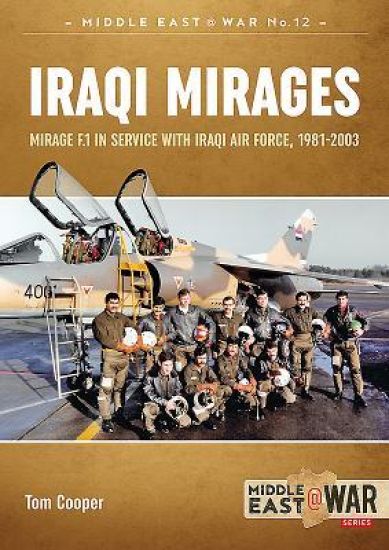
Iraqi Mirages

Iraqi Mirages

Tom Cooper; Milos Sipos

Helion Company
2019
nidottu
Originally envisaged as a privately funded project for a possible future NATO-fighter, the Dassault Mirage F.1 evolved into one of the most aesthetically attractive and commercially most successful combat aircraft of the 1970s and 1980s. Developed into more than a dozen of different variants and sub-variants – each of them custom-tailored to requirements of air forces that flew it – it also became a type that saw intensive combat service in numerous wars on no less than three different continents. Iraq became the biggest export customer for Mirage F.1. One way or the other, the Iraqi Air Force significantly contributed – and financed – the further development of this type, but also influenced research and development of a number of further systems that followed in its wake – most of which eventually found their way into operational service in France. While the Mirage F.1 has attracted at least some coverage in English language publications, its acquisition and combat deployment by Iraq still remains a topic with not a few controversies. The purpose of this volume is to redress the balance and provide an in-depth insight into the acquisition process, development and equipment of custom-tailored variants made for Iraq, training of Iraqi personnel on the type, and its combat deployment during wars against Iran, 1980-1988, and against the US-led, so-called Gulf Coalition, in 1991 and afterwards. Originally envisaged and acquired as a `pure’ interceptor, before long the Mirage F.1 in Iraqi service proved a highly capable multi-role platform aircraft, and was widely deployed not only for ground attack but also anti-shipping purposes, as an aerial tanker, and for delivering long-range pin-point attacks. Illustrated with over 120 photographs and many colour profiles, this book provides a unique, single point of reference on camouflage, markings, and armament configurations of Mirage F.1s in Iraqi service.