Kirjojen hintavertailu. Mukana 12 363 183 kirjaa ja 12 kauppaa.

Kirjailija

Milton Friedman

Kirjat ja teokset yhdessä paikassa: 57 kirjaa, julkaisuja vuosilta 1966-2026, suosituimpien joukossa Free to Choose: A Personal Statement. Vertaile teosten hintoja ja tarkista saatavuus suomalaisista kirjakaupoista.

57 kirjaa

Kirjojen julkaisuhaarukka 1966-2026.

The Optimum Quantity of Money

The Optimum Quantity of Money

Nicholas Eberstadt; Milton Friedman

AldineTransaction
2005
nidottu
This classic set of essays by Nobel Laureate and leading monetary theorist Milton Friedman presents a coherent view of the role of money, focusing on specific topics related to the empirical analysis of monetary phenomena and policy. The early chapters cover factors determining the real quantity of money held in a community and the welfare implications of policies that affect the quantity held. The following chapters formally restate why quantity analysis has become central to the science of economics. Friedman's presidential address to the American Economic Association, included here, provides a general summary of his views on the role of monetary policy, with an emphasis on its limitations and its possibilities. This theoretical framework is used in examining a number of empirical problems: the demand for money, the explanation of price changes in wartime periods, and the role of money in business cycles. These essays summarize some of the most important results of Friedman's extensive research over the course of his lifetime. The chapters on policy that follow survey the positions of earlier economists and deal with the importance of lags and the implications of destabilizing speculation in foreign markets. Taken as a whole, The Optimum Quantity of Money provides a comprehensive view of the body of monetary theory developed in leading centers of monetary analysis. This work is essential reading for economists and graduate students in the field. The volume will be no less important for practicing business and banking personnel as well. The new statement by Michael Bordo, a student of Friedman's and an expert in the field, provides a sense of where the field now stands in the economy and academy.
The Monetarist Controversy

The Monetarist Controversy

Franco Modigliani; Milton Friedman

University Press of the Pacific
2005
pokkari
At the January 1977 meeting of its monthly Economic Seminar series, the Federal Reserve Bank of San Francisco was honored to present Prof. Franco Modigliani, Immediate Past President of the American Economic Association. In his paper, Prof. Modigliani developed some of the themes which he had first covered last September in his AEA Presidential Address, ?gThe Monetarist Controversy"YOr, Should We Forsake Stabilization Policies??h The Bank was doubly fortunate to obtain, as seminar discussant, Nobel Laureate Milton Friedman, who was serving as Visiting Scholar at this institution during the winter term. This supplement to the Bank?fs Economic Review contains Prof. Modigliani?fs lecture, Prof. Friedman?fs reply, the discussion between the two and a floor discussion"Yplus, as an appendix, Prof. Modigliani?fs AEA Presidential Address. The seminar was chaired by Dr. Michael W. Keran, Vice President and Director of Research for the Federal Reserve Bank of San Francisco.
Lives at Risk

Lives at Risk

John C. Goodman; Gerald L. Musgrave; Devon M. Herrick; Milton Friedman

Rowman Littlefield Publishers
2004
sidottu
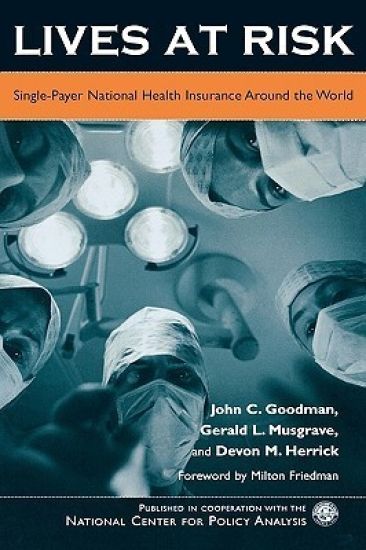
Virtually everyone agrees that our health care system needs reform. But what kind of reform? Some want a return to the system that prevailed in the 1950s. Others would like to see the adaptation of the government-run systems prevalent in other countries. The latter, national health insurance or single-payer health insurance, appears to be gaining ground in the United States. Before Americans find themselves participating in a health care system that has failed in every country it was adopted, we should be asking ourselves whether such a system is effective and efficient. In Lives at Risk, the authors examine the critical failures of national health insurance systems without focusing on minor blemishes or easily correctable problems. In doing so, the purpose is to identify the problems common to all countries with national health insurance and to explain why these problems emerge. Most national health care systems are in a state of sustained internal crisis as costs rise and the stated goals of universal access and quality care are not met. In almost all cases, the reason is the same: the politics of medicine. The problems of government-run health care systems flow inexorably from the fact that they are government-run rather than market driven.
Lives at Risk

Lives at Risk

John C. Goodman; Gerald L. Musgrave; Devon M. Herrick; Milton Friedman

Rowman Littlefield Publishers
2004
nidottu
Virtually everyone agrees that our health care system needs reform. But what kind of reform? Some want a return to the system that prevailed in the 1950s. Others would like to see the adaptation of the government-run systems prevalent in other countries. The latter, national health insurance or single-payer health insurance, appears to be gaining ground in the United States. Before Americans find themselves participating in a health care system that has failed in every country it was adopted, we should be asking ourselves whether such a system is effective and efficient. In Lives at Risk, the authors examine the critical failures of national health insurance systems without focusing on minor blemishes or easily correctable problems. In doing so, the purpose is to identify the problems common to all countries with national health insurance and to explain why these problems emerge. Most national health care systems are in a state of sustained internal crisis as costs rise and the stated goals of universal access and quality care are not met. In almost all cases, the reason is the same: the politics of medicine. The problems of government-run health care systems flow inexorably from the fact that they are government-run rather than market driven.
Kapitalismus und Freiheit

Kapitalismus und Freiheit

Milton Friedman

PIPER VERLAG GMBH
2004
pokkari
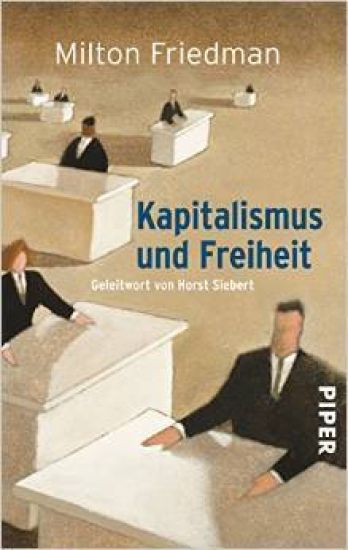
Milton Friedmans Buch ist aktueller denn je. Ihm geht es um die Freiheit des Menschen jenseits staatlicher Bevormundung. Seine Analyse zur Rolle des Staates, der Sozial- und Wohlfahrtssysteme ist nicht nur ein anschauliches Buch, sondern für jeden an Politik und Wirtschaft interessierten Leser eine spannende Lektüre. Mit einem neuen Vorwort des Autors und einem Geleitwort von Horst Siebert, dem ehemaligen Präsidenten des Kieler Instituts für Weltwirtschaft.
Keynes, Chicago and Friedman

Keynes, Chicago and Friedman

Milton Friedman

Pickering Chatto (Publishers) Ltd
2003
muu
These two volumes present essays on the subdiscipline of Chicago Monetarism in economics. Some of the issues under dispute can be regarded as resolved, while others are still being debated. The contibutors include Friedman, Patinkin, Harry Johnson and James Tobin.
Keynes, Chicago and Friedman, Volume 2

Keynes, Chicago and Friedman, Volume 2

Robert Leeson; Milton Friedman

Routledge
2003
sidottu
These two volumes present essays on the subdiscipline of Chicago Monetarism in economics. Some of the issues under dispute can be regarded as resolved, while others are still being debated. The contibutors include Friedman, Patinkin, Harry Johnson and James Tobin.
Keynes, Chicago and Friedman, Volume 1

Keynes, Chicago and Friedman, Volume 1

Robert Leeson; Milton Friedman

Routledge
2003
sidottu
These two volumes present essays on the subdiscipline of Chicago Monetarism in economics. Some of the issues under dispute can be regarded as resolved, while others are still being debated. The contibutors include Friedman, Patinkin, Harry Johnson and James Tobin.
Money, Inflation and the Constitutional Position of Central Bank

Money, Inflation and the Constitutional Position of Central Bank

Milton Friedman; Charles A. E. Goodhart

Institute of Economic Affairs
2003
sidottu
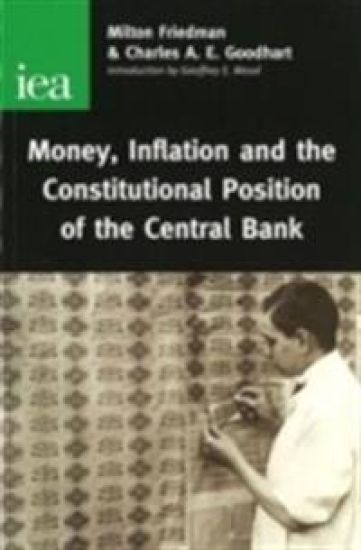
There are at least three requirements for an economy to maintain stable prices. Policy markers and opinion formers must understand that inflation brings no medium or long-term economic benefit; the causes of inflation -- monetary growth -must be also be understood; and there needs to be a stable and credible institutional structure that will deliver a sound monetary policy. This book brings together two classic IEA papers by Nobel Prize winner Milton Friedman with a new work by Charles Goodhart who is a Bank of England Advisor and former member of the Monetary Policy Committee. In doing so, 'Money, Inflation and the Constitutional Position of the Central Bank' provides a thorough yet accessible text appropriate for anybody who wants to understand inflation and how it should be controlled. Friedman's paper, 'Unemployment Versus Inflation?' is a lucid explanation of why higher inflation does not lead to lower unemployment, and his 'The Counter-Revolution in Monetary Theory', the first Wincott lecture, explains why excess monetary growth is the only cause of sustained inflation. Goodhart's paper 'The Constitutional Position of the Central Bank' was the 32nd Wincott Memorial Lecture. It explains how the Institutional arrangements for central banks should be developed to deliver stable prices and, importantly, to influence inflation expectations. Professor Geoffrey Wood sets the historical perspective in his introduction and also links the work of Goodhart and Friedman to the current thinking of the new Governor of the Bank of England, Mervyn King.
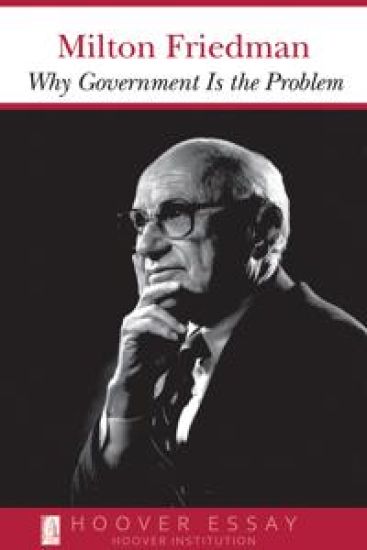
Why Government Is the Problem

Why Government Is the Problem

Milton Friedman

Hoover Institution Press,U.S.
1993
pokkari
The major social problems of the United States—deteriorating education, lawlessness and crime, homelessness, the collapse of family values, the crisis in medical care—have been produced by well-intended actions of government. That is easy to document. The difficult task is understanding why government is the problem. The power of special interests arising from the concentrated benefits of most government actions and their dispersed costs is only part of the answer. A more fundamental part is the difference between the self-interest of individuals when they are engaged in the private sector and the self-interest of the same individuals when they are engaged in the government sector. The result is a government system that is no longer controlled by "we, the people." Instead of Lincoln's government "of the people, by the people, and for the people," we now have a government "of the people, by the bureaucrats, for the bureaucrats," including the elected representatives who have become bureaucrats. At the moment, term limits apear to be the reform that promises to be most effective in curbing Leviathan.
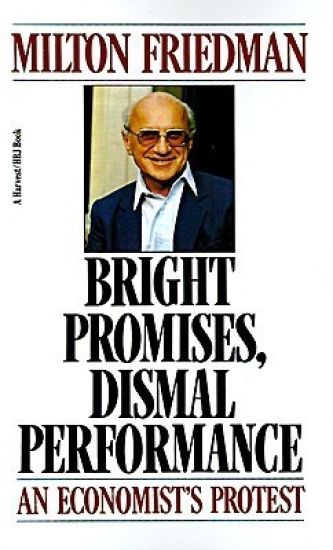
Bright Promises, Dismal Performance

Bright Promises, Dismal Performance

Milton Friedman

CENGAGE LEARNING, INC
1983
pokkari
The noted Nobel Prize-winning economist, Milton Friedman, writes here on current issues of prevailing concern to every American citizen and taxpayer -- including inflation, its causes, and how to arrest it: monetary policy and the disappointing performance of the Federal Reserve Board: the recessions that continue to plague us: and the constraints that are placed upon the workings of a free market.In more than 70 short essays, most of them written for his regular column in Newsweek magazine. Professor Friedman displays the powers of analysis and expression that have made him both the most widely respected economist in America today and a trusted advisor to our nation's leaders.These short commentaries address six major themes, from issues of economic and political freedom, to governmental regulation and fiscal policy, to international economics. They reveal the dynamics behind many of our most pressing current problems, as well as Friedman's affirmation of America's most cherished ideals.
A Program for Monetary Stability

A Program for Monetary Stability

Milton Friedman

Fordham University Press
1983
pokkari
"[T]he only really sure way to beat inflation is to cut off inflation at the root. . . Milton Friedman [presents his strategy against] inflation in his penetrating . . . book . . . This is controversial stuff, and Professor Friedman . . . doesn't blanch at what he feels is his call of duty. And many a banker will just see red . . . [This book] can be recommended for a good look at the real roots of inflation—the look that thus far has not been widespread enough, among enough people."—The Wall Street Journal
A Monetary History of the United States, 1867-1960

A Monetary History of the United States, 1867-1960

Milton Friedman; Anna Jacobson Schwartz

Princeton University Press
1971
pokkari
Writing in the June 1965 issue of theEconomic Journal, Harry G. Johnson begins with a sentence seemingly calibrated to the scale of the book he set himself to review: "The long-awaited monetary history of the United States by Friedman and Schwartz is in every sense of the term a monumental scholarly achievement--monumental in its sheer bulk, monumental in the definitiveness of its treatment of innumerable issues, large and small ...monumental, above all, in the theoretical and statistical effort and ingenuity that have been brought to bear on the solution of complex and subtle economic issues." Friedman and Schwartz marshaled massive historical data and sharp analytics to support the claim that monetary policy--steady control of the money supply--matters profoundly in the management of the nation's economy, especially in navigating serious economic fluctuations. In their influential chapter 7, The Great Contraction--which Princeton published in 1965 as a separate paperback--they address the central economic event of the century, the Depression. According to Hugh Rockoff, writing in January 1965: "If Great Depressions could be prevented through timely actions by the monetary authority (or by a monetary rule), as Friedman and Schwartz had contended, then the case for market economies was measurably stronger." Milton Friedman won the Nobel Prize in Economics in 1976 for work related to A Monetary History as well as to his other Princeton University Press book, A Theory of the Consumption Function (1957).
Essays in Positive Economics

Essays in Positive Economics

Milton Friedman

University of Chicago Press
1966
nidottu
"Stimulating, provocative, often infuriating, but well worth reading."—Peter Newman, Economica"His critical blast blows like a north wind against the more pretentious erections of modern economics. It is however a healthy and invigorating blast, without malice and with a sincere regard for scientific objectivity."—K.E. Boulding, Political Science Quarterly"Certainly one of the most engrossing volumes that has appeared recently in economic theory."—William J. Baumol, Review of Economics and Statistics