Kirjojen hintavertailu. Mukana 12 122 950 kirjaa ja 12 kauppaa.

Kirjailija

Miranda Priebe

Kirjat ja teokset yhdessä paikassa: 19 kirjaa, julkaisuja vuosilta 2016-2024, suosituimpien joukossa Distributed Operations in a Contested Environment. Vertaile teosten hintoja ja tarkista saatavuus suomalaisista kirjakaupoista.

19 kirjaa

Kirjojen julkaisuhaarukka 2016-2024.

Understanding the Current International Order

Understanding the Current International Order

Michael J. Mazarr; Miranda Priebe; Andrew Radin; Astrid Stuth Cevallos

RAND
2016
pokkari
In the first report of a series on the emerging international order, RAND researchers examine the liberal order in effect since World War II, including the mechanisms by which the order affects state behavior, the engines that drive states to participate, and the U.S. approach to the order since 1945.
Planning for the Aftermath

Planning for the Aftermath

Samuel Charap; Miranda Priebe

RAND Corporation
2024
pokkari
U.S. policy choices made at the conclusions of past wars have had enduring consequences. Although there is no end in sight to the Russia-Ukraine war, U.S. policymakers should begin considering a postwar Russia strategy now. To facilitate these considerations, the authors of this report review U.S. strategic options and the trade-offs that different choices pose for long-term U.S. interests.
Alternative Futures Following a Great Power War

Alternative Futures Following a Great Power War

Miranda Priebe; Bryan Frederick; Anika Binnendijk; Alexandra T Evans; Karl P Mueller; Cortez A Cooper; James Benkowski; Asha Clark; Stephanie Anne Pillion

RAND Corporation
2023
pokkari
The Department of Defense has become increasingly focused on competition with China and Russia and the possibility of great power war. RAND researchers generated four plausible near-term war scenarios and assessed how they could shape the postwar strategic environment. These scenarios show the complex relationship between wartime and postwar goals, highlighting the importance of considering postwar outcomes in prewar planning.
Future U.S. Peacetime Policy Toward Russia

Future U.S. Peacetime Policy Toward Russia

Miranda Priebe; Bryan Frederick; Alexandra T Evans; Samuel Charap; Gabrielle Tarini; Bryan Rooney

RAND Corporation
2023
pokkari
After the Ukraine war ends, U.S.-Russian relations will remain hostile. But future U.S. policymakers will also need to balance competing demands and might therefore consider a peacetime limited less-hardline approach toward Russia. Using four historical case studies, the authors found that such approaches can lead to durable but narrow gains without emboldening the rival. But such policies may not prevent later deterioration of the relationship.
Do Alliances and Partnerships Entangle the United States in Conflict?

Do Alliances and Partnerships Entangle the United States in Conflict?

Miranda Priebe; Bryan Rooney; Caitlin McCulloch

RAND
2022
nidottu
Strengthening U.S. security relationships is a core element of the Biden administration's foreign policy. But some analysts have argued that these relationships cause the United States to adopt its partners' interests, incentivize allies and partners to engage in reckless behavior, and risk dragging the United States into conflict. Others dismiss these concerns. In this report, RAND researchers assess the evidence for these competing claims.
Implementing Restraint

Implementing Restraint

Miranda Priebe; Bryan Rooney; Nathan Beauchamp-Mustafaga

RAND
2021
nidottu
Some U.S. policymakers are interested in a new approach to the U.S. role in the world: a realist grand strategy of restraint, under which the United States would cooperate more with other powers, reduce its forward military presence, and end some security commitments. The authors explain how U.S. policies toward key regions would change under such a strategy, identify unanswered questions, and offer next steps for developing policy implications.
Promoting Joint Warfighting Proficiency

Promoting Joint Warfighting Proficiency

Miranda Priebe; Laurinda L Rohn; Alyssa Demus

RAND
2018
nidottu
This report describes the current differences and similarities between Air Force and joint doctrine and identifies ways to increase doctrinal alignment. It also evaluates the potential role of doctrine in increasing airmen's joint warfighting proficiency and proposes additional ways to give airmen more exposure to joint constructs throughout their careers.
U.S. Presence and the Incidence of Conflict

U.S. Presence and the Incidence of Conflict

Angela O'Mahony; Miranda Priebe; Bryan Frederick

RAND
2018
nidottu
There is an ongoing debate about whether U.S. military presence brings stability or an increased likelihood of conflict to a region. The authors of this report analyze historical data to assess how U.S. military presence--in particular, U.S. troop presence and military assistance--is associated with the interstate and intrastate conflict behavior of states and nonstate actors.
Measuring the Health of the Liberal International Order

Measuring the Health of the Liberal International Order

Michael J Mazarr; Astrid Stuth Cevallos; Miranda Priebe; Andrew Radin; Kathleen Reedy; Alexander D Rothenberg; Julia A Thompson; Jordan Willcox

RAND
2017
nidottu
As part of a larger study on the future of the post-World War II liberal international order, RAND researchers analyze the health of the existing order and offer implications for future U.S. policy. The study's overall conclusion is that the postwar order continues to enjoy many elements of stability but is increasingly threatened by major geopolitical and domestic socioeconomic trends that call into question the order's fundamental assumptions.
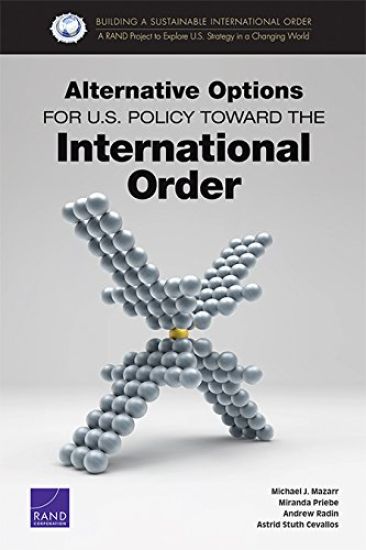
Alternative Options for U.S. Policy Toward the International Order

Alternative Options for U.S. Policy Toward the International Order

Michael J Mazarr; Miranda Priebe; Andrew Radin; Astrid Stuth Cevallos

RAND
2017
nidottu
Since 1945, the United States has pursued its global interests through creating and maintaining international economic institutions, bilateral and regional security organizations, and liberal political norms; these ordering mechanisms are often collectively referred to as the international order. This report examines options for future U.S. policies with respect to the order.