Kirjojen hintavertailu. Mukana 12 442 520 kirjaa ja 12 kauppaa.

Kirjailija

Mireille Rosello

Kirjat ja teokset yhdessä paikassa: 6 kirjaa, julkaisuja vuosilta 2002-2014, suosituimpien joukossa The Reparative in Narratives. Vertaile teosten hintoja ja tarkista saatavuus suomalaisista kirjakaupoista.

6 kirjaa

Kirjojen julkaisuhaarukka 2002-2014.

What's Queer About Europe?

What's Queer About Europe?

Mireille Rosello; Sudeep Dasgupta

Fordham University Press
2014
pokkari
What's Queer about Europe? examines how queer theory helps us initiate disorienting conjunctions and counterintuitive encounters for imagining historical and contemporary Europe. This book queers Europe and Europeanizes queer, forcing a reconsideration of both. Its contributors study Europe relationally, asking not so much what Europe is but what we do when we attempt to define it. The topics discussed include: gay marriage in Renaissance Rome, Russian anarchism and gender politics in early-twentieth-century Switzerland, colonialism and sexuality in Italy, queer masculinities in European popular culture, queer national identities in French cinema, and gender theories and activism. What these apparently disparate topics have in common is the urgency of the political, legal, and cultural issues they tackle. Asking what is queer about Europe means probing the blind spots that continue to structure the long and discrepant process of Europeanization.
What's Queer About Europe?

What's Queer About Europe?

Mireille Rosello; Sudeep Dasgupta

Fordham University Press
2014
sidottu
What's Queer about Europe? examines how queer theory helps us initiate disorienting conjunctions and counterintuitive encounters for imagining historical and contemporary Europe. This book queers Europe and Europeanizes queer, forcing a reconsideration of both. Its contributors study Europe relationally, asking not so much what Europe is but what we do when we attempt to define it. The topics discussed include: gay marriage in Renaissance Rome, Russian anarchism and gender politics in early-twentieth-century Switzerland, colonialism and sexuality in Italy, queer masculinities in European popular culture, queer national identities in French cinema, and gender theories and activism. What these apparently disparate topics have in common is the urgency of the political, legal, and cultural issues they tackle. Asking what is queer about Europe means probing the blind spots that continue to structure the long and discrepant process of Europeanization.

The Reparative in Narratives

The Reparative in Narratives

Mireille Rosello

Liverpool University Press
2010
nidottu
The authors studied in this book can be visualized as the islands that constitute an unknown, fragile and trembling literary and cultural Francophone archipelago. The archipelago does not appear on any map, in the middle of an ocean whose name we already know. No Francophone anthology would put these authors together as a matter of course because what connects them is a narrative grammar rather than a national origin or even a language. Yet, their writing techniques and their apprehension of the real (the ways in which they know and name the world) both reflect and actively participate in our evolving perception of what Gayatri Spivak calls the "planet". The Reparative in Narratives argues that argue that they repair trauma through writing.One description of these awe-inspiring, tender and sometimes horrifying tales is that their narrators are survivors who have experienced and sometimes inflicted unspeakable acts of violence. And yet, ultimately, despair, nihilism, cynicism or silence are never the consequences of their encounter with what some quickly call evil. The traumatic event has not killed them and has not killed their desire to write or perform, although the decidedly altered life that they live in the aftermath of the disaster forces them to become different types of storytellers. They are the first-person narrators of their story, and their narration reinvents them as speaking subjects. In turn, this requires that we accept new reading pacts. That pact is a temporal and geographical signature: the reparative narrative needs readers prepared to accept that healing belongs to the realm of possibilities and that exposure and denunciation do not exhaust the victim's range of possibilities. Rosello contends that this context-specific yet repeating pattern constitutes a response to the contemporary figuration of both globalized and extremely localized types of traumatic memories.
France and the Maghreb

France and the Maghreb

Mireille Rosello

University Press of Florida
2005
sidottu
Looking at writers, directors, and thinkers who are linked to the Maghreb, Mireille Rosello argues that new types of encounters between the French and the Algerians have the potential to counteract the negative force of history. She maintains that these "performative" encounters are moments of fragile and precarious exchange that could shift the tragic paradigm of violence and mistrust among Arabs, Berbers, and Europeans or among Christians, Muslims, and Jews. A performative encounter between historical adversaries creates new subject-positions, a new language, and a new protocol of cohabitation, she contends. Performance encounters inaugurate a new historical script. At such times subjects can redefine each other, and they can speak not in French or Arabic but in a language similar to Khatibi's poetical and interstitial "bilanguage" that reexamines the terms and practices of their interaction. Attentive to the interconnections among language, gender, literature, and cultural politics, Rosello looks at a rich variety of contemporary stories generated by historians (Benjamin Stora, Mohamed Harbi, Charles-Robert Ageron), philosophers (Jacques Derrida), filmmakers (Yamina Benguigui, Mehdi Lallaoui), and emerging and internationally famous writers (Fouad Laroui, Mehdi Charef, Abdelkebir Khatibi). She devotes special consideration to an innovative analysis of the work of one of the most important contemporary French-language writers, Assia Djebar.
Postcolonial Hospitality

Postcolonial Hospitality

Mireille Rosello

Stanford University Press
2002
sidottu
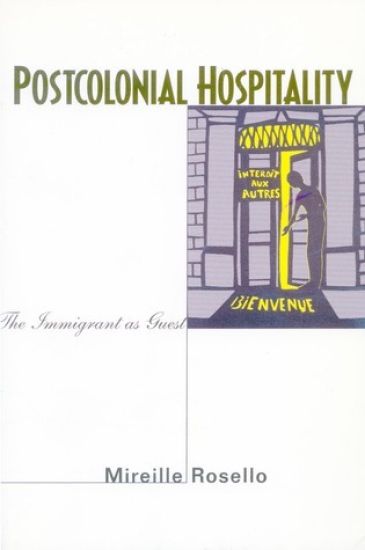
In recent years, hospitality has emerged as a category in French thinking for addressing a range of issues associated with immigration and other types of journeys. Rosello's book concentrates primarily on France and its former colonies in North and sub-Saharan Africa and considers how hospitality and its dissidence are defined, practiced, and represented in European and African fictions, theories, and myths at the end of the twentieth century. Postcolonial Hospitality explores the ways in which Western superpowers rewrite ideals of hospitality that are borrowed from a variety of sources and that sometimes constitute an incompatible system of values. Each chapter focuses on a problematic moment when hospitality is read either as excessive or lacking: when the host does not give what is ideally expected; when the guest is mistreated rather than protected; when the guest abuses the host rather than being grateful. In considering these issues, the author examines the relationship between ownership and generosity, focusing specifically on the connections among nationalism, immigration, and hospitality. Because the intersections between cultural differences and issues of gender often expose the fragility or arbitrariness of hospitable conventions, the author studies novels, films, and immigrant interviews that explore those moments of crisis when systems of hospitality clash.
Postcolonial Hospitality

Postcolonial Hospitality

Mireille Rosello

Stanford University Press
2002
pokkari
In recent years, hospitality has emerged as a category in French thinking for addressing a range of issues associated with immigration and other types of journeys. Rosello's book concentrates primarily on France and its former colonies in North and sub-Saharan Africa and considers how hospitality and its dissidence are defined, practiced, and represented in European and African fictions, theories, and myths at the end of the twentieth century. Postcolonial Hospitality explores the ways in which Western superpowers rewrite ideals of hospitality that are borrowed from a variety of sources and that sometimes constitute an incompatible system of values. Each chapter focuses on a problematic moment when hospitality is read either as excessive or lacking: when the host does not give what is ideally expected; when the guest is mistreated rather than protected; when the guest abuses the host rather than being grateful. In considering these issues, the author examines the relationship between ownership and generosity, focusing specifically on the connections among nationalism, immigration, and hospitality. Because the intersections between cultural differences and issues of gender often expose the fragility or arbitrariness of hospitable conventions, the author studies novels, films, and immigrant interviews that explore those moments of crisis when systems of hospitality clash.