
Kirjojen hintavertailu. Mukana 12 390 323 kirjaa ja 12 kauppaa.

Kirjailija

Miriam K. Mills

Kirjat ja teokset yhdessä paikassa: 3 kirjaa, julkaisuja vuosilta 1989-1993, suosituimpien joukossa Multi-Criteria Methods for Alternative Dispute Resolution. Vertaile teosten hintoja ja tarkista saatavuus suomalaisista kirjakaupoista.

3 kirjaa

Kirjojen julkaisuhaarukka 1989-1993.

Professional Developments in Policy Studies

Professional Developments in Policy Studies

Stuart S. Nagel; Miriam K. Mills

Praeger Publishers Inc
1993
sidottu
This is an insightful overview of what is happening at the cutting edge of professional public policy analysis. Written by a well-known expert, the survey assesses the many and varied aspects of the policy studies discipline. Stuart Nagel has provided an analysis of the profession that will be useful to practitioners and academics, as well as students and teachers, at both the undergraduate and graduate levels.This survey begins by suggesting ways for professionals to become more effective and interdisciplinary in their approaches to dealing with public policy. The author also analyzes cross-cutting governmental activities and different theoretical perspectives. He points to means for achieving policy goals, for selecting among alternative policies, and to the organizations and institutions that are concerned with public policy. A bibliography notes the most important recent publications dealing with professional developments in the field.
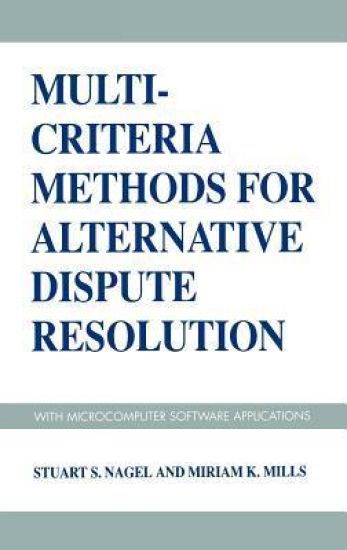
Multi-Criteria Methods for Alternative Dispute Resolution

Multi-Criteria Methods for Alternative Dispute Resolution

Stuart S. Nagel; Miriam K. Mills

Praeger Publishers Inc
1990
sidottu
This work examines the topic of dispute resolution, specifically the multi-criteria approach that seeks to arrive at a conclusion that is mutually beneficial to both sides. Through the use of decision-aiding software, the multi-criteria approach can allow each side to give on various criteria that are not important to it, but are important to the other side. In this way, a super-optimum solution may even be met, in which both sides receive something significantly better than they had expected. Such a result is very difficult, if not impossible, to achieve, Stuart Nagel points out, in traditional single-dimension dispute resolution.Nagel and Mills describe the nature of multi-criteria dispute resolution utilizing decision-aiding software. The first part of the book clarifies the general character of computer-aided negotiation, computer-aided mediation, and super-optimizing dispute resolution. Part two guides the reader through the use of Policy/Goal Percentaging (P/G%) decision-aiding software, centering on general decision-making, negotiation, mediation, and prediction of outcomes. Multi-criteria resolution in the context of rule-making and legal policy disputes is the focus of part three, where such matters as determining initial alternatives and criteria, resolving deadlocks, and arriving at super-optimum solutions are discussed. Part four emphasizes dispute resolution in the context of rule-applying and litigation disputes, as well as mediation at the international level and between lawyers and clients. The final part deals with future applications, such as computer-aided mediation and group decision-making with phone modems. The book's combination of decision-aiding software, arbitration-mediation, and super-optimum expansionist decision-making brings a truly innovative approach to the topic of dispute resolution. This volume should be a welcome addition to academic, legal, and public libraries, and a valuable reference work for lawyers, law students, and legal professors and researchers.
Biomedical Technology and Public Policy

Biomedical Technology and Public Policy

Robert H. Blank; Miriam K. Mills

Praeger Publishers Inc
1989
sidottu
This volume is designed to provide a framework for studying the public policy implications of a broad range of biomedical technologies. Each chapter focuses on the policy issues and political activities surrounding a single technology. Contributors address such issues as new reproductive technologies, animal experimentation, contraceptive drugs, genetic markers and technology and the aging society.