
Kirjailija
Mirjam Zadoff
Kirjat ja teokset yhdessä paikassa: 4 kirjaa, julkaisuja vuosilta 2012-2023, suosituimpien joukossa Marcel Odenbach: Es Brennt: Cat. Kunsthalle Nuremberg. Vertaile teosten hintoja ja tarkista saatavuus suomalaisista kirjakaupoista.
4 kirjaa
Kirjojen julkaisuhaarukka 2012-2023.
Marcel Odenbach: Es Brennt: Cat. Kunsthalle Nuremberg
Hans Dickel; Mirjam Zadoff; Ellen Seifermann
Snoeck Publishing Company
2021
nidottu
It has only just been reported that Marcel Odenbach (*1953) will be awarded the 2021 Wolfgang Hahn Prize. The small and memorable catalog published on the occasion of the current exhibition at Kunsthalle Nuremberg arrives just at the right time to illustrate the reason behind the choice of this award-winner: for quite a number of years now, the Cologne-based artist has been less interested in his own impact, but rather in his surroundings and his contemporaries. With his drawings, collages, videos, and installations, he explores questions of identity in the context of sexual orientation, class, and gender. Odenbach forms works that, owing to their experimental form and theoretical background, focus just as much on historical connections between colonialism and globalization as on the power of the normative and of representation. Since the mid-1970s, Marcel Odenbach has developed his pictorial language in montages and cross-fades of film and television recordings, archive material, as well as his own images and film sequences. Alongside the video works, he has always prepared drawings in the planning of video installations, which also work as independent image-text composition.
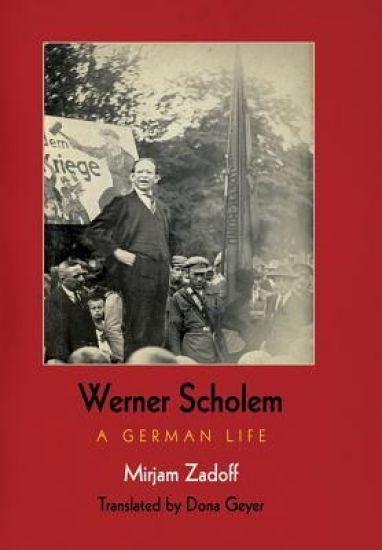
Werner Scholem never took the easy path. Born in 1895 into the Berlin Jewish middle class, he married a young non-Jewish woman of proletarian background. He was the youngest member of the Prussian Parliament in the 1920s, one of the leaders of the German Communist Party, and the editor of the influential journal The Red Flag. As an outspoken critic of Stalin, he was soon expelled from the party, only to take up a position at the head of a revolutionary Trotskyite faction in the years before 1933. Reviled by the National Socialists as a Communist and a Jew, he was among the first to be arrested when Hitler rose to power and, after a long incarceration, was murdered in Buchenwald. In Werner Scholem: A German Life Mirjam Zadoff has written a book that is at once a biography of an individual, a family chronicle, and the story of an entire era. It is an account of the ruptures within a society and of the growing insecurity in which German Jews lived between the two world wars—and especially of two brothers who chose opposing paths out of the shared conviction that there was no future for Jews in Germany after the First World War. While Werner pinned his hopes on a universal revolution he would never see, the younger Gerhard emigrated to Palestine where, as Gershom, he would choose revolutionary Zionism and the reanimation of ancient strains of Jewish mysticism.

From the last decades of the nineteenth century through the late 1930s, the West Bohemian spa towns of Carlsbad, Franzensbad, and Marienbad were fashionable destinations for visitors wishing to "take a cure"-to drink the waters, bathe in the mud, be treated by the latest X-ray, light, or gas therapies, or simply enjoy the respite afforded by elegant parks and comfortable lodgings. These were sociable and urbane places, settings for celebrity sightings, match-making, and stylish promenading. Originally the haunt of aristocrats, the spa towns came to be the favored summer resorts for the emerging bourgeoisie. Among the many who traveled there, a very high proportion were Jewish. In Next Year in Marienbad, Mirjam Zadoff writes the social and cultural history of Carlsbad, Franzensbad, and Marienbad as Jewish spaces. Secular and religious Jews from diverse national, cultural, and social backgrounds mingled in idyllic and often apolitical-seeming surroundings. During the season, shops sold Yiddish and Hebrew newspapers, kosher kitchens were opened, and theatrical presentations, concerts, and public readings catered to the Jewish clientele. Yet these same resorts were situated in a region of growing hostile nationalisms, and they were towns that might turn virulently anti-Semitic in the off season. Next Year in Marienbad draws from memoirs and letters, newspapers and maps, novels and postcards to create a compelling and engaging portrait of Jewish presence and cultural production in the years between the fin de siÈcle and the Second World War.