Kirjojen hintavertailu. Mukana 12 595 353 kirjaa ja 12 kauppaa.

Kirjailija

Miroslav Krstic

Kirjat ja teokset yhdessä paikassa: 25 kirjaa, julkaisuja vuosilta 1995-2025, suosituimpien joukossa Traffic Congestion Control by PDE Backstepping. Vertaile teosten hintoja ja tarkista saatavuus suomalaisista kirjakaupoista.

25 kirjaa

Kirjojen julkaisuhaarukka 1995-2025.

Traffic Congestion Control by PDE Backstepping

Traffic Congestion Control by PDE Backstepping

Huan Yu; Miroslav Krstic

BIRKHAUSER VERLAG AG
2023
nidottu
This monograph explores the design of controllers that suppress oscillations and instabilities in congested traffic flow using PDE backstepping methods. The first part of the text is concerned with basic backstepping control of freeway traffic using the Aw-Rascle-Zhang (ARZ) second-order PDE model. It begins by illustrating a basic control problem – suppressing traffic with stop-and-go oscillations downstream of ramp metering – before turning to the more challenging case for traffic upstream of ramp metering. The authors demonstrate how to design state observers for the purpose of stabilization using output-feedback control. Experimental traffic data are then used to calibrate the ARZ model and validate the boundary observer design. Because large uncertainties may arise in traffic models, adaptive control and reinforcement learning methods are also explored in detail. Part II then extends the conventional ARZ model utilized until this point in orderto address more complex traffic conditions: multi-lane traffic, multi-class traffic, networks of freeway segments, and driver use of routing apps. The final chapters demonstrate the use of the Lighthill-Whitham-Richards (LWR) first-order PDE model to regulate congestion in traffic flows and to optimize flow through a bottleneck. In order to make the text self-contained, an introduction to the PDE backstepping method for systems of coupled first-order hyperbolic PDEs is included. Traffic Congestion Control by PDE Backstepping is ideal for control theorists working on control of systems modeled by PDEs and for traffic engineers and applied scientists working on unsteady traffic flows. It will also be a valuable resource for researchers interested in boundary control of coupled systems of first-order hyperbolic PDEs.
Traffic Congestion Control by PDE Backstepping

Traffic Congestion Control by PDE Backstepping

Huan Yu; Miroslav Krstic

BIRKHAUSER VERLAG AG
2022
sidottu
This monograph explores the design of controllers that suppress oscillations and instabilities in congested traffic flow using PDE backstepping methods. The first part of the text is concerned with basic backstepping control of freeway traffic using the Aw-Rascle-Zhang (ARZ) second-order PDE model. It begins by illustrating a basic control problem – suppressing traffic with stop-and-go oscillations downstream of ramp metering – before turning to the more challenging case for traffic upstream of ramp metering. The authors demonstrate how to design state observers for the purpose of stabilization using output-feedback control. Experimental traffic data are then used to calibrate the ARZ model and validate the boundary observer design. Because large uncertainties may arise in traffic models, adaptive control and reinforcement learning methods are also explored in detail. Part II then extends the conventional ARZ model utilized until this point in orderto address more complex traffic conditions: multi-lane traffic, multi-class traffic, networks of freeway segments, and driver use of routing apps. The final chapters demonstrate the use of the Lighthill-Whitham-Richards (LWR) first-order PDE model to regulate congestion in traffic flows and to optimize flow through a bottleneck. In order to make the text self-contained, an introduction to the PDE backstepping method for systems of coupled first-order hyperbolic PDEs is included. Traffic Congestion Control by PDE Backstepping is ideal for control theorists working on control of systems modeled by PDEs and for traffic engineers and applied scientists working on unsteady traffic flows. It will also be a valuable resource for researchers interested in boundary control of coupled systems of first-order hyperbolic PDEs.
Stochastic Averaging and Stochastic Extremum Seeking

Stochastic Averaging and Stochastic Extremum Seeking

Shu-Jun Liu; Miroslav Krstic

Springer London Ltd
2014
nidottu
Stochastic Averaging and Extremum Seeking treats methods inspired by attempts to understand the seemingly non-mathematical question of bacterial chemotaxis and their application in other environments. The text presents significant generalizations on existing stochastic averaging theory developed from scratch and necessitated by the need to avoid violation of previous theoretical assumptions by algorithms which are otherwise effective in treating these systems. Coverage is given to four main topics. Stochastic averaging theorems are developed for the analysis of continuous-time nonlinear systems with random forcing, removing prior restrictions on nonlinearity growth and on the finiteness of the time interval. The new stochastic averaging theorems are usable not only as approximation tools but also for providing stability guarantees. Stochastic extremum-seeking algorithms are introduced for optimization of systems without available models. Both gradient- and Newton-based algorithms are presented, offering the user the choice between the simplicity of implementation (gradient) and the ability to achieve a known, arbitrary convergence rate (Newton). The design of algorithms for non-cooperative/adversarial games is described. The analysis of their convergence to Nash equilibria is provided. The algorithms are illustrated on models of economic competition and on problems of the deployment of teams of robotic vehicles. Bacterial locomotion, such as chemotaxis in E. coli, is explored with the aim of identifying two simple feedback laws for climbing nutrient gradients. Stochastic extremum seeking is shown to be a biologically-plausible interpretation for chemotaxis. For the same chemotaxis-inspired stochastic feedback laws, the book also provides a detailed analysis of convergence for models of nonholonomic robotic vehicles operating in GPS-denied environments. The book contains block diagrams and several simulation examples, including examples arising from bacterial locomotion, multi-agent robotic systems, and economic market models. Stochastic Averaging and Extremum Seeking will be informative for control engineers from backgrounds in electrical, mechanical, chemical and aerospace engineering and to applied mathematicians. Economics researchers, biologists, biophysicists and roboticists will find the applications examples instructive.
Stochastic Averaging and Stochastic Extremum Seeking

Stochastic Averaging and Stochastic Extremum Seeking

Shu-Jun Liu; Miroslav Krstic

Springer London Ltd
2012
sidottu
Stochastic Averaging and Extremum Seeking treats methods inspired by attempts to understand the seemingly non-mathematical question of bacterial chemotaxis and their application in other environments. The text presents significant generalizations on existing stochastic averaging theory developed from scratch and necessitated by the need to avoid violation of previous theoretical assumptions by algorithms which are otherwise effective in treating these systems. Coverage is given to four main topics. Stochastic averaging theorems are developed for the analysis of continuous-time nonlinear systems with random forcing, removing prior restrictions on nonlinearity growth and on the finiteness of the time interval. The new stochastic averaging theorems are usable not only as approximation tools but also for providing stability guarantees. Stochastic extremum-seeking algorithms are introduced for optimization of systems without available models. Both gradient- and Newton-based algorithms are presented, offering the user the choice between the simplicity of implementation (gradient) and the ability to achieve a known, arbitrary convergence rate (Newton). The design of algorithms for non-cooperative/adversarial games is described. The analysis of their convergence to Nash equilibria is provided. The algorithms are illustrated on models of economic competition and on problems of the deployment of teams of robotic vehicles. Bacterial locomotion, such as chemotaxis in E. coli, is explored with the aim of identifying two simple feedback laws for climbing nutrient gradients. Stochastic extremum seeking is shown to be a biologically-plausible interpretation for chemotaxis. For the same chemotaxis-inspired stochastic feedback laws, the book also provides a detailed analysis of convergence for models of nonholonomic robotic vehicles operating in GPS-denied environments. The book contains block diagrams and several simulation examples, including examples arising from bacterial locomotion, multi-agent robotic systems, and economic market models. Stochastic Averaging and Extremum Seeking will be informative for control engineers from backgrounds in electrical, mechanical, chemical and aerospace engineering and to applied mathematicians. Economics researchers, biologists, biophysicists and roboticists will find the applications examples instructive.
Robust Adaptive Control

Robust Adaptive Control

Iasson Karafyllis; Miroslav Krstic

SOCIETY FOR INDUSTRIAL APPLIED MATHEMATICS,U.S.
2025
sidottu
The book presents a solution to a problem in adaptive control design that was open for 40 years: robustification of disturbances without compromising asymptotic performance. This original methodology builds on foundational ideas, such as the use of a deadzone in the update law and nonlinear damping in the controller, and advances the tools for and the theory behind designing robust adaptive controllers, thus guaranteeing robustness properties stronger than previously achieved. Numerous examples provide detailed analyses of the new methodology. The authors present all stability notions that are useful in adaptive control, provide examples of all robustness problems (e.g. parameter drift), and analyze all approaches to robustification of adaptive controllers that have appeared in the literature; develop the Deadzone-Adapted Disturbance Suppression (DADS) control, a novel adaptive control scheme, and construct a novel robust identifier that can work in parallel with every direct adaptive controller (not only DADS);present the wing rock instability problem, an application of the DADS control scheme, solved with the DADS controller; and provide ideas for the extension of the control scheme to cases not studied in the book.
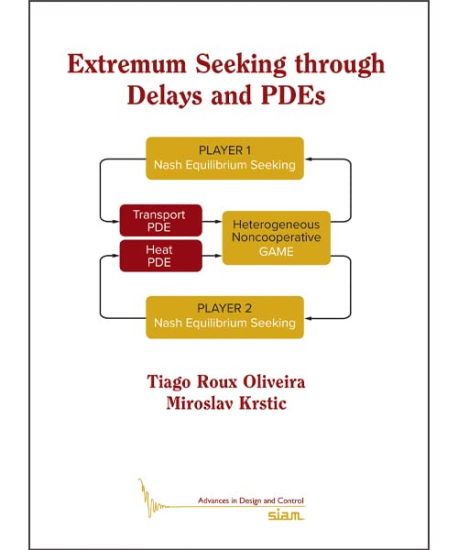
Extremum Seeking through Delays and PDEs

Extremum Seeking through Delays and PDEs

Tiago Roux Oliveira; Miroslav Krstic

SOCIETY FOR INDUSTRIAL APPLIED MATHEMATICS,U.S.
2023
sidottu
Extremum Seeking through Delays and PDEs, the first book on the topic, expands the scope of applicability of the extremum seeking method, from static and finite-dimensional systems to infinite-dimensional systems. Readers will find:Numerous algorithms for model-free real-time optimization are developed and their convergence guaranteed.Extensions from single-player optimization to noncooperative games, under delays and pdes, are provided.The delays and pdes are compensated in the control designs using the pde backstepping approach, and stability is ensured using infinite-dimensional versions of averaging theory. Accessible and powerful tools for analysis.This book is intended for control engineers in all disciplines (electrical, mechanical, aerospace, chemical), mathematicians, physicists, biologists, and economists. It is appropriate for graduate students, researchers, and industrial users.
PDE Control of String-Actuated Motion

PDE Control of String-Actuated Motion

Ji Wang; Miroslav Krstic

PRINCETON UNIVERSITY PRESS
2022
sidottu
New adaptive and event-triggered control designs with concrete applications in undersea construction, offshore drilling, and cable elevatorsControl applications in undersea construction, cable elevators, and offshore drilling present major methodological challenges because they involve PDE systems (cables and drillstrings) of time-varying length, coupled with ODE systems (the attached loads or tools) that usually have unknown parameters and unmeasured states. In PDE Control of String-Actuated Motion, Ji Wang and Miroslav Krstic develop control algorithms for these complex PDE-ODE systems evolving on time-varying domains.Motivated by physical systems, the book’s algorithms are designed to operate, with rigorous mathematical guarantees, in the presence of real-world challenges, such as unknown parameters, unmeasured distributed states, environmental disturbances, delays, and event-triggered implementations. The book leverages the power of the PDE backstepping approach and expands its scope in many directions.Filled with theoretical innovations and comprehensive in its coverage, PDE Control of String-Actuated Motion provides new design tools and mathematical techniques with far-reaching potential in adaptive control, delay systems, and event-triggered control.
PDE Control of String-Actuated Motion

PDE Control of String-Actuated Motion

Ji Wang; Miroslav Krstic

PRINCETON UNIVERSITY PRESS
2022
pokkari
New adaptive and event-triggered control designs with concrete applications in undersea construction, offshore drilling, and cable elevatorsControl applications in undersea construction, cable elevators, and offshore drilling present major methodological challenges because they involve PDE systems (cables and drillstrings) of time-varying length, coupled with ODE systems (the attached loads or tools) that usually have unknown parameters and unmeasured states. In PDE Control of String-Actuated Motion, Ji Wang and Miroslav Krstic develop control algorithms for these complex PDE-ODE systems evolving on time-varying domains.Motivated by physical systems, the book’s algorithms are designed to operate, with rigorous mathematical guarantees, in the presence of real-world challenges, such as unknown parameters, unmeasured distributed states, environmental disturbances, delays, and event-triggered implementations. The book leverages the power of the PDE backstepping approach and expands its scope in many directions.Filled with theoretical innovations and comprehensive in its coverage, PDE Control of String-Actuated Motion provides new design tools and mathematical techniques with far-reaching potential in adaptive control, delay systems, and event-triggered control.
Materials Phase Change PDE Control & Estimation

Materials Phase Change PDE Control & Estimation

Shumon Koga; Miroslav Krstic

Springer Nature Switzerland AG
2021
nidottu
This monograph introduces breakthrough control algorithms for partial differential equation models with moving boundaries, the study of which is known as the Stefan problem. The algorithms can be used to improve the performance of various processes with phase changes, such as additive manufacturing. Using the authors' innovative design solutions, readers will also be equipped to apply estimation algorithms for real-world phase change dynamics, from polar ice to lithium-ion batteries.A historical treatment of the Stefan problem opens the book, situating readers in the larger context of the area. Following this, the chapters are organized into two parts. The first presents the design method and analysis of the boundary control and estimation algorithms. Part two then explores a number of applications, such as 3D printing via screw extrusion and laser sintering, and also discusses the experimental verifications conducted. A number of open problems and provided as well,offering readers multiple paths to explore in future research.Materials Phase Change PDE Control & Estimation is ideal for researchers and graduate students working on control and dynamical systems, and particularly those studying partial differential equations and moving boundaries. It will also appeal to industrial engineers and graduate students in engineering who are interested in this area.
Materials Phase Change PDE Control & Estimation

Materials Phase Change PDE Control & Estimation

Shumon Koga; Miroslav Krstic

Springer Nature Switzerland AG
2020
sidottu
This monograph introduces breakthrough control algorithms for partial differential equation models with moving boundaries, the study of which is known as the Stefan problem. The algorithms can be used to improve the performance of various processes with phase changes, such as additive manufacturing. Using the authors' innovative design solutions, readers will also be equipped to apply estimation algorithms for real-world phase change dynamics, from polar ice to lithium-ion batteries.A historical treatment of the Stefan problem opens the book, situating readers in the larger context of the area. Following this, the chapters are organized into two parts. The first presents the design method and analysis of the boundary control and estimation algorithms. Part two then explores a number of applications, such as 3D printing via screw extrusion and laser sintering, and also discusses the experimental verifications conducted. A number of open problems and provided as well,offering readers multiple paths to explore in future research.Materials Phase Change PDE Control & Estimation is ideal for researchers and graduate students working on control and dynamical systems, and particularly those studying partial differential equations and moving boundaries. It will also appeal to industrial engineers and graduate students in engineering who are interested in this area.
Delay-Adaptive Linear Control

Delay-Adaptive Linear Control

Yang Zhu; Miroslav Krstic

PRINCETON UNIVERSITY PRESS
2020
sidottu
Actuator and sensor delays are among the most common dynamic phenomena in engineering practice, and when disregarded, they render controlled systems unstable. Over the past sixty years, predictor feedback has been a key tool for compensating such delays, but conventional predictor feedback algorithms assume that the delays and other parameters of a given system are known. When incorrect parameter values are used in the predictor, the resulting controller may be as destabilizing as without the delay compensation.Delay-Adaptive Linear Control develops adaptive predictor feedback algorithms equipped with online estimators of unknown delays and other parameters. Such estimators are designed as nonlinear differential equations, which dynamically adjust the parameters of the predictor. The design and analysis of the adaptive predictors involves a Lyapunov stability study of systems whose dimension is infinite, because of the delays, and nonlinear, because of the parameter estimators. This comprehensive book solves adaptive delay compensation problems for systems with single and multiple inputs/outputs, unknown and distinct delays in different input channels, unknown delay kernels, unknown plant parameters, unmeasurable finite-dimensional plant states, and unmeasurable infinite-dimensional actuator states.Presenting breakthroughs in adaptive control and control of delay systems, Delay-Adaptive Linear Control offers powerful new tools for the control engineer and the mathematician.
Input-to-State Stability for PDEs

Input-to-State Stability for PDEs

Iasson Karafyllis; Miroslav Krstic

Springer Nature Switzerland AG
2019
nidottu
This book lays the foundation for the study of input-to-state stability (ISS) of partial differential equations (PDEs) predominantly of two classes—parabolic and hyperbolic. This foundation consists of new PDE-specific tools. In addition to developing ISS theorems, equipped with gain estimates with respect to external disturbances, the authors develop small-gain stability theorems for systems involving PDEs. A variety of system combinations are considered: PDEs (of either class) with static maps;PDEs (again, of either class) with ODEs;PDEs of the same class (parabolic with parabolic and hyperbolic with hyperbolic); andfeedback loops of PDEs of different classes (parabolic with hyperbolic). In addition to stability results (including ISS), the text develops existence and uniqueness theory for all systems that are considered. Many of these results answer for the first time the existence and uniqueness problems for many problems that have dominated the PDE control literature of the last two decades, including—for PDEs that include non-local terms—backstepping control designs which result in non-local boundary conditions. Input-to-State Stability for PDEs will interest applied mathematicians and control specialists researching PDEs either as graduate students or full-time academics. It also contains a large number of applications that are at the core of many scientific disciplines and so will be of importance for researchers in physics, engineering, biology, social systems and others.
Predictor Feedback for Delay Systems: Implementations and Approximations

Predictor Feedback for Delay Systems: Implementations and Approximations

Iasson Karafyllis; Miroslav Krstic

Birkhauser Verlag AG
2018
nidottu
This monograph bridges the gap between the nonlinear predictor as a concept and as a practical tool, presenting a complete theory of the application of predictor feedback to time-invariant, uncertain systems with constant input delays and/or measurement delays. It supplies several methods for generating the necessary real-time solutions to the systems’ nonlinear differential equations, which the authors refer to as approximate predictors.Predictor feedback for linear time-invariant (LTI) systems is presented in Part I to provide a solid foundation on the necessary concepts, as LTI systems pose fewer technical difficulties than nonlinear systems. Part II extends all of the concepts to nonlinear time-invariant systems. Finally, Part III explores extensions of predictor feedback to systems described by integral delay equations and to discrete-time systems.The book’s core is the design of control and observer algorithms with which global stabilization, guaranteed in the previous literature with idealized (but non-implementable) predictors, is preserved with approximate predictors developed in the book.An applications-driven engineer will find a large number of explicit formulae, which are given throughout the book to assist in the application of the theory to a variety of control problems. A mathematician will find sophisticated new proof techniques, which are developed for the purpose of providing global stability guarantees for the nonlinear infinite-dimensional delay system under feedback laws employing practically implementable approximate predictors.Researchers working on global stabilization problems for time-delay systems will find this monograph to be a helpful summary of the state of the art, while graduate students in the broad field of systems and control will advance their skills in nonlinear control design and the analysis of nonlinear delay systems.
Input-to-State Stability for PDEs

Input-to-State Stability for PDEs

Iasson Karafyllis; Miroslav Krstic

Springer International Publishing AG
2018
sidottu
This book lays the foundation for the study of input-to-state stability (ISS) of partial differential equations (PDEs) predominantly of two classes—parabolic and hyperbolic. This foundation consists of new PDE-specific tools. In addition to developing ISS theorems, equipped with gain estimates with respect to external disturbances, the authors develop small-gain stability theorems for systems involving PDEs. A variety of system combinations are considered: PDEs (of either class) with static maps;PDEs (again, of either class) with ODEs;PDEs of the same class (parabolic with parabolic and hyperbolic with hyperbolic); andfeedback loops of PDEs of different classes (parabolic with hyperbolic). In addition to stability results (including ISS), the text develops existence and uniqueness theory for all systems that are considered. Many of these results answer for the first time the existence and uniqueness problems for many problems that have dominated the PDE control literature of the last two decades, including—for PDEs that include non-local terms—backstepping control designs which result in non-local boundary conditions. Input-to-State Stability for PDEs will interest applied mathematicians and control specialists researching PDEs either as graduate students or full-time academics. It also contains a large number of applications that are at the core of many scientific disciplines and so will be of importance for researchers in physics, engineering, biology, social systems and others.
Model-Free Stabilization by Extremum Seeking

Model-Free Stabilization by Extremum Seeking

Alexander Scheinker; Miroslav Krstic

Springer International Publishing AG
2016
nidottu
With this brief, the authors present algorithms for model-free stabilization of unstable dynamic systems. An extremum-seeking algorithm assigns the role of a cost function to the dynamic system’s control Lyapunov function (clf) aiming at its minimization. The minimization of the clf drives the clf to zero and achieves asymptotic stabilization. This approach does not rely on, or require knowledge of, the system model. Instead, it employs periodic perturbation signals, along with the clf. The same effect is achieved as by using clf-based feedback laws that profit from modeling knowledge, but in a time-average sense. Rather than use integrals of the systems vector field, we employ Lie-bracket-based (i.e., derivative-based) averaging. The brief contains numerous examples and applications, including examples with unknown control directions and experiments with charged particle accelerators. It is intended for theoretical control engineers and mathematicians, and practitioners working in various industrial areas and in robotics.
Nonlinear Control Under Nonconstant Delays

Nonlinear Control Under Nonconstant Delays

Nikoloas Bekiaris-Liberis; Miroslav Krstic

Society for Industrial Applied Mathematics,U.S.
2013
sidottu
The authors have developed a methodology for control of nonlinear systems in the presence of long delays, with large and rapid variation in the actuation or sensing path, or in the presence of long delays affecting the internal state of a system. In addition to control synthesis, they introduce tools to quantify the performance and the robustness properties of the designs provided in the book. The book is based on the concept of predictor feedback and infinite-dimensional backstepping transformation for linear systems and the authors guide the reader from the basic ideas of the concept - with constant delays only on the input - all the way through to nonlinear systems with state-dependent delays on the input as well as on system states. Several examples are presented that help the reader digest some of the intricacies in the methodology. Readers will find the book useful because the authors provide elegant and systematic treatments of long-standing problems in delay systems, such as systems with state-dependent delays that arise in many applications.In addition, the authors give all control designs by explicit formulae, making the book especially useful for engineers who have faced delay-related challenges and are concerned with actual implementations and they accompany all control designs with Lyapunov-based analysis for establishing stability and performance guarantees.
Flow Control by Feedback

Flow Control by Feedback

Ole Morten Aamo; Miroslav Krstic

Springer London Ltd
2010
nidottu
In the 70+ year history of control theory and engineering, few applications have stirred as much excitement as flow control. The same can probably be said for the general area of fluid mechanics with its much longer history of several centuries. This excitement is understandable and justified. Turbulence in fluid flows has been recognized as the last great unsolved problem of classical 1 physics and has driven the careers of many leading mathematicians of the 20th century.2 Likewise, control theorists have hardly ever come across a problem this challenging. The emergence of flow control as an attractive new field is owed to the break­ throughs in micro-electro-mechanical systems (MEMS) and other technologies for instrumenting fluid flows on extremely short length and time scales. The remaining missing ingredient for turning flow control into a practical tool is control algorithms with provable performance guarantees. This research mono­ graph is the first book dedicated to this problem-systematic feedback design for fluid flows.
Adaptive Control of Parabolic PDEs

Adaptive Control of Parabolic PDEs

Andrey Smyshlyaev; Miroslav Krstic

Princeton University Press
2010
sidottu
This book introduces a comprehensive methodology for adaptive control design of parabolic partial differential equations with unknown functional parameters, including reaction-convection-diffusion systems ubiquitous in chemical, thermal, biomedical, aerospace, and energy systems. Andrey Smyshlyaev and Miroslav Krstic develop explicit feedback laws that do not require real-time solution of Riccati or other algebraic operator-valued equations. The book emphasizes stabilization by boundary control and using boundary sensing for unstable PDE systems with an infinite relative degree. The book also presents a rich collection of methods for system identification of PDEs, methods that employ Lyapunov, passivity, observer-based, swapping-based, gradient, and least-squares tools and parameterizations, among others. Including a wealth of stimulating ideas and providing the mathematical and control-systems background needed to follow the designs and proofs, the book will be of great use to students and researchers in mathematics, engineering, and physics. It also makes a valuable supplemental text for graduate courses on distributed parameter systems and adaptive control.
Delay Compensation for Nonlinear, Adaptive, and PDE Systems
Some of the most common dynamic phenomena that arise in engineering practice—actuator and sensor delays—fall outside the scope of standard finite-dimensional system theory. The first attempt at infinite-dimensional feedback design in the field of control systems—the Smith predictor—has remained limited to linear finite-dimensional plants over the last five decades. Shedding light on new opportunities in predictor feedback, this book significantly broadens the set of techniques available to a mathematician or engineer working on delay systems. The book is a collection of tools and techniques that make predictor feedback ideas applicable to nonlinear systems, systems modeled by PDEs, systems with highly uncertain or completely unknown input/output delays, and systems whose actuator or sensor dynamics are modeled by more general hyperbolic or parabolic PDEs, rather than by pure delay. Numerous examples and a detailed treatment of individual classes of problems will help the reader master the techniques. Delay Compensation for Nonlinear, Adaptive, and PDE Systems is an excellent reference guide for graduate students, researchers, and professionals in mathematics, systems control, as well as chemical, mechanical, electrical, computer, aerospace, and civil/structural engineering. Parts of the book may be used in graduate courses on general distributed parameter systems, linear delay systems, PDEs, nonlinear control, state estimator and observers, adaptive control, robust control, or linear time-varying systems.
Boundary Control of PDE's

Boundary Control of PDE's

Miroslav Krstic; Andrey Smyshlyaev

Society for Industrial Applied Mathematics,U.S.
2008
sidottu
This concise and highly-usable textbook presents an introduction to backstepping, an elegant new approach to boundary control of partial differential equations (PDEs). Backstepping provides mathematical tools for constructing coordinate transformations and boundary feedback laws for converting complex and unstable PDE systems into elementary, stable, and physically intuitive "target PDE systems" that are familiar to engineers and physicists. Readers will be introduced to constructive control synthesis and Lyapunov stability analysis for distributed parameter systems. The text's broad coverage includes parabolic PDEs; hyperbolic PDEs of first and second order; fluid, thermal, and structural systems; delay systems; PDEs with third and fourth derivatives in space (including variants of linearized Ginzburg-Landau, Schrodinger, Kuramoto-Sivashinsky, KdV, beam, and Navier-Stokes equations); real-valued as well as complex-valued PDEs; stabilization as well as motion planning and trajectory tracking for PDEs; and elements of adaptive control for PDEs and control of nonlinear PDEs.Boundary Control of PDEs is appropriate for courses in control theory and includes homework exercises and a solutions manual that is available from the authors upon request. The results are explicit and the style is accessible; students are not expected to have a background beyond that of a typical engineering or physics graduate. Even an instructor who is not an expert on control of PDEs will find it possible to teach effectively from this book. At the same time, an expert researcher in PDEs looking for novel technical challenges will find many topics of interest, particularly in control synthesis for unstable PDEs, nonlinear PDEs, and PDEs with unknown coefficients.