Kirjojen hintavertailu. Mukana 12 595 353 kirjaa ja 12 kauppaa.
Kirjailija
Miroslaw Kozlowski
Kirjat ja teokset yhdessä paikassa: 20 kirjaa, julkaisuja vuosilta 2006-2021, suosituimpien joukossa Grundlagen der Wechselwirkung von Laserpulsen mit Materie. Vertaile teosten hintoja ja tarkista saatavuus suomalaisista kirjakaupoista.
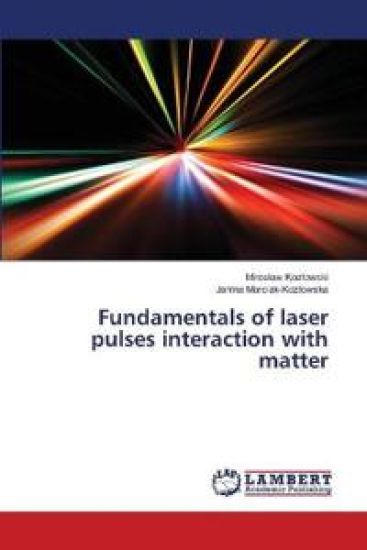
The book describes the present status of the theory of laser matter interaction. Starting from classical Fourier equation for transport phenomena induced by ultrashort laser pulses quantum theory is developed. It is shown that for ultrashort laser pulses the new transport equations are hyperbolic quantum equations-Klein -Gordon and thermal Proca equation The following problems are discussed: transport phenomena in Minkowski space time, relativistic diffusion and wave mode of the heat transport.
This book is based on the results of our interest in the ?eld of ultrashort laser pulses interaction with matter. The aim of our monograph was to build the balanced description of the thermal transport phenomena generated by laser pulses shorter than the characteristic relaxation time. In the book we explore the matter on the quark, nuclear as well atomic scales. Also on the cosmic scale (Planck Era) the thermal disturbance shorter than the Planck time creates the new picture of the Universe. The mathematics, especially PDE, are the main tool in the description of the ultrashort thermal phenomena. Two types of the PDE: parabolic and hyperbolic partial di?erential equations are of special interest in the study of the thermal processes. We assume a moderate knowledge of basic Fourier and d’Alembert eq- tions. The scope of the book is deliberately limited to the background of the quantum mechanics equations: Schr¨ odinger and Klein-Gordon. In this book the attosecond laser pulses are the main source of the dist- bance of the thermal state of the matter. Recently, the attosecond laser pulses constitute a novel tool for probing processes taking place on the time scale of electron motion inside atoms. The research presented in this book appears to provide the basic tools and concepts for attosecond thermal dynamics. Nevertheless much research is still needed to make this emerging ?eld routinely applicable for a broad range of processes on atomic and subatomic scales.
This book is based on the results of our interest in the ?eld of ultrashort laser pulses interaction with matter. The aim of our monograph was to build the balanced description of the thermal transport phenomena generated by laser pulses shorter than the characteristic relaxation time. In the book we explore the matter on the quark, nuclear as well atomic scales. Also on the cosmic scale (Planck Era) the thermal disturbance shorter than the Planck time creates the new picture of the Universe. The mathematics, especially PDE, are the main tool in the description of the ultrashort thermal phenomena. Two types of the PDE: parabolic and hyperbolic partial di?erential equations are of special interest in the study of the thermal processes. We assume a moderate knowledge of basic Fourier and d’Alembert eq- tions. The scope of the book is deliberately limited to the background of the quantum mechanics equations: Schr¨ odinger and Klein-Gordon. In this book the attosecond laser pulses are the main source of the dist- bance of the thermal state of the matter. Recently, the attosecond laser pulses constitute a novel tool for probing processes taking place on the time scale of electron motion inside atoms. The research presented in this book appears to provide the basic tools and concepts for attosecond thermal dynamics. Nevertheless much research is still needed to make this emerging ?eld routinely applicable for a broad range of processes on atomic and subatomic scales.