Kirjojen hintavertailu. Mukana 12 595 353 kirjaa ja 12 kauppaa.

Kirjailija

Mlada Bukovansky

Kirjat ja teokset yhdessä paikassa: 5 kirjaa, julkaisuja vuosilta 2010-2022, suosituimpien joukossa On Revolutions. Vertaile teosten hintoja ja tarkista saatavuus suomalaisista kirjakaupoista.

5 kirjaa

Kirjojen julkaisuhaarukka 2010-2022.

On Revolutions

On Revolutions

Colin J. Beck; Mlada Bukovansky; Erica Chenoweth; George Lawson; Sharon Erickson Nepstad; Daniel P. Ritter

OXFORD UNIVERSITY PRESS INC
2022
nidottu
A cutting-edge appraisal of revolution and its future. On Revolutions, co-authored by six prominent scholars of revolutions, reinvigorates revolutionary studies for the twenty-first century. Integrating insights from diverse fields--including civil resistance studies, international relations, social movements, and terrorism--they offer new ways of thinking about persistent problems in the study of revolution. This book outlines an approach that reaches beyond the common categorical distinctions. As the authors argue, revolutions are not just political or social, but they feature many types of change. Structure and agency are not mutually distinct; they are mutually reinforcing processes. Contention is not just violent or nonviolent, but it is usually a mix of both. Revolutions do not just succeed or fail, but they achieve and simultaneously fall short. And causal conditions are not just domestic or international, but instead, they are dependent on the interplay of each. Demonstrating the merits of this approach through a wide range of cases, the authors explore new opportunities for conceptual thinking about revolution, provide methodological advice, and engage with the ethical issues that exist at the nexus of scholarship and activism.
On Revolutions

On Revolutions

Colin J. Beck; Mlada Bukovansky; Erica Chenoweth; George Lawson; Sharon Erickson Nepstad; Daniel P. Ritter

OXFORD UNIVERSITY PRESS INC
2022
sidottu
A cutting-edge appraisal of revolution and its future. On Revolutions, co-authored by six prominent scholars of revolutions, reinvigorates revolutionary studies for the twenty-first century. Integrating insights from diverse fields--including civil resistance studies, international relations, social movements, and terrorism--they offer new ways of thinking about persistent problems in the study of revolution. This book outlines an approach that reaches beyond the common categorical distinctions. As the authors argue, revolutions are not just political or social, but they feature many types of change. Structure and agency are not mutually distinct; they are mutually reinforcing processes. Contention is not just violent or nonviolent, but it is usually a mix of both. Revolutions do not just succeed or fail, but they achieve and simultaneously fall short. And causal conditions are not just domestic or international, but instead, they are dependent on the interplay of each. Demonstrating the merits of this approach through a wide range of cases, the authors explore new opportunities for conceptual thinking about revolution, provide methodological advice, and engage with the ethical issues that exist at the nexus of scholarship and activism.
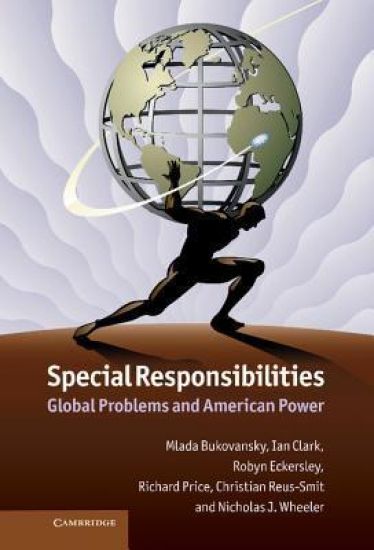
Special Responsibilities

Special Responsibilities

Mlada Bukovansky; Ian Clark; Robyn Eckersley; Richard Price; Christian Reus-Smit; Nicholas J. Wheeler

Cambridge University Press
2012
sidottu
The language of special responsibilities is ubiquitous in world politics, with policymakers and commentators alike speaking and acting as though particular states have, or ought to have, unique obligations in managing global problems. Surprisingly, scholars are yet to provide any in-depth analysis of this fascinating aspect of world politics. This path-breaking study examines the nature of special responsibilities, the complex politics that surround them and how they condition international social power. The argument is illustrated with detailed case-studies of nuclear proliferation, climate change and global finance. All three problems have been addressed by an allocation of special responsibilities, but while this has structured politics in these areas, it has also been the subject of ongoing contestation. With a focus on the United States, this book argues that power must be understood as a social phenomenon and that American power varies significantly across security, economic and environmental domains.
Special Responsibilities

Special Responsibilities

Mlada Bukovansky; Ian Clark; Robyn Eckersley; Richard Price; Christian Reus-Smit; Nicholas J. Wheeler

Cambridge University Press
2012
pokkari
The language of special responsibilities is ubiquitous in world politics, with policymakers and commentators alike speaking and acting as though particular states have, or ought to have, unique obligations in managing global problems. Surprisingly, scholars are yet to provide any in-depth analysis of this fascinating aspect of world politics. This path-breaking study examines the nature of special responsibilities, the complex politics that surround them and how they condition international social power. The argument is illustrated with detailed case-studies of nuclear proliferation, climate change and global finance. All three problems have been addressed by an allocation of special responsibilities, but while this has structured politics in these areas, it has also been the subject of ongoing contestation. With a focus on the United States, this book argues that power must be understood as a social phenomenon and that American power varies significantly across security, economic and environmental domains.
Legitimacy and Power Politics

Legitimacy and Power Politics

Mlada Bukovansky

Princeton University Press
2010
pokkari
This book examines the causes and consequences of a major transformation in both domestic and international politics: the shift from dynastically legitimated monarchical sovereignty to popularly legitimated national sovereignty. It analyzes the impact of Enlightenment discourse on politics in eighteenth-century Europe and the United States, showing how that discourse facilitated new authority struggles in Old Regime Europe, shaped the American and French Revolutions, and influenced the relationships between the revolutionary regimes and the international system. The interaction between traditional and democratic ideas of legitimacy transformed the international system by the early nineteenth century, when people began to take for granted the desirability of equality, individual rights, and restraint of power. Using an interpretive, historically sensitive approach to international relations, the author considers the complex interplay between elite discourses about political legitimacy and strategic power struggles within and among states. She shows how culture, power, and interests interacted to produce a crucial yet poorly understood case of international change. The book not only shows the limits of liberal and realist theories of international relations, but also demonstrates how aspects of these theories can be integrated with insights derived from a constructivist perspective that takes culture and legitimacy seriously. The author finds that cultural contests over the terms of political legitimacy constitute one of the central mechanisms by which the character of sovereignty is transformed in the international system--a conclusion as true today as it was in the eighteenth century.