Kirjojen hintavertailu. Mukana 12 595 353 kirjaa ja 12 kauppaa.

Kirjailija

Mohamad Razali Abdullah

Kirjat ja teokset yhdessä paikassa: 5 kirjaa, julkaisuja vuosilta 2018-2024, suosituimpien joukossa Data Mining and Machine Learning in High-Performance Sport. Vertaile teosten hintoja ja tarkista saatavuus suomalaisista kirjakaupoista.

5 kirjaa

Kirjojen julkaisuhaarukka 2018-2024.

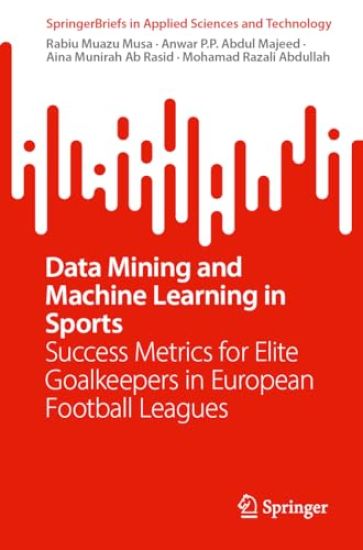
Data Mining and Machine Learning in Sports

Data Mining and Machine Learning in Sports

Rabiu Muazu Musa; Anwar P. P. Abdul Majeed; Aina Munirah Ab Rasid; Mohamad Razali Abdullah

SPRINGER VERLAG, SINGAPORE
2024
nidottu
This brief highlights the factors associated with good goalkeeping techniques and their impact on goalkeepers’ performance in elite European football leagues. The goalkeeping performances of 1600 goalkeepers from five consecutive seasons across the English Premier League, Spanish La Liga, Italian Serie A, and German Bundesliga are studied. The findings from this brief are useful for identifying the success metrices of top-class goalkeepers that help stakeholders to devise strategies to further enhance their performances and empower talent identification experts with pertinent information for mapping out future high-performance goalkeepers.
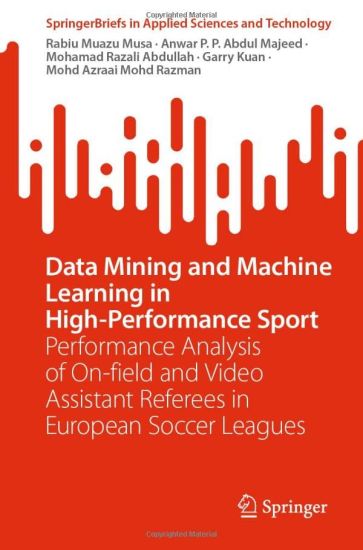
Data Mining and Machine Learning in High-Performance Sport

Data Mining and Machine Learning in High-Performance Sport

Rabiu Muazu Musa; Anwar P.P. Abdul Majeed; Mohamad Razali Abdullah; Garry Kuan; Mohd Azraai Mohd Razman

SPRINGER VERLAG, SINGAPORE
2022
nidottu
This book explores the application of data mining and machine learning techniques in studying the activity pattern, decision-making skills, misconducts, and actions resulting in the intervention of VAR in European soccer leagues referees. The game of soccer at the elite level is characterised by intense competitions, a high level of intensity, technical, and tactical skills coupled with a long duration of play. Referees are required to officiate the game and deliver correct and indisputable decisions throughout the duration of play. The increase in the spatial and temporal task demands of the game necessitates that the referees must respond and cope with the physiological and psychological loads inherent in the game. The referees are also required to deliver an accurate decision and uphold the rules and regulations of the game during a match. These demands and attributes make the work of referees highly complex. The increasing pace and complexity of the game resulted in the introduction of the Video Assistant Referee (VAR) to assist and improve the decision-making of on-field referees. Despite the integration of VAR into the current refereeing system, the performances of the referees are yet to be error-free. Machine learning coupled with data mining techniques has shown to be vital in providing insights from a large dataset which could be used to draw important inferences that can aid decision-making for diagnostics purposes and overall performance improvement. A total of 6232 matches from 5 consecutive seasons officiated across the English Premier League, Spanish LaLiga, Italian Serie A as well as the German Bundesliga was studied. It is envisioned that the findings in this book could be useful in recognising the activity pattern of top-class referees, that is non-trivial for the stakeholders in devising strategies to further enhance the performances of referees as well as empower talent identification experts with pertinent information for mapping out future high-performance referees.?
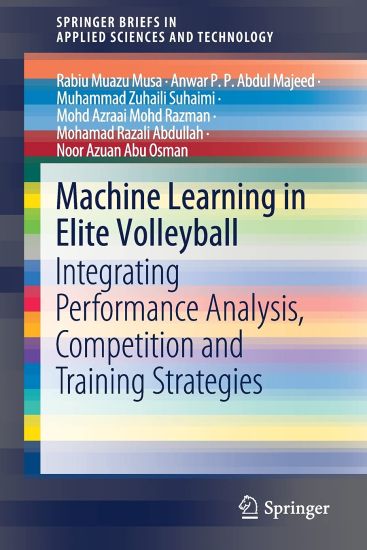
Machine Learning in Elite Volleyball

Machine Learning in Elite Volleyball

Rabiu Muazu Musa; Anwar P. P. Abdul Majeed; Muhammad Zuhaili Suhaimi; Mohd Azraai Mohd Razman; Mohamad Razali Abdullah; Noor Azuan Abu Osman

Springer Verlag, Singapore
2021
nidottu
This brief highlights the use of various Machine Learning (ML) algorithms to evaluate training and competitional strategies in Volleyball, as well as to identify high-performance players in the sport. Several psychological elements/strategies coupled with human performance parameters are discussed in view to ascertain their impact on performance in elite Volleyball competitions. It presents key performance indicators as well as human performance parameters that can be used in future evaluation of team performance and players. The details outlined in this brief are vital to coaches, club managers, talent identification experts, performance analysts as well as other important stakeholders in the evaluation of performance and to foster improvement in this sport.
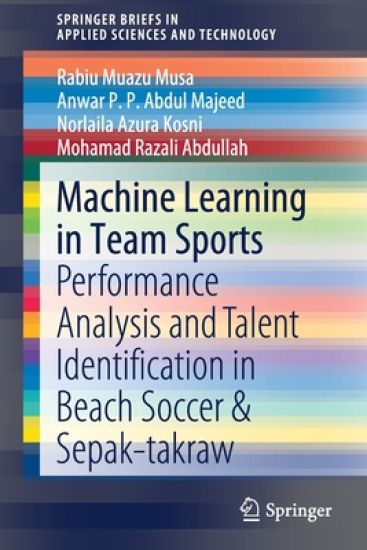
Machine Learning in Team Sports

Machine Learning in Team Sports

Rabiu Muazu Musa; Anwar P.P. Abdul Majeed; Norlaila Azura Kosni; Mohamad Razali Abdullah

Springer Verlag, Singapore
2020
nidottu
This brief highlights the application of performance analysis tools in data acquisition, and various machine learning algorithms for evaluating team performance as well as talent identification in beach soccer and sepak takraw. Numerous performance indicators and human performance parameters are considered based on their relevance to each sport. The findings presented here demonstrate that the key performance indicators as well as human performance parameters can be used in the future evaluation of team performance as well as talent identification in these sports. Accordingly, they offer a valuable resource for coaches, club managers, talent identification experts, performance analysts and other relevant stakeholders involved in performance assessments.
Machine Learning in Sports

Machine Learning in Sports

Rabiu Muazu Musa; Zahari Taha; Anwar P.P.Abdul Majeed; Mohamad Razali Abdullah

Springer Verlag, Singapore
2018
nidottu
This brief highlights the association of different performance variables that influences archery performance and the employment of different machine learning algorithms in the identification of potential archers. The sport of archery is often associated with a myriad of performance indicators namely bio-physiological, psychological, anthropometric as well as physical fitness. Traditionally, the determination of potential archers is carried out by means of conventional statistical techniques. Nonetheless, such methods often fall short in associating non-linear relationships between the variables. This book explores the notion of machine learning that is capable of mitigating the aforesaid issue. This book is valuable for coaches and managers in identifying potential archers during talent identification programs.?