Kirjojen hintavertailu. Mukana 12 407 504 kirjaa ja 12 kauppaa.
Kirjailija
Mohamed Medhat Gaber
Kirjat ja teokset yhdessä paikassa: 5 kirjaa, julkaisuja vuosilta 2013-2018, suosituimpien joukossa Astronomy and Big Data. Vertaile teosten hintoja ja tarkista saatavuus suomalaisista kirjakaupoista.
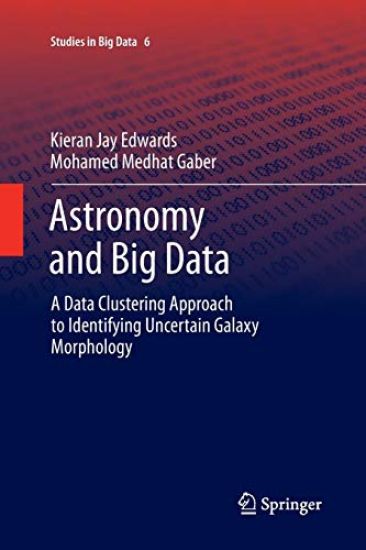
With the onset of massive cosmological data collection through media such as the Sloan Digital Sky Survey (SDSS), galaxy classification has been accomplished for the most part with the help of citizen science communities like Galaxy Zoo. Seeking the wisdom of the crowd for such Big Data processing has proved extremely beneficial. However, an analysis of one of the Galaxy Zoo morphological classification data sets has shown that a significant majority of all classified galaxies are labelled as “Uncertain”.This book reports on how to use data mining, more specifically clustering, to identify galaxies that the public has shown some degree of uncertainty for as to whether they belong to one morphology type or another. The book shows the importance of transitions between different data mining techniques in an insightful workflow. It demonstrates that Clustering enables to identify discriminating features in the analysed data sets, adopting a novel feature selection algorithms called Incremental Feature Selection (IFS). The book shows the use of state-of-the-art classification techniques, Random Forests and Support Vector Machines to validate the acquired results. It is concluded that a vast majority of these galaxies are, in fact, of spiral morphology with a small subset potentially consisting of stars, elliptical galaxies or galaxies of other morphological variants.
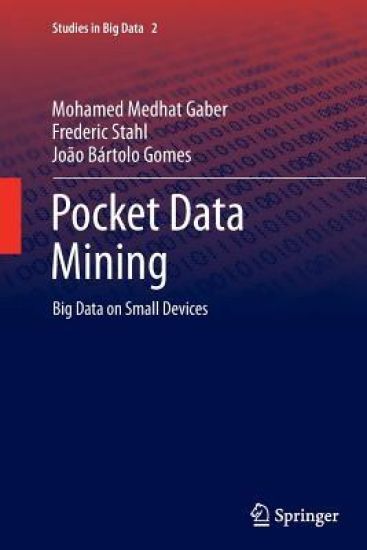
Owing to continuous advances in the computational power of handheld devices like smartphones and tablet computers, it has become possible to perform Big Data operations including modern data mining processes onboard these small devices. A decade of research has proved the feasibility of what has been termed as Mobile Data Mining, with a focus on one mobile device running data mining processes. However, it is not before 2010 until the authors of this book initiated the Pocket Data Mining (PDM) project exploiting the seamless communication among handheld devices performing data analysis tasks that were infeasible until recently. PDM is the process of collaboratively extracting knowledge from distributed data streams in a mobile computing environment. This book provides the reader with an in-depth treatment on this emerging area of research. Details of techniques used and thorough experimental studies are given. More importantly and exclusive to this book, the authors provide detailed practical guide on the deployment of PDM in the mobile environment. An important extension to the basic implementation of PDM dealing with concept drift is also reported. In the era of Big Data, potential applications of paramount importance offered by PDM in a variety of domains including security, business and telemedicine are discussed.
With the onset of massive cosmological data collection through media such as the Sloan Digital Sky Survey (SDSS), galaxy classification has been accomplished for the most part with the help of citizen science communities like Galaxy Zoo. Seeking the wisdom of the crowd for such Big Data processing has proved extremely beneficial. However, an analysis of one of the Galaxy Zoo morphological classification data sets has shown that a significant majority of all classified galaxies are labelled as “Uncertain”.This book reports on how to use data mining, more specifically clustering, to identify galaxies that the public has shown some degree of uncertainty for as to whether they belong to one morphology type or another. The book shows the importance of transitions between different data mining techniques in an insightful workflow. It demonstrates that Clustering enables to identify discriminating features in the analysed data sets, adopting a novel feature selection algorithms called Incremental Feature Selection (IFS). The book shows the use of state-of-the-art classification techniques, Random Forests and Support Vector Machines to validate the acquired results. It is concluded that a vast majority of these galaxies are, in fact, of spiral morphology with a small subset potentially consisting of stars, elliptical galaxies or galaxies of other morphological variants.
Owing to continuous advances in the computational power of handheld devices like smartphones and tablet computers, it has become possible to perform Big Data operations including modern data mining processes onboard these small devices. A decade of research has proved the feasibility of what has been termed as Mobile Data Mining, with a focus on one mobile device running data mining processes. However, it is not before 2010 until the authors of this book initiated the Pocket Data Mining (PDM) project exploiting the seamless communication among handheld devices performing data analysis tasks that were infeasible until recently. PDM is the process of collaboratively extracting knowledge from distributed data streams in a mobile computing environment. This book provides the reader with an in-depth treatment on this emerging area of research. Details of techniques used and thorough experimental studies are given. More importantly and exclusive to this book, the authors provide detailed practical guide on the deployment of PDM in the mobile environment. An important extension to the basic implementation of PDM dealing with concept drift is also reported. In the era of Big Data, potential applications of paramount importance offered by PDM in a variety of domains including security, business and telemedicine are discussed.