Kirjojen hintavertailu. Mukana 12 595 353 kirjaa ja 12 kauppaa.

Kirjailija

Mohammad H Tamdgidi

Kirjat ja teokset yhdessä paikassa: 27 kirjaa, julkaisuja vuosilta 2007-2025, suosituimpien joukossa Omar Khayyam's Secret. Vertaile teosten hintoja ja tarkista saatavuus suomalaisista kirjakaupoista.

Mukana myös kirjoitusasut: Mohammad H. Tamdgidi

27 kirjaa

Kirjojen julkaisuhaarukka 2007-2025.

Omar Khayyam's Secret

Omar Khayyam's Secret

Mohammad H Tamdgidi

Okcir Press (Imprint of Ahead Publishing House)
2021
pokkari
Omar Khayyam's Secret: Hermeneutics of the Robaiyat in Quantum Sociological Imagination is a twelve-book series of which this book is the second volume, subtitled Khayyami Millennium: Reporting the Discovery and the Reconfirmation of the True Dates of Birth and Passing of Omar Khayyam (AD 1021-1123). Each book is independently readable, although it will be best understood as a part of the whole series. In the overall series, the transdisciplinary sociologist Mohammad H. Tamdgidi shares the results of his decades-long research on Omar Khayyam, the enigmatic 11th/12th centuries Persian Muslim sage, philosopher, astronomer, mathematician, physician, writer, and poet from Neyshabour, Iran, whose life and works still remain behind a veil of deep mystery. Tamdgidi's purpose has been to find definitive answers to the many puzzles still surrounding Khayyam, especially regarding the existence, nature, and purpose of the Robaiyat in his life and works. To explore the questions posed, he advances a new hermeneutic method of textual analysis, informed by what he calls the quantum sociological imagination, to gather and study all the attributed philosophical, religious, scientific, and literary writings of Khayyam. In this second book of the series, Tamdgidi lays down an essential foundation for the series by revisiting the unresolved questions surrounding the dates of birth and passing of Omar Khayyam. Critically reexamining the manner in which Omar Khayyam's birth horoscope as reported in Zahireddin Abolhassan Beyhaqi's Tatemmat Sewan al-Hekmat (Supplement to the Chest of Wisdom) was used by Swāmi Govinda Tīrtha in his The Nectar of Grace: Omar Khayyam's Life and Works (1941) to determine Khayyam's birth date, Tamdgidi uncovers a number of serious internal inconsistencies and factual inaccuracies that prevented Tīrtha (and, since then, other scholars more or less taking for granted his results) from arriving at a reliable date for Khayyam's birth, hurling Khayyami studies into decades of confusion regarding Khayyam's life and works. Tamdgidi then shares in the book the detailed account of his own discovery of Khayyam's true date of birth for the first time, a finding that eluded Khayyami studies for centuries and is bound to revolutionize the studies for decades to come. Tamdgidi then turns his attention to the task of definitively establishing the true date of passing of Omar Khayyam. Conducting an in-depth, superposed analysis of Beyhaqi's Tatemmat Sewan el-Hekmat (Supplement to the Chest of Wisdom), Abdorrahman Khazeni's Mizan ol-Hekmat (Balance of Wisdom), Nezami Arouzi's Chahar Maqaleh (Four Discourses), and Yar Ahmad Rashidi Tabrizi's Tarabkhaneh (House of Joy), amid other relevant texts, he succeeds in firmly reconfirming and further discovering, in a textually reliable way, not only the year, the season, the month, and the day, but even the most likely time of day at which the poet mathematician, astronomer, and calender reformer died as a solar centenarian, completing his 102nd solar year age. Strange is that these discoveries are made just in time as we approach the first solar millennium of Omar Khayyam's birth date on June 10, AD 1021, at sunrise of Neyshabour, Iran, and the ninth solar centennial of his passing on June 10, AD 1123, on the eve also of his birthday, closing the circle of his life's "coming and going."
Omar Khayyam's Secret

Omar Khayyam's Secret

Mohammad H Tamdgidi

Okcir Press (Imprint of Ahead Publishing House)
2021
sidottu
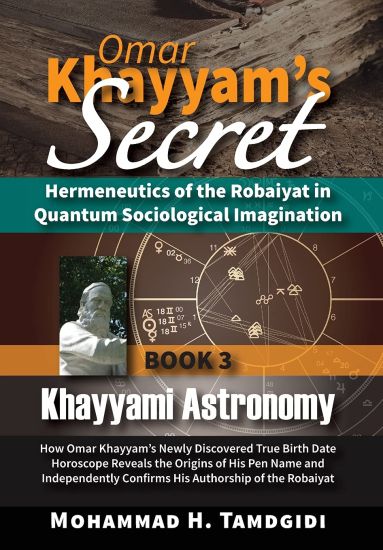
Omar Khayyam's Secret: Hermeneutics of the Robaiyat in Quantum Sociological Imagination is a twelve-book series of which this book is the third volume, subtitled Khayyami Astronomy: How Omar Khayyam's Newly Discovered True Birth Date Horoscope Reveals the Origins of His Pen Name and Independently Confirms His Authorship of the Robaiyat. Each book is independently readable, although it will be best understood as a part of the whole series. In the overall series, the transdisciplinary sociologist Mohammad H. Tamdgidi shares the results of his decades-long research on Omar Khayyam, the enigmatic 11th/12th centuries Persian Muslim sage, philosopher, astronomer, mathematician, physician, writer, and poet from Neyshabour, Iran, whose life and works still remain behind a veil of deep mystery. Tamdgidi's purpose has been to find definitive answers to the many puzzles still surrounding Khayyam, especially regarding the existence, nature, and purpose of the Robaiyat in his life and works. To explore the questions posed, he advances a new hermeneutic method of textual analysis, informed by what he calls the quantum sociological imagination, to gather and study all the attributed philosophical, religious, scientific, and literary writings of Khayyam. Omar Khayyam's true birth date horoscope, as newly discovered in this series, is comprised of a dazzling number of Air Triplicities sharing a vertex on a Sun-Mercury Cazimi point on the same Ascendant degree 18 of Gemini. Among other features, his Venus, Sextile with Moon, also plays a lifelong, secretively creative role to intentionally balance his chart. These features would not have escaped the attention of Omar Khayyam, a master astronomer and expert in matters astrological, no matter how much he embraced, doubted, or rejected astrological interpretations. In this third book of the series, conducting an in-depth hermeneutic analysis of Khayyam's horoscope, Tamdgidi reports having discovered the origins of Khayyam's pen name in his horoscope. The long-held myth that "Khayyam" was a parental name, even if true, in no way takes away from the new finding; it only adds to its intrigue. Tamdgidi's hermeneutic analysis of Khayyam's horoscope in intersection with extant Khayyami Robaiyat also leads him to discover an entirely neglected signature quatrain that he proves could not be from anyone but Khayyam, one that provides a reliably independent confirmation of his authorship of the Robaiyat. He also shows how another neglected quatrain reporting its poet to have aged to a hundred is from Khayyam. This means all the extant Khayyami quatrains are now in need of hermeneutic reevaluation. Tamdgidi's further study of a sample of fifty Khayyami Robaiyat leads him to conclude that their poet definitively intended the poems to remain in veil, that they were considered to be a collection of interrelated quatrains and not sporadic separate quatrains written marginally in pastime, that they were meant to offer a life's intellectual journey as in a "book of life," that the poems' critically nuanced engagement with astrology was not incidental but essential throughout the collection, and that, judging from the signature quatrain discovered, 1000 quatrains were intended to comprise the collection. Oddly it appears that, after all, "The Khayyam who stitched his tents of wisdom" was a trope that had its origins in Omar Khayyam's horoscope heavens.
Omar Khayyam's Secret

Omar Khayyam's Secret

Mohammad H Tamdgidi

Okcir Press (Imprint of Ahead Publishing House)
2021
sidottu
Omar Khayyam's Secret: Hermeneutics of the Robaiyat in Quantum Sociological Imagination is a twelve-book series of which this book, subtitled New Khayyami Studies: Quantumizing the Newtonian Structures of C. Wright Mills's Sociological Imagination for A New Hermeneutic Method, is the first volume. Each book is independently readable, although it will be best understood as a part of the whole series. In the overall series, the transdisciplinary sociologist Mohammad H. Tamdgidi shares the results of his decades-long research on Omar Khayyam, the enigmatic 11th/12th centuries Persian Muslim sage, philosopher, astronomer, mathematician, physician, writer, and poet from Neyshabour, Iran, whose life and works still remain behind a veil of deep mystery. Tamdgidi's purpose has been to find definitive answers to the many puzzles still surrounding Khayyam, especially regarding the existence, nature, and purpose of the Robaiyat in his life and works. To explore the questions posed, he advances a new hermeneutic method of textual analysis, informed by what he calls the quantum sociological imagination, to gather and study all the attributed philosophical, religious, scientific, and literary writings of Khayyam. In this first book of the series, following a common preface and introduction to the series, Tamdgidi develops the quantum sociological imagination method framing his hermeneutic study in the series as a whole. In the prefatory note he shares the origins of this series and how the study is itself a moment in the trajectory of a broader research project. In his introduction, he describes how centuries of Khayyami studies, especially during the last two, have reached an impasse in shedding light on his enigmatic life and works, especially his attributed Robaiyat. The four chapters of the book are then dedicated to developing the quantum sociological imagination as a new hermeneutic method framing the Khayyami studies in the series. The method builds, in an applied way, on the results of Tamdgidi's recent work in the sociology of scientific knowledge, Liberating Sociology: From Newtonian Toward Quantum Imagination: Volume 1: Unriddling the Quantum Enigma (2020), where he explored extensively, in greater depth, and in the context of understanding the so-called "quantum enigma," the Newtonian and quantum ways of imagining reality. In this first book, he shares the findings of that research in summary amid new applied insights developed in relation to Khayyami studies. In the first chapter, Tamdgidi raises a set of eight questions about the structure of C. Wright Mills's sociological imagination as a potential framework for Khayyami studies. In the second chapter, he shows how the questions are symptomatic of Newtonian structures that still continue to frame Mills's sociological imagination. In the third chapter, the author explores how the sociological imagination can be reinvented to be more in tune with the findings of quantum science. In the last chapter, the implications of the quantum sociological imagination for devising a hermeneutic method for new Khayyam and Robaiyat studies are outlined. In conclusion, the findings of this first book of the Omar Khayyam's Secret series are summarized.
Omar Khayyam's Secret

Omar Khayyam's Secret

Mohammad H Tamdgidi

Okcir Press (Imprint of Ahead Publishing House)
2021
pokkari
Omar Khayyam's Secret: Hermeneutics of the Robaiyat in Quantum Sociological Imagination is a twelve-book series of which this book, subtitled New Khayyami Studies: Quantumizing the Newtonian Structures of C. Wright Mills's Sociological Imagination for A New Hermeneutic Method, is the first volume. Each book is independently readable, although it will be best understood as a part of the whole series. In the overall series, the transdisciplinary sociologist Mohammad H. Tamdgidi shares the results of his decades-long research on Omar Khayyam, the enigmatic 11th/12th centuries Persian Muslim sage, philosopher, astronomer, mathematician, physician, writer, and poet from Neyshabour, Iran, whose life and works still remain behind a veil of deep mystery. Tamdgidi's purpose has been to find definitive answers to the many puzzles still surrounding Khayyam, especially regarding the existence, nature, and purpose of the Robaiyat in his life and works. To explore the questions posed, he advances a new hermeneutic method of textual analysis, informed by what he calls the quantum sociological imagination, to gather and study all the attributed philosophical, religious, scientific, and literary writings of Khayyam. In this first book of the series, following a common preface and introduction to the series, Tamdgidi develops the quantum sociological imagination method framing his hermeneutic study in the series as a whole. In the prefatory note he shares the origins of this series and how the study is itself a moment in the trajectory of a broader research project. In his introduction, he describes how centuries of Khayyami studies, especially during the last two, have reached an impasse in shedding light on his enigmatic life and works, especially his attributed Robaiyat. The four chapters of the book are then dedicated to developing the quantum sociological imagination as a new hermeneutic method framing the Khayyami studies in the series. The method builds, in an applied way, on the results of Tamdgidi's recent work in the sociology of scientific knowledge, Liberating Sociology: From Newtonian Toward Quantum Imagination: Volume 1: Unriddling the Quantum Enigma (2020), where he explored extensively, in greater depth, and in the context of understanding the so-called "quantum enigma," the Newtonian and quantum ways of imagining reality. In this first book, he shares the findings of that research in summary amid new applied insights developed in relation to Khayyami studies. In the first chapter, Tamdgidi raises a set of eight questions about the structure of C. Wright Mills's sociological imagination as a potential framework for Khayyami studies. In the second chapter, he shows how the questions are symptomatic of Newtonian structures that still continue to frame Mills's sociological imagination. In the third chapter, the author explores how the sociological imagination can be reinvented to be more in tune with the findings of quantum science. In the last chapter, the implications of the quantum sociological imagination for devising a hermeneutic method for new Khayyam and Robaiyat studies are outlined. In conclusion, the findings of this first book of the Omar Khayyam's Secret series are summarized.
Omar Khayyam's Secret

Omar Khayyam's Secret

Mohammad H Tamdgidi

Okcir Press (Imprint of Ahead Publishing House)
2021
pokkari
Omar Khayyam's Secret: Hermeneutics of the Robaiyat in Quantum Sociological Imagination is a twelve-book series of which this book is the third volume, subtitled Khayyami Astronomy: How Omar Khayyam's Newly Discovered True Birth Date Horoscope Reveals the Origins of His Pen Name and Independently Confirms His Authorship of the Robaiyat. Each book is independently readable, although it will be best understood as a part of the whole series. In the overall series, the transdisciplinary sociologist Mohammad H. Tamdgidi shares the results of his decades-long research on Omar Khayyam, the enigmatic 11th/12th centuries Persian Muslim sage, philosopher, astronomer, mathematician, physician, writer, and poet from Neyshabour, Iran, whose life and works still remain behind a veil of deep mystery. Tamdgidi's purpose has been to find definitive answers to the many puzzles still surrounding Khayyam, especially regarding the existence, nature, and purpose of the Robaiyat in his life and works. To explore the questions posed, he advances a new hermeneutic method of textual analysis, informed by what he calls the quantum sociological imagination, to gather and study all the attributed philosophical, religious, scientific, and literary writings of Khayyam. Omar Khayyam's true birth date horoscope, as newly discovered in this series, is comprised of a dazzling number of Air Triplicities sharing a vertex on a Sun-Mercury Cazimi point on the same Ascendant degree 18 of Gemini. Among other features, his Venus, Sextile with Moon, also plays a lifelong, secretively creative role to intentionally balance his chart. These features would not have escaped the attention of Omar Khayyam, a master astronomer and expert in matters astrological, no matter how much he embraced, doubted, or rejected astrological interpretations. In this third book of the series, conducting an in-depth hermeneutic analysis of Khayyam's horoscope, Tamdgidi reports having discovered the origins of Khayyam's pen name in his horoscope. The long-held myth that "Khayyam" was a parental name, even if true, in no way takes away from the new finding; it only adds to its intrigue. Tamdgidi's hermeneutic analysis of Khayyam's horoscope in intersection with extant Khayyami Robaiyat also leads him to discover an entirely neglected signature quatrain that he proves could not be from anyone but Khayyam, one that provides a reliably independent confirmation of his authorship of the Robaiyat. He also shows how another neglected quatrain reporting its poet to have aged to a hundred is from Khayyam. This means all the extant Khayyami quatrains are now in need of hermeneutic reevaluation. Tamdgidi's further study of a sample of fifty Khayyami Robaiyat leads him to conclude that their poet definitively intended the poems to remain in veil, that they were considered to be a collection of interrelated quatrains and not sporadic separate quatrains written marginally in pastime, that they were meant to offer a life's intellectual journey as in a "book of life," that the poems' critically nuanced engagement with astrology was not incidental but essential throughout the collection, and that, judging from the signature quatrain discovered, 1000 quatrains were intended to comprise the collection. Oddly it appears that, after all, "The Khayyam who stitched his tents of wisdom" was a trope that had its origins in Omar Khayyam's horoscope heavens.
Advancing Utopistics

Advancing Utopistics

Mohammad H. Tamdgidi

Paradigm
2009
nidottu
Mohammad H. Tamdgidi is Assistant Professor of Sociology at the University of Massachusetts Boston. He is the Founding Editor of Human Architecture:Journal of the Sociology of Self-Knowledge.
Advancing Utopistics

Advancing Utopistics

Mohammad H. Tamdgidi

Paradigm
2007
sidottu
Mohammad H. Tamdgidi is Assistant Professor of Sociology at the University of Massachusetts Boston. He is the Founding Editor of Human Architecture:Journal of the Sociology of Self-Knowledge.