Kirjojen hintavertailu. Mukana 12 390 323 kirjaa ja 12 kauppaa.

Kirjailija

Mohammad Karamouz

Kirjat ja teokset yhdessä paikassa: 8 kirjaa, julkaisuja vuosilta 2003-2025, suosituimpien joukossa Urban Water Cycle Processes and Interactions. Vertaile teosten hintoja ja tarkista saatavuus suomalaisista kirjakaupoista.

8 kirjaa

Kirjojen julkaisuhaarukka 2003-2025.

Urban Water Engineering and Management

Urban Water Engineering and Management

Mohammad Karamouz; Ali Moridi

TAYLOR FRANCIS LTD
2025
sidottu
Integrating the latest developments in urban water hydrology and management, Urban Water Engineering and Management takes a system approach to urban water hydrology, engineering, planning, and management, supplying examples and case studies, and highlighting pressing issues such as urban water governance, disaster management, and climate change impacts on urban areas. This expanded and updated edition draws attention to climate change how it impacts the water cycle. Time-series analysis is simplified in a practical manner, and hydro-informatics principles and applications in urban water are also added as unique features of this edition. Written and designed especially for intermediate and advanced courses/modules in water resources in civil and environmental engineering, and in urban planning, this book can be used as a textbook for civil engineering, urban and regional planning, geography, environmental science, and in courses dealing with the urban water cycle.Features:Is updated throughout and adds numerous new examples and case studies, addressing critical issues such as urban water governance, asset and disaster management, and the impacts of climate change on urban areas.Integrates the latest developments in urban water hydrology and management, providing a holistic system perspective on urban water engineering, and planning.Includes numerous examples, case studies, and technological and IT tools addressing critical issues such as urban water governance, asset and disaster management, and the impacts of climate change on urban areas.Offers new insights for engineers, policy-makers, and decision-makers, emphasizing the importance of integrated water management and planning solutions for sustainable urban development.
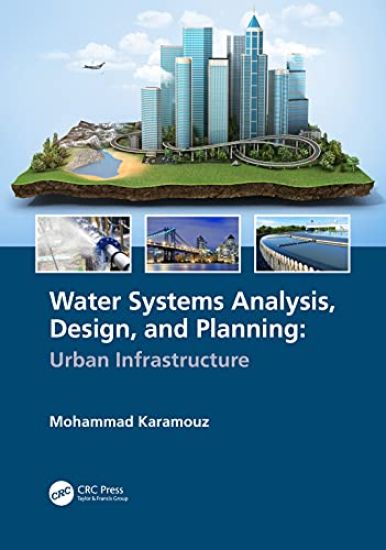
Water Systems Analysis, Design, and Planning

Water Systems Analysis, Design, and Planning

Mohammad Karamouz

TAYLOR FRANCIS LTD
2024
nidottu
This book presents three distinct pillars for analysis, design, and planning: urban water cycle and variability as the state of water being; landscape architecture as the medium for built-by-design; and total systems as the planning approach. The increasing demand for water and urban and industrial expansions have caused myriad environmental, social, economic, and political predicaments. More frequent and severe floods and droughts have changed the resiliency and ability of water infrastructure systems to operate and provide services to the public. These concerns and issues have also changed the way we plan and manage our water resources.Focusing on urban challenges and contexts, the book provides foundational information regarding water science and engineering while also examining topics relating to urban stormwater, water supply, and wastewater infrastructures. It also addresses critical emerging issues such as simulation and economic modeling, flood resiliency, environmental visualization, satellite data applications, and digital data model (DEM) advancements.Features: Explores various theoretical, practical, and real-world applications of system analysis, design, and planning of urban water infrastructures Discusses hydrology, hydraulics, and basic laws of water flow movement through natural and constructed environments Describes a wide range of novel topics ranging from water assets, water economics, systems analysis, risk, reliability, and disaster management Examines the details of hydrologic and hydrodynamic modeling and simulation of conceptual and data-driven models Delineates flood resiliency, environmental visualization, pattern recognition, and machine learning attributes Explores a compilation of tools and emerging techniques that elevate the reader to a higher plateau in water and environmental systems managementWater Systems Analysis, Design, and Planning: Urban Infrastructure serves as a useful resource for advanced undergraduate and graduate students taking courses in the areas of water resources and systems analysis, as well as practicing engineers and landscape professionals.
Water Systems Analysis, Design, and Planning

Water Systems Analysis, Design, and Planning

Mohammad Karamouz

TAYLOR FRANCIS LTD
2021
sidottu
This book presents three distinct pillars for analysis, design, and planning: urban water cycle and variability as the state of water being; landscape architecture as the medium for built-by-design; and total systems as the planning approach. The increasing demand for water and urban and industrial expansions have caused myriad environmental, social, economic, and political predicaments. More frequent and severe floods and droughts have changed the resiliency and ability of water infrastructure systems to operate and provide services to the public. These concerns and issues have also changed the way we plan and manage our water resources.Focusing on urban challenges and contexts, the book provides foundational information regarding water science and engineering while also examining topics relating to urban stormwater, water supply, and wastewater infrastructures. It also addresses critical emerging issues such as simulation and economic modeling, flood resiliency, environmental visualization, satellite data applications, and digital data model (DEM) advancements.Features: Explores various theoretical, practical, and real-world applications of system analysis, design, and planning of urban water infrastructures Discusses hydrology, hydraulics, and basic laws of water flow movement through natural and constructed environments Describes a wide range of novel topics ranging from water assets, water economics, systems analysis, risk, reliability, and disaster management Examines the details of hydrologic and hydrodynamic modeling and simulation of conceptual and data-driven models Delineates flood resiliency, environmental visualization, pattern recognition, and machine learning attributes Explores a compilation of tools and emerging techniques that elevate the reader to a higher plateau in water and environmental systems managementWater Systems Analysis, Design, and Planning: Urban Infrastructure serves as a useful resource for advanced undergraduate and graduate students taking courses in the areas of water resources and systems analysis, as well as practicing engineers and landscape professionals.
Groundwater Hydrology

Groundwater Hydrology

Mohammad Karamouz; Azadeh Ahmadi; Masih Akhbari

CRC Press
2020
sidottu
Increasing demand for water, higher standards of living, depletion of resources of acceptable quality, and excessive water pollution due to urban, agricultural, and industrial expansions have caused intense environmental, social, economic, and political predicaments. More frequent and severe floods and droughts have changed the resiliency and ability of water infrastructure systems to operate and provide services to the public. These concerns and issues have also changed the way we plan and manage our surface and groundwater resources. Groundwater Hydrology: Engineering, Planning, and Management, Second Edition presents a compilation of the state-of-the-art subjects and techniques in the education and practice of groundwater and describes them in a systematic and integrated fashion useful for undergraduate and graduate students and practitioners. This new edition features updated materials, computer codes, and case studies throughout.Features: Discusses groundwater hydrology, hydraulics, and basic laws of groundwater movement Describes environmental water quality issues related to groundwater, aquifer restoration, and remediation techniques, as well as the impacts of climate change \ Examines the details of groundwater modeling and simulation of conceptual models Applies systems analysis techniques in groundwater planning and management Delineates the modeling and downscaling of climate change impacts on groundwater under the latest IPCC climate scenariosWritten for students as well as practicing water resource engineers, the book develops a system view of groundwater fundamentals and model-making techniques through the application of science, engineering, planning, and management principles. It discusses the classical issues in groundwater hydrology and hydraulics followed by coverage of water quality issues. It also introduces basic tools and decision-making techniques for future groundwater development activities, taking into account regional sustainability issues. The combined coverage of engineering and planning tools and techniques, as well as specific challenges for restoration and remediation of polluted aquifers sets this book apart.
Urban Water Engineering and Management

Urban Water Engineering and Management

Mohammad Karamouz; Ali Moridi; Sara Nazif

CRC Press Inc
2010
sidottu
In past decades, urban water management practices focused on optimizing the design and operation of water distribution networks, wastewater collection systems, and water and wastewater treatment plants. However, municipalities are now faced with aging urban water infrastructures whose operation must be improved and expanded to maintain current high standards of living as well as new challenges such as climate change, systems sustainability and water quality issues. Integrating the latest developments in urban water hydrology and management, Urban Water Engineering and Management takes a system approach to urban water hydrology, engineering, planning and management, supplying examples and case studies and highlighting pressing issues such as urban water governance, disaster management, and climate change impacts on urban areas. The book draws attention to climate change as a main concern of this century by focusing on its impact the components of water cycle.The book covers modeling of urban water cycle components, urban water supply, and distribution systems demand forecasting. It also presents classical issues, such as design of water distribution networks and wastewater and storm collection in urban settings, from a system's perspective. The text also includes a discussion of water governance and disaster management in urban areas and the urbanization effects on the environment and the needed water infrastructure development in urban areas. Against this background, the authors discuss the importance of understanding the principles of simulation, optimization, multiple-criterion decision making, and conflict resolution for successful, integrated urban water management. They explore integrated water management and planning solutions for incorporating structural and nonstructural means to achieve the best operational schemes at affordable costs, going beyond using the existing structures and physical limitations on water availability to include technical, social, political, and economic aspects of better water and wastewater management in urban areas. Written and designed especially for intermediate and advanced courses/modules in water resources in civil and environmental engineering, and in urban planning, the book can be used as a textbook for civil engineering, urban and regional planning, geography, environmental science, and in courses dealing with urban water cycle. It also introduces new horizons for engineers as well as policy and decision makers who plan for future urban water and regional sustainability. Engineers and planners, especially those who work on design, planning, and management of urban systems and/or community development, can use this book in practice because it deals with a broad range of real world urban water problems.
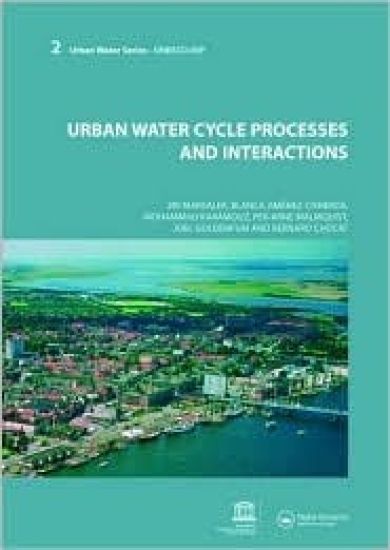
Urban Water Cycle Processes and Interactions

Urban Water Cycle Processes and Interactions

Jiri Marsalek; Blanca Jimenez Cisneros; Mohammad Karamouz; Per-Arne Malmquist; Joel Goldenfum; Bernard Chocat

CRC Press
2007
sidottu
Effective management of urban water should be based on a scientific understanding of the impact of human activity on both the urban hydrological cycle – including its processes and interactions – and the environment itself. Such anthropogenic impacts, which vary broadly in time and space, need to be quantified with respect to local climate, urban development, cultural, environmental and religious practices, and other socio-economic factors.Urban Water Cycle Processes and Interactions represents the fruit of a project by UNESCO’s International Hydrological Programme on this topic. The volume begins by introducing the urban water cycle concept and the need for integrated or total management. It then explores in detail the manifold hydrological components of the cycle, the diverse elements of urban infrastructure and water services, and the various effects of urbanization on the environment – from the atmosphere and surface waters to wetlands, soils and groundwater, as well as biodiversity. A concluding series of recommendations for effective urban water management summarize the important findings set forth here.Urban Water Series - UNESCO-IHP VolumesFollowing from the Sixth Phase of UNESCO’s International Hydrological Programme (2002–2007), the Urban Water Series – UNESCO-IHP addresses fundamental issues related to the role of water in cities and the effects of urbanization on the hydrological cycle and water resources. Focusing on the development of integrated approaches to sustainable urban water management, the Series should inform the work of urban water management practitioners, policy-makers and educators throughout the world.
Urban Water Cycle Processes and Interactions

Urban Water Cycle Processes and Interactions

Jiri Marsalek; Blanca Jimenez Cisneros; Mohammad Karamouz; Per-Arne Malmquist; Joel Goldenfum; Bernard Chocat

CRC Press
2007
nidottu
Effective management of urban water should be based on a scientific understanding of the impact of human activity on both the urban hydrological cycle – including its processes and interactions – and the environment itself. Such anthropogenic impacts, which vary broadly in time and space, need to be quantified with respect to local climate, urban development, cultural, environmental and religious practices, and other socio-economic factors.Urban Water Cycle Processes and Interactions represents the fruit of a project by UNESCO’s International Hydrological Programme on this topic. The volume begins by introducing the urban water cycle concept and the need for integrated or total management. It then explores in detail the manifold hydrological components of the cycle, the diverse elements of urban infrastructure and water services, and the various effects of urbanization on the environment – from the atmosphere and surface waters to wetlands, soils and groundwater, as well as biodiversity. A concluding series of recommendations for effective urban water management summarize the important findings set forth here.Urban Water Series - UNESCO-IHP VolumesFollowing from the Sixth Phase of UNESCO’s International Hydrological Programme (2002–2007), the Urban Water Series – UNESCO-IHP addresses fundamental issues related to the role of water in cities and the effects of urbanization on the hydrological cycle and water resources. Focusing on the development of integrated approaches to sustainable urban water management, the Series should inform the work of urban water management practitioners, policy-makers and educators throughout the world.
Water Resources Systems Analysis

Water Resources Systems Analysis

Mohammad Karamouz; Ferenc Szidarovszky; Banafsheh Zahraie

CRC Press Inc
2003
sidottu
Focusing on conflict resolution, Water Resources Systems Analysis discusses systematic approaches to the mathematical modeling of various water resources issues, which helps decision-makers allocate water effectively and efficiently. Readers will gain an understanding of simulation, optimization, multi-criterion-decision-making, as well as engineering economics and time series analysis, all necessary for successful water systems analysis. The book explores recent developments in surface and groundwater systems optimization and modeling, and it relates these to real field applications and case studies. Supported by essential mathematical tools, this book gives current and future hydrologists, water resources managers, and civil engineers a logical reference for prioritizing and addressing critical issues such as flood control, power generation, and water quality management.