Kirjojen hintavertailu. Mukana 12 332 797 kirjaa ja 12 kauppaa.

Kirjailija

Molly Dunigan

Kirjat ja teokset yhdessä paikassa: 22 kirjaa, julkaisuja vuosilta 2010-2023, suosituimpien joukossa Anticipating Flashpoints with Russia. Vertaile teosten hintoja ja tarkista saatavuus suomalaisista kirjakaupoista.

22 kirjaa

Kirjojen julkaisuhaarukka 2010-2023.

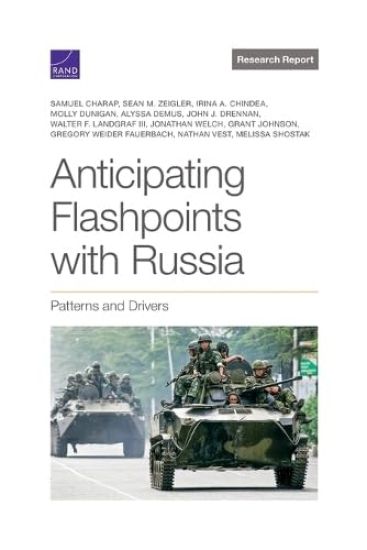
Anticipating Flashpoints with Russia

Anticipating Flashpoints with Russia

Samuel Charap; Sean M Zeigler; Irina a Chindea; Molly Dunigan; Alyssa Demus; John J Drennan; Walter F Landgraf; Jonathan Welch; Grant Johnson; Gregory Weider Fauerbach; Nathan Vest; Melissa Shostak

RAND Corporation
2023
pokkari
The authors sought to identify possible Russian flashpoints in Europe that could entangle the United States. Using quantitative and qualitative methods to analyze historical data on Russian disputes and conflicts, they identified the key drivers of such flashpoints. They derive planning implications for the United States and the U.S. Army in particular. This research was completed prior to Russia's full-scale invasion of Ukraine in February 2022.
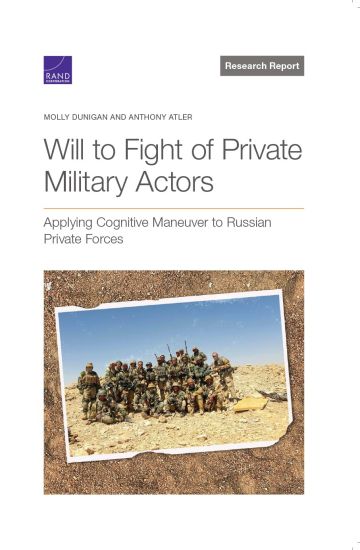
Will to Fight of Private Military Actors

Will to Fight of Private Military Actors

Molly Dunigan; Anthony Atler

RAND Corporation
2023
pokkari
Deploying private military actors allows Russia to expand its military footprint while maintaining plausible deniability of direct involvement in military operations. An adaptation of the RAND-developed military will-to-fight model highlights opportunities to counter these actors and target potential vulnerabilities through cognitive maneuver at the individual, team, organizational, state, and societal levels.
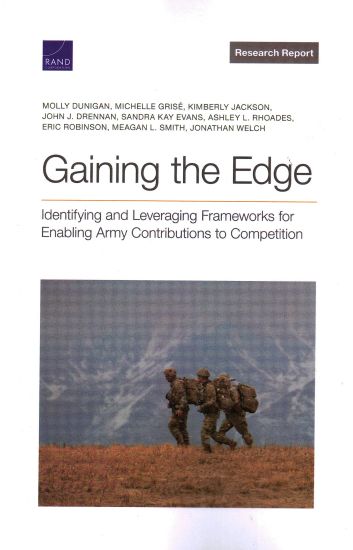
Gaining the Edge

Gaining the Edge

Molly Dunigan; Michelle Grisé; John J Drennan; Sandra Kay Evans; Ashley L Rhoades; Eric Robinson; Meagan L Smith; Jonathan Welch

RAND Corporation
2023
pokkari
Competition with near peers has become the defining U.S. national security priority in recent years, requiring the U.S. Army to rethink its roles and responsibilities. In support of Army efforts to better contribute to DoD's response to competition challenges, the authors reviewed relevant documentation; interviewed subject-matter experts; and examined overlaps between the existing supply of Army capabilities and the demands of competition.
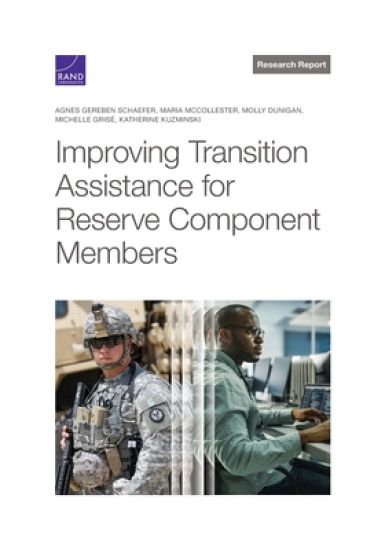
Improving Transition Assistance for Reserve Component Members

Improving Transition Assistance for Reserve Component Members

Agnes Gereben Schaefer; Maria McCollester; Molly Dunigan; Michelle Grisé; Katherine Kuzminski

RAND Corporation
2023
pokkari
This report presents findings that identify (1) unmet needs for transitioning reserve component members, (2) the impact of current reserve component Transition Assistance Program (TAP) requirements on individuals and units, and (3) potential improvements to TAP. Drawing from these findings, the authors present recommendations for improving TAP's effectiveness in addressing reserve component members' transition needs.
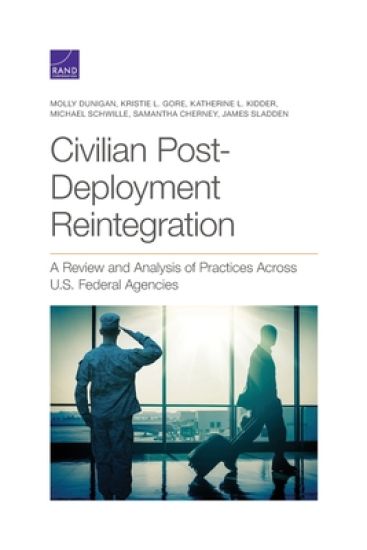
Civilian Post-Deployment Reintegration

Civilian Post-Deployment Reintegration

Molly Dunigan; Kristie L Gore; Katherine L Kidder

RAND
2020
nidottu
In the past two decades, the United States has deployed a high number of U.S. federal government civilians to high-threat environments. Past findings point to a likely need for civilian post-deployment reintegration support. However, until now, a descriptive account of such support has been lacking. In this report, the authors present assessments of federal agencies' practices to reintegrate civilians following a deployment to high-threat areas.
Human Capital Needs for the Department of Defense Operational Contract Support Planning and Integration Workfo
Contractors provide supplies and perform other functions in theaters of conflict. This comprehensive review of the U.S. Department of Defense (DoD) operational contract support (OCS) planning and integration workforce shows that some doctrinally mandated tasks are not being performed by DoD personnel and that the force receives limited training in OCS, recommending several options to address these shortfalls.
Sustaining the Army's Reserve Components as an Operational Force

Sustaining the Army's Reserve Components as an Operational Force

Christopher M Schnaubelt; Raphael S Cohen; Molly Dunigan; Gian Gentile; Jaime L Hastings; Joshua Klimas; Jefferson P Marquis; Agnes Gereben Schaefer; Bonnie Triezenberg; Michelle Darrah Ziegler

RAND
2017
nidottu
This report identifies emerging policy lessons regarding the use of, and reforms to, the U.S. Army's Reserve Components (RCs) as an operational reserve derived from analyses of their contributions to Operations Enduring Freedom, Iraqi Freedom, New Dawn, and other recent contingency operations. These lessons can be applied to sustain the readiness of the U.S. Army Reserve and Army National Guard in future contingencies.
A Review of Alternative Methods to Inventory Contracted Services in the Department of Defense
Growing concern about U.S. Department of Defense (DoD) contracts for private-sector services led Congress to mandate the development of the DoD Inventory of Contracted Services to collect information on the activities performed under DoD services contracts. RAND was asked to conduct a review of the system's data, congressional and other stakeholder needs, and whether these needs could be met by other databases.
Expeditionary Civilians

Expeditionary Civilians

Molly Dunigan; Michael Schwille; Susanne Sondergaard; Susan S. Everingham; Todd Nichols

RAND
2016
pokkari
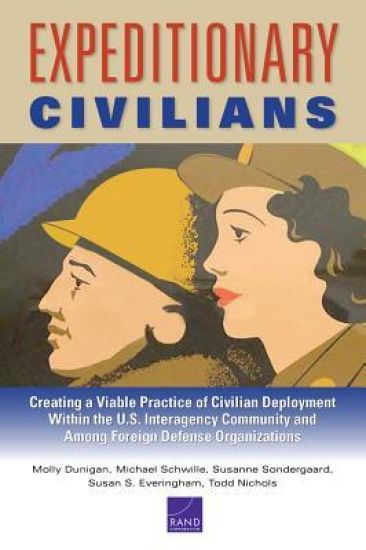
An end-to-end review of guidance across the civilian deployment process in the U.S. Department of Defense involved investigating the deployment approaches of analogous organizations, both U.S. and foreign. This report describes the requirements that generate the need for deployable civilians, the types of missions civilians support, and the methods that organizations use to identify, select, track and deploy civilians.
Expeditionary Civilians

Expeditionary Civilians

Molly Dunigan; Susan S. Everingham; Todd Nichols; Michael Schwille; Susanne Sondergaard

RAND
2016
pokkari
U.S. Department of Defense (DoD) policy requires identification of a subset of civilians to be organized, trained, and equipped to respond to expeditionary requirements. This research presents the results of an end-to-end review and analysis of DoD civilian deployment, assesses the viability of current DoD civilian deployment practice, and proposes a systematic approach to developing and maintaining DoD s civilian deployment capability."
Out of the Shadows

Out of the Shadows

Molly Dunigan; Carrie M. Farmer; Rachel M. Burns; Alison Hawks; Claude Messan Setodji

RAND
2013
pokkari
Private contractors have been deployed extensively around the globe for the past decade and may be exposed to many of the stressors that are known to have physical and mental health implications for military personnel. Results from a RAND survey offer preliminary findings about the mental and physical health of contractors, their deployment experiences, and their access to and use of health care resources
Paths to Victory

Paths to Victory

Christopher Paul; Colin P. Clarke; Beth Grill; Molly Dunigan

RAND
2013
pokkari
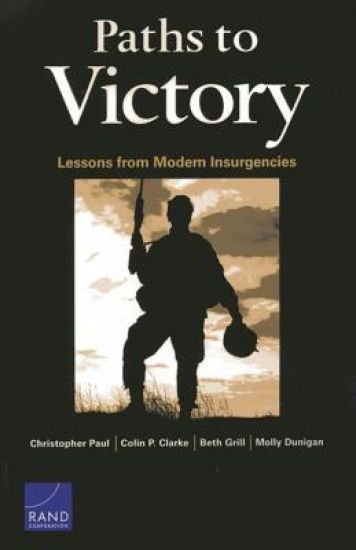
Building on a 2010 RAND study of the 30 insurgencies begun and completed between 1978 and 2008, this study added 41 new cases to the data set, allowing comparisons across all 71 insurgencies begun and completed worldwide since World War II to distill the paths to victory. With many more cases to compare, the study was able to more rigorously test the previous findings and address several critical questions that the earlier study could not.
Paths to Victory

Paths to Victory

Christopher Paul; Colin P. Clarke; Beth Grill; Molly Dunigan

RAND
2013
pokkari
In-depth case studies of 41 insurgencies since World War II break each conflict into phases and examine the trajectory that led to the outcome (insurgent win or counterinsurgent win). Detailed analysis of the findings, including those from an original set of 30 insurgencies (for a total of 71 historical cases), is available in the companion volume, Paths to Victory: Lessons from Modern Insurgencies.
Characterizing and Exploring the Implications of Maritime Irregular Warfare

Characterizing and Exploring the Implications of Maritime Irregular Warfare

Molly Dunigan; Dick Hoffmann; Peter Chalk; Brian Nichiporuk; Paul DeLuca

RAND
2012
pokkari
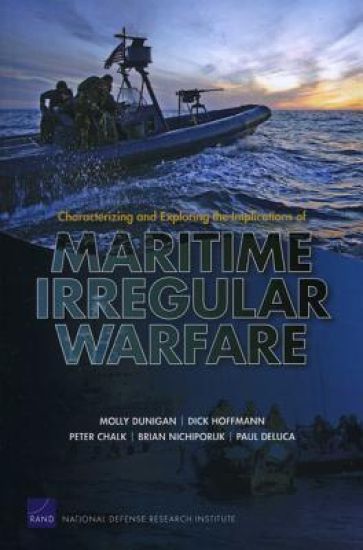
Although irregular warfare includes a range of activities in which naval forces have played an integral role, there has been little examination of the characteristics or potential of such operations in maritime environments. An assessment of the maritime component of a series of historical and ongoing operations reveals that current notions of irregular warfare would benefit from increased recognition of potential maritime contributions.
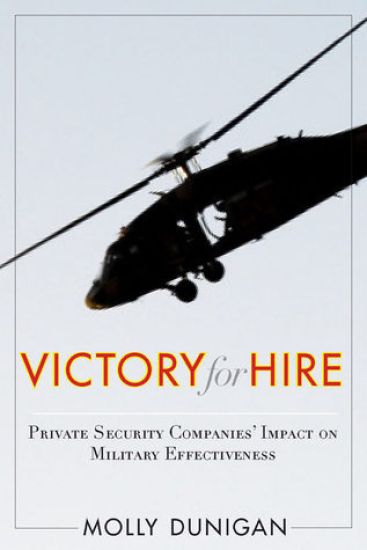
Victory for Hire

Victory for Hire

Molly Dunigan

Stanford University Press
2011
sidottu
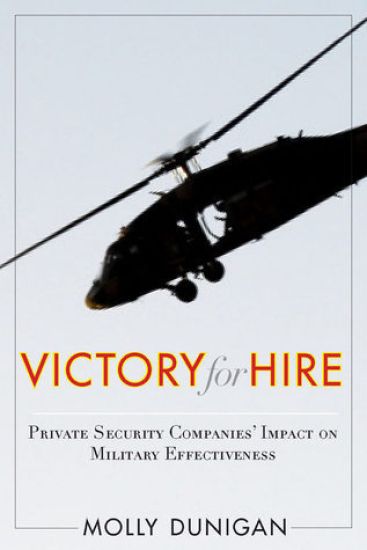
At peak utilization, private security contractors (PSCs) constituted a larger occupying force in Iraq and Afghanistan than did U.S. troops. Yet, no book has so far assessed the impact of private security companies on military effectiveness. Filling that gap, Molly Dunigan reveals how the increasing tendency to outsource missions to PSCs has significant ramifications for both tactical and long-term strategic military effectiveness—and for the likelihood that the democracies that deploy PSCs will be victorious in warfare, both over the short- and long-term. She highlights some of the ongoing problems with deploying large numbers of private security contractors alongside the military, specifically identifying the deployment scenarios involving PSCs that are most likely to have either positive or negative implications for military effectiveness. She then provides detailed recommendations to alleviate these problems. Given the likelihood that the U.S. will continue to use PSCs in future contingencies, this book has real implications for the future of U.S. military and foreign policy.
Victory for Hire

Victory for Hire

Molly Dunigan

Stanford University Press
2011
pokkari
At peak utilization, private security contractors (PSCs) constituted a larger occupying force in Iraq and Afghanistan than did U.S. troops. Yet, no book has so far assessed the impact of private security companies on military effectiveness. Filling that gap, Molly Dunigan reveals how the increasing tendency to outsource missions to PSCs has significant ramifications for both tactical and long-term strategic military effectiveness—and for the likelihood that the democracies that deploy PSCs will be victorious in warfare, both over the short- and long-term. She highlights some of the ongoing problems with deploying large numbers of private security contractors alongside the military, specifically identifying the deployment scenarios involving PSCs that are most likely to have either positive or negative implications for military effectiveness. She then provides detailed recommendations to alleviate these problems. Given the likelihood that the U.S. will continue to use PSCs in future contingencies, this book has real implications for the future of U.S. military and foreign policy.