Kirjojen hintavertailu. Mukana 12 657 676 kirjaa ja 12 kauppaa.

Kirjailija

Morgan L.W. Hazelton

Kirjat ja teokset yhdessä paikassa: 2 kirjaa, julkaisuja vuosilta 2022-2023, suosituimpien joukossa The Elevator Effect. Vertaile teosten hintoja ja tarkista saatavuus suomalaisista kirjakaupoista.

Mukana myös kirjoitusasut: Morgan L. W. Hazelton

2 kirjaa

Kirjojen julkaisuhaarukka 2022-2023.

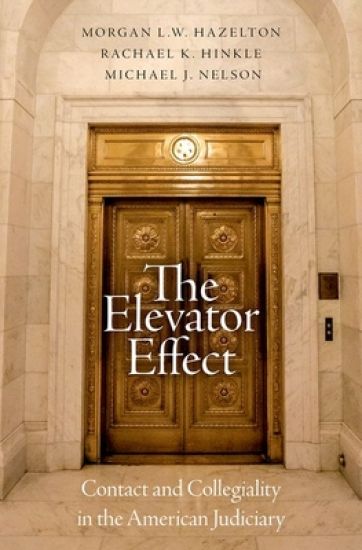
The Elevator Effect

The Elevator Effect

Morgan L.W. Hazelton; Rachael K. Hinkle; Michael J. Nelson

OXFORD UNIVERSITY PRESS INC
2023
sidottu
Appellate judges wield enormous influence in the United States. Their decisions define the scope of legislative and executive power, adjudicate relationships between the federal government and the states, and determine the breadth of individuals' rights and liberties. But, compared to their colleagues on trial courts, they face a significant constraint on their power: their colleagues. The Elevator Effect: Contact and Collegiality in the American Judiciary presents a comprehensive, first of its kind examination of the importance of interpersonal relationships among judges for judicial decision-making and legal development. Regarding decision-making, the authors demonstrate that more frequent interpersonal contact among judges diminishes the role of ideology in judicial decision-making to the point where it is both substantively and statistically imperceptible. This finding stands in stark contrast to judicial decision-making accounts that present ideology as an unwavering determinant of judicial choice. With regard to legal development, the book shows that collegiality affects both the language that judges use to express their disagreement with one another and the precedents they choose to support their arguments. Thus, the overriding argument of The Elevator Effect is that collegiality affects nearly every aspect of judicial behavior. The authors draw on an impressive and unique original collection of data to untangle the relationship between judges' interpersonal relationships and the law they produce. The Elevator Effect presents a clear and highly readable narrative backed by analysis of judicial behavior throughout the U.S. federal judicial hierarchy to demonstrate that the institutional structure in which judges operate substantially tempers judicial behavior. Written in a broad and accessible style, this book will captivate students across a range of disciplines, such as law, political sciences, and empirical legal studies, and also policymakers and the public.
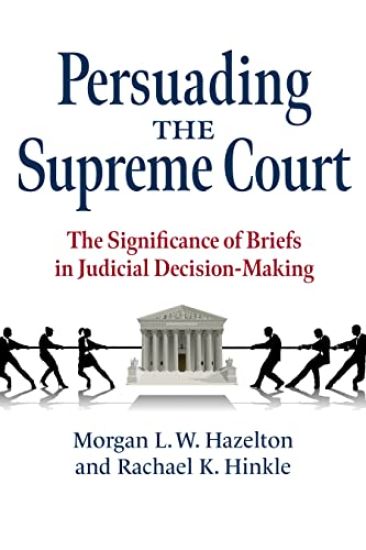
Persuading the Supreme Court

Persuading the Supreme Court

Morgan L. W. Hazelton; Rachael K. Hinkle

UNIVERSITY PRESS OF KANSAS
2022
nidottu
Each year the public, media, and government wait in anticipation for the Supreme Court to announce major decisions. These opinions have shaped legal policy in areas as important as healthcare, marriage, abortion, and immigration. It is not surprising that parties and outside individuals and interest groups invest an estimated $25 million to $50 million a year to produce roughly one thousand amicus briefs to communicate information to the justices, seeking to impact these rulings. Despite the importance of the Court and the information it receives, many questions remain unanswered regarding the production of such information and its relationship to the Court’s decisions. Persuading the Supreme Court leverages the very written arguments submitted to the Court to shed light on both their construction and impact.Drawing on more than 25,000 party and amicus briefs led between 1984 and 2015 and the text of the related court opinions, as well as interviews with former Supreme Court clerks and attorneys who have prepared and led briefs before the Supreme Court, Morgan Hazelton and Rachael Hinkle have shed light on one of the more mysterious and consequential features of Supreme Court decision-making. Persuading the Supreme Court offers new evidence that the resource advantage enjoyed by some parties likely stems from both the ability of their experienced attorneys to craft excellent briefs and their reputations with the justices. The analyses also reveal that information operates differently in terms of influencing who wins and what policy is announced.Using those original interviews and quantitative analyses of a rich original dataset of tens of thousands of briefs, with measures built using sophisticated natural language processing tools, Hazelton and Hinkle investigate the factors that influence what information litigants and their attorneys provide to the Supreme Court and what the justices and their clerks do with that information in deciding cases that set legal policy for the entire country.