

Kirjailija
Morris Goldstein
Kirjat ja teokset yhdessä paikassa: 15 kirjaa, julkaisuja vuosilta 1995-2025, suosituimpien joukossa Thus Religion Grows The Story Of Judaism. Vertaile teosten hintoja ja tarkista saatavuus suomalaisista kirjakaupoista.
15 kirjaa
Kirjojen julkaisuhaarukka 1995-2025.

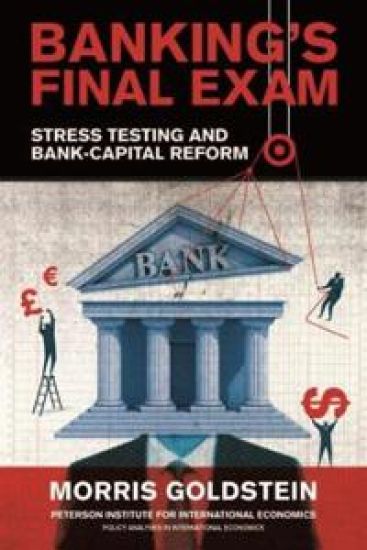
Banking's Final Exam – Stress Testing and Bank–Capital Reform
Morris Goldstein
The Peterson Institute for International Economics
2017
nidottu
Spurred by the success of the first stress test of US banks toward the end of the global economic crisis in 2009, stress testing of large financial institutions has become the cornerstone of banking supervision worldwide. The aim of the tests is to determine which banks are adequately capitalized under severe economic shocks and to order corrective measures for those that are vulnerable. In Banking's Final Exam, one of the world's leading experts on banking regulation concludes that the tests administered on both sides of the Atlantic suffer from fundamental weaknesses, leading to a false sense of reassurance about the safety and soundness of the banking system. Some weaknesses can be corrected within the existing bank-capital regime, but others will require bold reforms--including higher minimum capital requirements for the largest and most systemically-important banks. The banking industry is likely to resist these reforms, but this book explains why their objections do not hold water.
The book includes selected papers of Morris Goldstein on the following topics in international macroeconomics: international trade, currency regimes, exchange rate policy, international policy coordination, banking, financial crises, financial regulation, IMF policies, and China's exchange rate policy. Some of the papers are empirical in nature, while others address key policy issues in international macroeconomics. Many of the papers are co-authored with other well-known international economists, including Jacob Frenkel, Mohsin Khan, Nicholas Lardy, Peter Montiel, Michael Mussa, Carmen Reinhart, and Philip Turner, among others. Taken as a group, the papers should give the reader a good picture of many of the most important issues in international macroeconomics over the past 35 years.

Lift Up Your Life: A Personal Philosophy for Our Times
Morris Goldstein
Literary Licensing, LLC
2011
nidottu
The Future of China's Exchange Rate Policy
Morris Goldstein
The Peterson Institute for International Economics
2008
nidottu
Over the past five years China has emerged as the world's largest global surplus economy; indeed by 2007-08 the size of its surplus relative to its GDP was of a magnitude unprecedented for a large trading economy. This development is especially surprising since in the first twenty-five years of economic reform China's trade and current account surpluses were quite small by East Asian standards, averaging less than 2 percent of GDP. This study provides a comprehensive analysis of the key economic challenges facing the Chinese authorities in light of the still undervalued exchange rate, the large build-up of foreign exchange reserves, and more recently the sharp decline in economic growth. It analyzes the implications of China's exchange-rate policy for the effectiveness of monetary policy, the transition to a commercially oriented banking system, the evolving structure of output and demand, and the risk of protectionism abroad.The policy-options portion of the study takes account of the significant real effective appreciation of the renminbi over the past fifteen months and will contrast the pros and cons of a "stay-the-course" policy with that of a bolder, "three-stage" approach that would seek to maintain recent progress and to reduce even further the undervaluation of the renminbi.
Debating China's Exchange Rate Policy
Morris Goldstein; Nicholas Lardy
The Peterson Institute for International Economics
2008
nidottu
More than two and a half years have passed since China announced a number of changes to its foreign exchange regime in July 2005. During this period, the debate on the pros and cons of China's exchange rate policy, which had begun in earnest several years earlier, intensified. This important new book, based on an Institute conference in October 2007, takes stock of exchange rate policy in China and identifies the major policy options going forward. Specific proposals presented in the volume address how best to eliminate any misalignment of the renminbi; how best to reduce pressures emanating from the sterilization of large reserve accumulation; how best to make capital flows the ally-not the enemy-of exchange rate policy; and what institutional arrangements and policy guidelines to put in place to reap the greatest benefits from management of China's large foreign exchange reserves. Leading experts-including three from China-have contributed to the volume. The keynote address by Wu Xiaoling, deputy governor to the People's Bank of China at the time of the conference, is also presented in the book.

Controlling Currency Mismatches in Emerging Markets
Morris Goldstein; Philip Turner
The Peterson Institute for International Economics
2004
nidottu
In most of the currency crises of the 1990s, the largest output falls have occurred in those emerging economies with large currency mismatches, a phenomenon that occurs when assets and liabilities are denominated in different currencies such that net worth is sensitive to changes in the exchange rate. Currency mismatching makes crisis management much more difficult since it constrains the willingness of the monetary authority to reduce interest rates in a recession (for fear of initiating a large fall in the currency that would bring with it large-scale insolvencies). The mismatching also produces a "fear of floating" on the part of emerging economies, sometimes inducing them to make currency-regime choices that are not in their own long-term interest. Morris Goldstein and Philip Turner summarize what is known about the origins of currency mismatching in emerging economies, discuss how best to define and measure currency mismatching, and review policy options for reducing the size of the problem.

Managed Floating Plus
Morris Goldstein
The Peterson Institute for International Economics
2002
nidottu
In this analysis Morris Goldstein examines currency regime choices for emerging economies that are heavily involved with private capital markets. The author argues that the best regime choice for such economies would be managed floating plus, where "plus" is shorthand for a framework that includes inflation targeting and aggressive measures to discourage currency mismatching. Goldstein argues that if managed floating were enhanced in this way, it would retain the desirable features of a flexible rate regime while addressing the nominal anchor and balance-sheet problems that have historically underpinned a "fear of floating" and handicapped the performance of managed floating in emerging economies. The author also shows why managed floating plus is superior to four alternative currency-regime options-an adjustable peg system, a "BBC (basket, band, crawl) regime," a currency board, and dollarization.
Assessing Financial Vulnerability – An Early Warning System for Emerging Markets
Morris Goldstein; Graciela Kaminsky; Carmen Reinhart
The Peterson Institute for International Economics
2000
nidottu
The European currency crises of 1992-93, the Mexican crisis of 1994-95, and especially the Asian/global crisis of 1997-98, have all contributed to a heightened interest in the early warning signals of financial crises. This pathbreaking study presents a comprehensive battery of empirical tests on the performance of alternative early warning indicators for emerging-market economies that should prove useful in the construction of a more effective global warning system. Not only are the authors able to draw conclusions about which specific indicators have sent the most reliable early warning signals of currency and banking crises in emerging economies, they also test the out-of-sample performance of the model during the Asian crisis and find that it does a good job of identifying the most vulnerable economies. In addition, they show how the early warning system can be used to construct a "composite" crisis indicator to weigh the importance of alternative channels of cross-country "contagion" of crises, and to generate information about the recovery path from crises.This timely study comes on the eve of impending changes at the International Monetary Fund as that institution reexamines how it reacts to financial crises. Moreover, the study provides "...a wealth of valuable elements for anyone investigating and forecasting adverse developments in emerging markets as well as industrial countries," according to Ewoud Schuitemaker, vice president of the economics department at ABN AMRO Bank.
Safeguarding Prosperity in a Global Financial System – The Future International Financial Architecture
Morris Goldstein
The Peterson Institute for International Economics
1999
nidottu
This report contains the findings and recommendations of an independent blue-ribbon commission on the future international financial architecture. The commission was sponsored by the Council on Foreign Relations, and co-chaired by Peter G. Peterson and Carla A. Hills, with the Institute for International Economics' Morris Goldstein serving as project director. The membership is listed below. The report analyzes the main factors that give rise to banking, currency, and debt crises, and it proposes a set of interrelated recommendations for improving crisis prevention and resolution. It also explains why the United States, despite its impressive overall economic performance since the outbreak of the Asian crisis, has a large stake in the future international financial architecture.The commission's recommendations aim at altering the behavior of emerging-market borrowers and their private creditors in ways that would reduce vulnerabilities in the exchange rate systems of emerging economies; inducing private creditors to accept their fair share of the costs of crisis resolution; reforming the IMF's lending policies; and refocusing the mandates of the IMF and the World Bank on leaner agendas. Its recommendations range well beyond the decisions taken to date by the international financial community. A series of dissenting opinions by individual members is included. Other members of the commission were Paul Allaire, C. Fred Bergsten, Kenneth Dam, George David, Jorge Dominguez, Kenneth Duberstein, Barry Eichengreen, Martin Feldstein, Maurice Greenberg, Lee Hamilton, John Heimann, Peter Kenen, Paul Krugman, Nicholas Lardy, David Lipton, Ray Marshall, Norman Ornstein, William Rhodes, Stephen Roach, Henry Schacht, James Schlesinger, George Soros, Laura Tyson, Ezra Vogel, Paul Volcker, and Vin Weber.

The Asian Financial Crisis – Causes, Cures, and Systemic Implications
Morris Goldstein
The Peterson Institute for International Economics
1998
nidottu
The turmoil that rocked Asian markets after the middle of 1997 and that spread far afield was the third major currency crisis of the 1990s. Thailand, Indonesia, Malaysia, and South Korea suffered outright recessions in 1998. In an effort to contain the crisis, almost $120 billion was pledged in IMF-led official rescue packages. How could this happen to a group of countries that has been so highly regarded in the 1990's by private international capital markets? How could the crisis be overcome, and what changes are necessary to prevent it from happening again? Morris Goldstein provides the answers to these questions by first explaining how the Asian financial crisis arose and spread. He traces the crisis through its three interrelated origins: financial sector weaknesses; external sector problems; and the contagion that spread from Thailand to other countries. Goldstein then outlines what needed to be done in the ASEAN-4 economies, in Japan and China, and in the design of IMF-led official rescue packages to end the crisis. Goldstein's final remarks offer specific proposals for improving the international financial architecture.
The Case for an International Banking Standard
Morris Goldstein
The Peterson Institute for International Economics
1997
nidottu
This study presents the case for an international banking standard (IBS) to deal with the rash of banking crises in developing countries. Over the past 15 years, almost three-fourths of the IMF's member countries have experienced at least one serious bout of banking problems; there have been at least a dozen developing country episodes where the costs of these crises amounted to 10 percent or more of the country's GDP; and the total public sector resolution costs of developing-country banking crises have been estimated to be $250 billion. Not only are these banking crises extremely costly to developing countries, they also pose increased risk to industrial countries. Morris Goldstein demonstrates that existing international agreements do not address the main sources of these crises, and the adoption of a voluntary IBS offers a more attractive route to banking reform than the relevant alternatives. The study recommends minimum standards in eight key areas of banking supervision and addresses the operational issues associated with the design and implementation of an IBS.
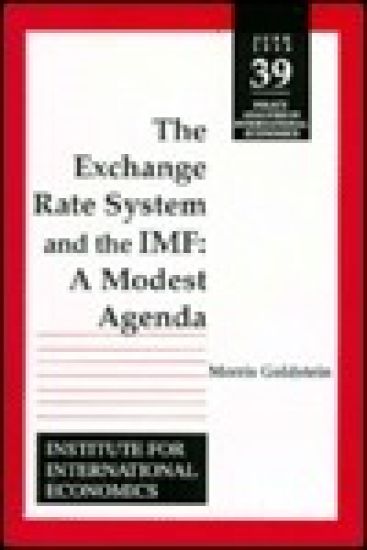
The Exchange Rate System and the IMF – A Modest Agenda
Morris Goldstein
The Peterson Institute for International Economics
1995
nidottu
Global currency markets have remained unsettled. The dollar hit record lows against both the yen and the mark in 1995. The Mexican crisis led to a free fall of the peso. Renewed tensions in the European Monetary System required devaluations in Spain and Portugal. It is thus fortuitous that the world's major countries, starting with the G-7 summit in Italy in June 1994, have agreed to reexamine the world monetary system and the role of its chief institutional custodian the International Monetary Fund. Yet there is little agreement on what should be done. Sweeping change in the form of explicit, binding exchange rate targets for the United States, Japan, and Europe does not seem to be in the cards. More limited reforms might gain more acceptance. But what should be the nature of those reforms? Would they be worth the effort? This study sets out a modest agenda for managing the exchange rate system, improving the system's early warning capabilities, and strengthening the IMF s oversight responsibilities. It could help improve functioning of the world economy and global financial stability.