Kirjojen hintavertailu. Mukana 12 595 353 kirjaa ja 12 kauppaa.

Kirjailija

Motoichi Ohtsu

Kirjat ja teokset yhdessä paikassa: 11 kirjaa, julkaisuja vuosilta 1999-2025, suosituimpien joukossa Principles of Nanophotonics. Vertaile teosten hintoja ja tarkista saatavuus suomalaisista kirjakaupoista.

11 kirjaa

Kirjojen julkaisuhaarukka 1999-2025.

Dressed Photons to Revolutionize Modern Physics

Dressed Photons to Revolutionize Modern Physics

Motoichi Ohtsu; Hirofumi Sakuma

Springer International Publishing AG
2025
sidottu
This book presents an in-depth review of the recent interdisciplinary studies that have shed light on the mechanisms of the creation, energy transfer, and measurement of the dressed photon. A dressed photon is a type of photon that results from the interaction between light and matter in a confined space, typically on the scale of nanometers. It has been applied to nano-fabrication technologies, energy conversion technologies, and silicon light-emitting devices. Despite its extensive applications in various fields, the dressed photon's off-shell nature has posed challenges in describing it through conventional optical scientific theories. The book explains how, through a mathematical viewpoint, the underlying spatiotemporal vortex dynamics connect the dressed photon, the dark energy field, and the structure of the universe. The canonical equations of motion, which describe the time evolution of dynamical systems with Hamiltonian structure, play a key role in understanding these physical phenomena. In particular, the covariant form of equations of motion, where vortex tensors explicitly appear, corresponds to the transformed canonical equations of motion in the Eulerian representation. This newly augmented view of the equations of motion presents a deeper understanding of the interconnectedness of different physical phenomena, which can enlighten graduate students, junior scientists, and industry engineers engaged or interested in this field.
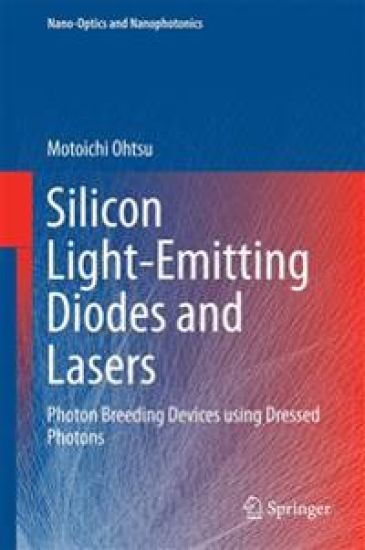
Silicon Light-Emitting Diodes and Lasers

Silicon Light-Emitting Diodes and Lasers

Motoichi Ohtsu

Springer International Publishing AG
2018
nidottu
This book focuses on a novel phenomenon named photon breeding. It is applied to realizing light-emitting diodes and lasers made of indirect-transition-type silicon bulk crystals in which the light-emission principle is based on dressed photons. After presenting physical pictures of dressed photons and dressed-photon phonons, the principle of light emission by using dressed-photon phonons is reviewed. A novel phenomenon named photon breeding is also reviewed. Next, the fabrication and operation of light emitting diodes and lasers are described The role of coherent phonons in these devices is discussed. Finally, light-emitting diodes using other relevant crystals are described and other relevant devices are also reviewed.
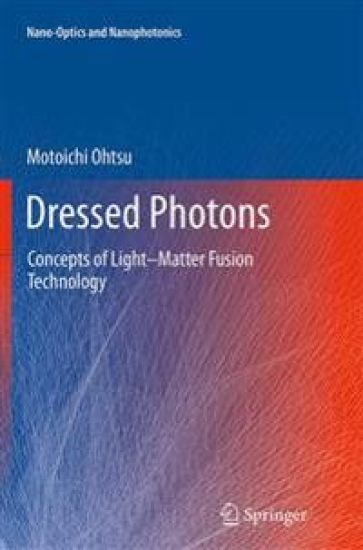
Dressed Photons

Dressed Photons

Motoichi Ohtsu

Springer-Verlag Berlin and Heidelberg GmbH Co. K
2016
nidottu
Authored by the developer of dressed photon science and technology as well as nanophotonics, this book outlines concepts of the subject using a novel theoretical framework that differs from conventional wave optics. It provides a quantum theoretical description of optical near fields and related problems that puts matter excitation such as electronic and vibrational ones on an equal footing with photons. By this description, optical near fields are interpreted as quasi-particles and named dressed photons which carry the material excitation energy in a nanometric space. The author then explores novel nanophotonic devices, fabrications, and energy conversion based on the theoretical picture of dressed photons. Further, this book looks at how the assembly of nanophotonic devices produces information and communication systems. Dressed photon science and technology is on its way to revolutionizing various applications in devices, fabrications, and systems. Promoting further exploration in the field, this book presents physically intuitive concepts, theories, and technical details for students, engineers, and scientists engaged in research and development in dressed photon science and technology as well as nanophotonics.
Silicon Light-Emitting Diodes and Lasers

Silicon Light-Emitting Diodes and Lasers

Motoichi Ohtsu

Springer International Publishing AG
2016
sidottu
This book focuses on a novel phenomenon named photon breeding. It is applied to realizing light-emitting diodes and lasers made of indirect-transition-type silicon bulk crystals in which the light-emission principle is based on dressed photons. After presenting physical pictures of dressed photons and dressed-photon phonons, the principle of light emission by using dressed-photon phonons is reviewed. A novel phenomenon named photon breeding is also reviewed. Next, the fabrication and operation of light emitting diodes and lasers are described The role of coherent phonons in these devices is discussed. Finally, light-emitting diodes using other relevant crystals are described and other relevant devices are also reviewed.
Dressed Photons

Dressed Photons

Motoichi Ohtsu

Springer-Verlag Berlin and Heidelberg GmbH Co. K
2013
sidottu
Authored by the developer of dressed photon science and technology as well as nanophotonics, this book outlines concepts of the subject using a novel theoretical framework that differs from conventional wave optics. It provides a quantum theoretical description of optical near fields and related problems that puts matter excitation such as electronic and vibrational ones on an equal footing with photons. By this description, optical near fields are interpreted as quasi-particles and named dressed photons which carry the material excitation energy in a nanometric space. The author then explores novel nanophotonic devices, fabrications, and energy conversion based on the theoretical picture of dressed photons. Further, this book looks at how the assembly of nanophotonic devices produces information and communication systems. Dressed photon science and technology is on its way to revolutionizing various applications in devices, fabrications, and systems. Promoting further exploration in the field, this book presents physically intuitive concepts, theories, and technical details for students, engineers, and scientists engaged in research and development in dressed photon science and technology as well as nanophotonics.
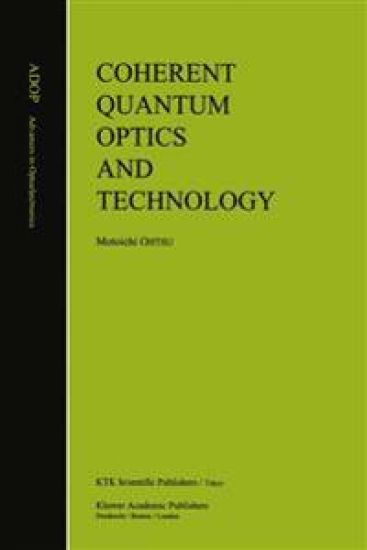
Coherent Quantum Optics and Technology
While preparing the manuscript ofthis book, the author was informed that Profs. H. Dehmelt, Univ. ofWashington, W. Paul, Univ. Bonn and N. F. Ramsey, HarvardUniv. havewontheNobel PrizeinPhysics(1989;fortheirNobellectures, refertoRev.ModernPhysics,Vol.62(l990)pp.525-552).Theirmaincontributions are the pioneering works on the Ramsey resonance method, ion trap, and so on, which are the main topics to be discussed in this book. TherearetwoothergroupspreviouslyawardedwiththeNobelprizeinPhysics for their contributions to laser physics and quantum optics; C. H. Townes, N. G. Basov, and A. M. Prokhorov were awarded a Nobel prize for their works on the inventionofmasers and lasers as well as the basic studiesofquantum electronics; N. Bloembergen and A. L. Schawlow, in 1981, for their works on laser spectros- copy. It is an exceptional case that a branch ofphysics could win the Nobel prize threetimes.Thisfactreflectsandimpliesthatlaserphysicsandphysicsusinglasers are important fields ofbasic study, which relate closely to the quantum optics and atomicphysics. Furthermore,asthecaseofsemiconductorlasers,ithasbecomean importantfield for industrial applications, e.g., opticalcommunicationand optical diskmemories. As shownbythese examples, itcan beconsideredthatthe studyof laser isauniversaloneinscienceandtechnology,coveringawide rangefrombasic physics to industrial applications.
Near-Field Nano-Optics

Near-Field Nano-Optics

Motoichi Ohtsu; Hirokazu Hori

Springer-Verlag New York Inc.
2012
nidottu
Conventional optical science and technology have been restricted by the diffraction limit from reducing the sizes of optical and photoruc devices to nanometric dimensions. Thus, the size of optical integrated circuits has been incompatible with that of their counterpart, integrated electronic circuits, which have much smaller dimensions. This book provides potential ideas and methods to overcome this difficulty. Near-field optics has developed very rapidly from around the middle 1980s after preliminary trials in the microwave frequency region, as proposed as early as 1928. At the early stages of this development, most technical efforts were devoted to realizing super-high-resolution optical microscopy beyond the diffraction limit. However, the possibility of exploiting the optical near-field, phenomenon of quasistatic electromagnetic interaction at subwavelength distances between nanometric particles has opened new ways to nanometric optical science and technology, and many applications to nanometric fabrication and manipulation have been proposed and implemented. Building on this historical background, this book describes recent progress in near-field optical science and technology, mainly using research of the author's groups. The title of this book, Near-Field Nano-Optics-From Basic Principles to Nano-Fabrication and Nano-Photonics, implies capabilities of the optical near­ field not only for imaging/microscopy, but also for fabrication/manipulation/proc­ essing on a nanometric scale.
Optical Near Fields

Optical Near Fields

Motoichi Ohtsu; Kiyoshi Kobayashi

Springer-Verlag Berlin and Heidelberg GmbH Co. K
2010
nidottu
This book outlines physically intuitive concepts and theories for students, engineers, and scientists who will be engaged in research in nanophotonics and atom photonics. The main topic is the optical near ?eld, i.e., the thin ?lm of light that is localized on the surface of a nanometric material. In the early 1980s, one of the authors (M. Ohtsu) started his pioneering research on optical near ?elds because he judged that nanometer-sized light would be required to shift the paradigm of optical science and technology. This ?eld of research did not exist previously, and was not compatible with trends in opticalscienceandtechnology.However,hewasencouragedbytheknowledge that scientists in other countries started similar research in the mid 1980s. In the 1990s, optical technology progressed very rapidly and the p- tonics industry developed, but further progress became di?cult due to the fundamental limit of light known as the di?raction limit. However, there was a growing awareness among scientists and engineers that this limit can be overcome using optical near ?elds. Since a drastic paradigm shift in the c- cepts of optics is required to understand the intrinsic nature of optical near ?elds, the demand for a textbook on this subject has increased. The present book aims to meet this demand.
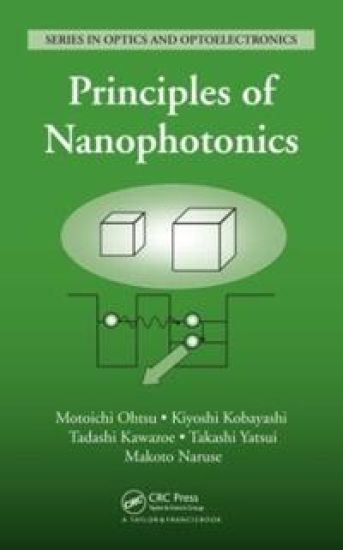
Principles of Nanophotonics

Principles of Nanophotonics

Motoichi Ohtsu; Kiyoshi Kobayashi; Tadashi Kawazoe; Takashi Yatsui; Makoto Naruse

CRC Press Inc
2008
sidottu
The Theory and Applications of Nanophotonics Devices, Fabrication, and SystemsCoauthored by the developer of nanophotonics, Principles of Nanophotonics outlines physically intuitive concepts of the subject using a novel theoretical framework that differs from conventional wave optics. It probes far-reaching physical insights into the local electromagnetic interaction in the nanometric subsystem composed of electrons and photons. After reviewing the background, history, and current status of research and development in nanophotonics and related technologies, the book presents a unique theoretical model to describe the interactions among nanometric material systems via optical near-fields. It also evaluates a nonadiabatic fabrication process using this theoretical model. The authors then explore nanophotonic devices and fabrication techniques and provide examples of qualitative innovation. The final chapter looks at how the assembly of nanophotonic devices produces a nanophotonic system. Realize the Great Potential of Nanophotonics Nanophotonics is on its way to revolutionizing various applications in devices, fabrications, and information and communication systems. Promoting further exploration in the field, this book helps you understand the theory behind nanophotonics and how it can be applied to devices and systems.
Optical Near Fields

Optical Near Fields

Motoichi Ohtsu; Kiyoshi Kobayashi

Springer-Verlag Berlin and Heidelberg GmbH Co. K
2003
sidottu
This book outlines physically intuitive concepts and theories for students, engineers, and scientists who will be engaged in research in nanophotonics and atom photonics. The main topic is the optical near ?eld, i.e., the thin ?lm of light that is localized on the surface of a nanometric material. In the early 1980s, one of the authors (M. Ohtsu) started his pioneering research on optical near ?elds because he judged that nanometer-sized light would be required to shift the paradigm of optical science and technology. This ?eld of research did not exist previously, and was not compatible with trends in opticalscienceandtechnology.However,hewasencouragedbytheknowledge that scientists in other countries started similar research in the mid 1980s. In the 1990s, optical technology progressed very rapidly and the p- tonics industry developed, but further progress became di?cult due to the fundamental limit of light known as the di?raction limit. However, there was a growing awareness among scientists and engineers that this limit can be overcome using optical near ?elds. Since a drastic paradigm shift in the c- cepts of optics is required to understand the intrinsic nature of optical near ?elds, the demand for a textbook on this subject has increased. The present book aims to meet this demand.
Near Field Nano-optics

Near Field Nano-optics

Motoichi Ohtsu; Hirokazu Hori

Kluwer Academic / Plenum Publishers
1999
sidottu
This work describes progress in near-field optical science and technology. The title implies capabilities of optical near-field not only for imaging/microscopy but also for fabrication/manipulation/processing on a nanometric scale. The authors introduce the differences between near-field optics and far-field optics from both experimental and theoretical perspectives. The work touches on a wide range of topics in near-field optics, and can be used both by the novice and experienced researcher already familiar with the subject, to connect the experimental with the theoretical aspects of near-field optics.