Kirjojen hintavertailu. Mukana 12 390 323 kirjaa ja 12 kauppaa.

Kirjailija

Muhammad H. Rashid

Kirjat ja teokset yhdessä paikassa: 5 kirjaa, julkaisuja vuosilta 2012-2025, suosituimpien joukossa Simulation and Analysis of Circuits for Power Electronics. Vertaile teosten hintoja ja tarkista saatavuus suomalaisista kirjakaupoista.

5 kirjaa

Kirjojen julkaisuhaarukka 2012-2025.

Simulation and Analysis of Circuits for Power Electronics

Simulation and Analysis of Circuits for Power Electronics

Muhammad H. Rashid

INSTITUTION OF ENGINEERING AND TECHNOLOGY
2025
sidottu
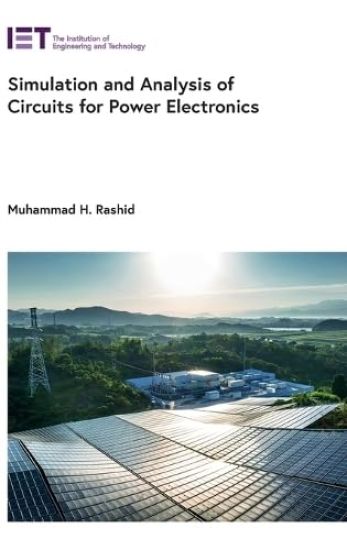
Power electronics play a vital role in many spheres, including integrating renewable energy, ensuring the reliability of complex power distribution systems, and in increasing efficiency of electric vehicles and industrial machines. Simulation of power electronic circuitry is thus a key and cost-effective means to detect and avoid problems during development of circuitry in power generation, distribution and use. This is true for both novel and established circuit designs. Simulation and Analysis of Circuits for Power Electronics gives particular consideration to power electronics consisting of piece-wise circuits, focusing especially on LTspice circuit simulation and performance analysis. The book integrates the free-version LTspice for drawing schematics and simulating to generate waveforms of the output voltage and currents, mathematical derivations of the circuits, and the Mathcad software tool for computation of the mathematical derivations to determine the performance parameters. Starting with fundamentals, chapters cover switched RLC circuits, diode rectifiers, DC-DC and DC-AC converters; thereafter, treatment focuses on resonant pulse inverters, rectifiers, AC voltage controllers, and protection of semiconductor devices. Readers become enabled to apply simulation to novel circuitry as part of their research activities. Each chapter follows a unified structure in presenting the circuit, modelling approach, numerical examples, and use of data and results. Presenting fundamentals and strategies for circuitry simulation for power electronics, this book offers structured information from principles through to applications, so is a useful guide for students, researchers and anyone wishing to refresh their knowledge of this field. It will also be useful for working engineers with some background in electric circuits and differential equations.
Electric Renewable Energy Systems

Electric Renewable Energy Systems

Muhammad H. Rashid

Academic Press Inc
2015
nidottu
This derivative volume stemming from content included in our seminal Power Electronics Handbook takes its chapters related to renewables and establishes them at the core of a new volume dedicated to the increasingly pivotal and as yet under-published intersection of Power Electronics and Alternative Energy. While this re-versioning provides a corollary revenue stream to better leverage our core handbook asset, it does more than simply re-package existing content. Each chapter will be significantly updated and expanded by more than 50%, and all new introductory and summary chapters will be added to contextualize and tie the volume together. Therefore, unlike traditional derivative volumes, we will be able to offer new and updated material to the market and include this largely original content in our ScienceDirect Energy collection. Due to the inherently multi-disciplinary nature of renewables, many engineers come from backgrounds in Physics, Materials, or Chemical Engineering, and therefore do not have experience working in-depth with electronics. As more and more alternative and distributed energy systems require grid hook-ups and on-site storage, a working knowledge of batteries, inverters and other power electronics components becomes requisite. Further, as renewables enjoy broadening commercial implementation, power electronics professionals are interested to learn of the challenges and strategies particular to applications in alternative energy. This book will bring each group up-to-speed with the primary issues of importance at this technological node. This content clarifies the juncture of two key coverage areas for our Energy portfolio: alternative sources and power systems. It serves to bridge the information in our power engineering and renewable energy lists, supporting the growing grid cluster in the former and adding key information on practical implementation to the latter.
SPICE and LTspice for Power Electronics and Electric Power
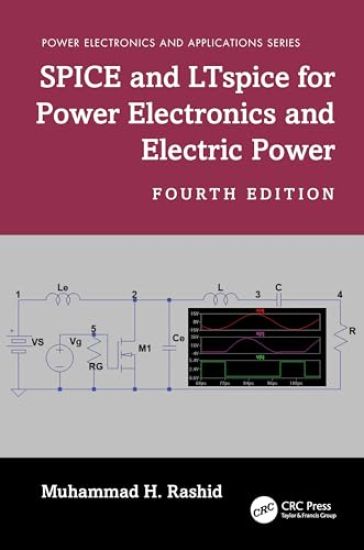
Power electronics can be a difficult course for students to understand and for professional professors to teach, simplifying the process for both. LTspice for power electronics and electrical power edition illustrates methods of integrating industry-standard LTspice software for design verification and as a theoretical laboratory bench.Helpful LTspice software and Program Files Available for DownloadBased on the author Muhammad H. Rashid’s considerable experience merging design content and SPICE into a power electronics course, this vastly improved and updated edition focuses on helping readers integrate the LTspice simulator with a minimum amount of time and effort. Giving users a better understanding of the operation of a power electronic circuit, the author explores the transient behavior of current and voltage waveforms for every circuit element at every stage. The book also includes examples of common types of power converters as well as circuits with linear and nonlinear inductors.New in this edition:Changes to run on OrCAD SPICE, or LTspice IV or higherStudents’ learning outcomes (SLOs) listed at the start of each chapterAbstracts of chaptersList the input side and output side performance parameters of the convertersThe characteristics of power semiconductors—diodes, BJTs, MOSFETs, and IGBTsGenerating PWM and sinusoidal PWM gating signalsEvaluating the power efficiency of convertersMonte Carlo analysis of convertersWorst-case analysis of convertersNonlinear transformer modelEvaluate user-defined electrical quantities (.MEASURE)This book demonstrates techniques for executing power conversion and ensuring the quality of output waveform rather than the accurate modeling of power semiconductor devices. This approach benefits students, enabling them to compare classroom results obtained with simple switch models of devices.
SPICE for Power Electronics and Electric Power
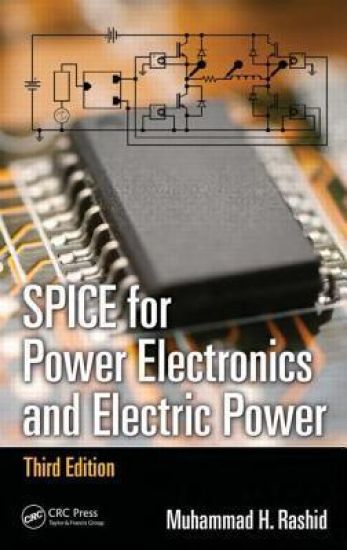
Power electronics can be a difficult course for students to understand and for professors to teach. Simplifying the process for both, SPICE for Power Electronics and Electric Power, Third Edition illustrates methods of integrating industry standard SPICE software for design verification and as a theoretical laboratory bench. Helpful PSpice Software and Program Files Available for DownloadBased on the author Muhammad H. Rashid’s considerable experience merging design content and SPICE into a power electronics course, this vastly improved and updated edition focuses on helping readers integrate the SPICE simulator with a minimum amount of time and effort. Giving users a better understanding of the operation of a power electronics circuit, the author explores the transient behavior of current and voltage waveforms for each and every circuit element at every stage. The book also includes examples of all types of power converters, as well as circuits with linear and nonlinear inductors. New in this edition:Student learning outcomes (SLOs) listed at the start of each chapterChanges to run on OrCAD version 9.2Added VPRINT1 and IPRINT1 commands and examplesNotes that identify important conceptsExamples illustrating EVALUE, GVALUE, ETABLE, GTABLE, ELAPLACE, GLAPLACE, EFREQ, and GFREQMathematical relations for expected outcomes, where appropriateThe Fourier series of the output voltages for rectifiers and invertersPSpice simulations of DC link inverters and AC voltage controllers with PWM controlThis book demonstrates techniques of executing power conversions and ensuring the quality of the output waveforms rather than the accurate modeling of power semiconductor devices. This approach benefits students, enabling them to compare classroom results obtained with simple switch models of devices. In addition, a new chapter covers multi-level converters. Assuming no prior knowledge of SPICE or PSpice simulation, the text provides detailed step-by-step instructions on how to draw a schematic of a circuit, execute simulations, and view or plot the output results. It also includes suggestions for laboratory experiments and design problems that can be used for student homework assignments.
SPICE for Power Electronics and Electric Power

SPICE for Power Electronics and Electric Power

Muhammad H. Rashid

CRC Press Inc
2012
sidottu
Power electronics can be a difficult course for students to understand and for professors to teach. Simplifying the process for both, SPICE for Power Electronics and Electric Power, Third Edition illustrates methods of integrating industry standard SPICE software for design verification and as a theoretical laboratory bench. Helpful PSpice Software and Program Files Available for DownloadBased on the author Muhammad H. Rashid’s considerable experience merging design content and SPICE into a power electronics course, this vastly improved and updated edition focuses on helping readers integrate the SPICE simulator with a minimum amount of time and effort. Giving users a better understanding of the operation of a power electronics circuit, the author explores the transient behavior of current and voltage waveforms for each and every circuit element at every stage. The book also includes examples of all types of power converters, as well as circuits with linear and nonlinear inductors. New in this edition:Student learning outcomes (SLOs) listed at the start of each chapterChanges to run on OrCAD version 9.2Added VPRINT1 and IPRINT1 commands and examplesNotes that identify important conceptsExamples illustrating EVALUE, GVALUE, ETABLE, GTABLE, ELAPLACE, GLAPLACE, EFREQ, and GFREQMathematical relations for expected outcomes, where appropriateThe Fourier series of the output voltages for rectifiers and invertersPSpice simulations of DC link inverters and AC voltage controllers with PWM controlThis book demonstrates techniques of executing power conversions and ensuring the quality of the output waveforms rather than the accurate modeling of power semiconductor devices. This approach benefits students, enabling them to compare classroom results obtained with simple switch models of devices. In addition, a new chapter covers multi-level converters. Assuming no prior knowledge of SPICE or PSpice simulation, the text provides detailed step-by-step instructions on how to draw a schematic of a circuit, execute simulations, and view or plot the output results. It also includes suggestions for laboratory experiments and design problems that can be used for student homework assignments.