Kirjojen hintavertailu. Mukana 12 390 323 kirjaa ja 12 kauppaa.
Kirjailija
Muhammad Shafique
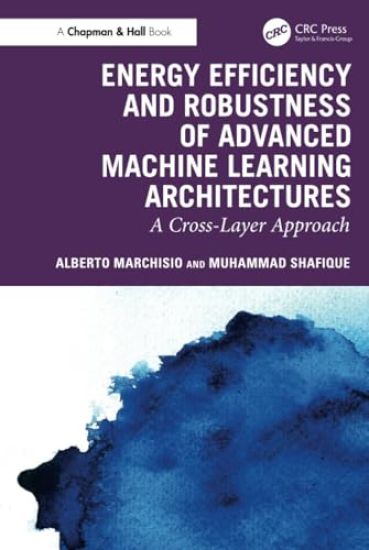
Kirjat ja teokset yhdessä paikassa: 14 kirjaa, julkaisuja vuosilta 2011-2026, suosituimpien joukossa Energy Efficiency and Robustness of Advanced Machine Learning Architectures. Vertaile teosten hintoja ja tarkista saatavuus suomalaisista kirjakaupoista.
Machine Learning (ML) algorithms have shown a high level of accuracy, and applications are widely used in many systems and platforms. However, developing efficient ML-based systems requires addressing three problems: energy-efficiency, robustness, and techniques that typically focus on optimizing for a single objective/have a limited set of goals. This book tackles these challenges by exploiting the unique features of advanced ML models and investigates cross-layer concepts and techniques to engage both hardware and software-level methods to build robust and energy-efficient architectures for these advanced ML networks. More specifically, this book improves the energy efficiency of complex models like CapsNets, through a specialized flow of hardware-level designs and software-level optimizations exploiting the application-driven knowledge of these systems and the error tolerance through approximations and quantization. This book also improves the robustness of ML models, in particular for SNNs executed on neuromorphic hardware, due to their inherent cost-effective features. This book integrates multiple optimization objectives into specialized frameworks for jointly optimizing the robustness and energy efficiency of these systems. This is an important resource for students and researchers of computer and electrical engineering who are interested in developing energy efficient and robust ML. The Open Access version of this book, available at http://www.taylorfrancis.com, has been made available under a Creative Commons Attribution-Non Commercial-No Derivatives (CC-BY-NC-ND) 4.0 license.
Machine Learning (ML) algorithms have shown a high level of accuracy, and applications are widely used in many systems and platforms. However, developing efficient ML-based systems requires addressing three problems: energy-efficiency, robustness, and techniques that typically focus on optimizing for a single objective/have a limited set of goals.This book tackles these challenges by exploiting the unique features of advanced ML models and investigates cross-layer concepts and techniques to engage both hardware and software-level methods to build robust and energy-efficient architectures for these advanced ML networks. More specifically, this book improves the energy efficiency of complex models like CapsNets, through a specialized flow of hardware-level designs and software-level optimizations exploiting the application-driven knowledge of these systems and the error tolerance through approximations and quantization. This book also improves the robustness of ML models, in particular for SNNs executed on neuromorphic hardware, due to their inherent cost-effective features. This book integrates multiple optimization objectives into specialized frameworks for jointly optimizing the robustness and energy efficiency of these systems.This is an important resource for students and researchers of computer and electrical engineering who are interested in developing energy efficient and robust ML.The Open Access version of this book, available at http://www.taylorfrancis.com, has been made available under a Creative Commons Attribution-Non Commercial-No Derivatives (CC-BY-NC-ND) 4.0 license.
This book focuses on two of the most relevant problems related to power management on multicore and manycore systems. Specifically, one part of the book focuses on maximizing/optimizing computational performance under power or thermal constraints, while another part focuses on minimizing energy consumption under performance (or real-time) constraints.
This book provides its readers with the means to implement energy-efficient video systems, by using different optimization approaches at multiple abstraction levels. The authors evaluate the complete video system with a motive to optimize its different software and hardware components in synergy, increase the throughput-per-watt, and address reliability issues. Subsequently, this book provides algorithmic and architectural enhancements, best practices and deployment models for new video systems, while considering new implementation paradigms of hardware accelerators, parallelism for heterogeneous multi- and many-core systems, and systems with long life-cycles. Particular emphasis is given to the current video encoding industry standard H.264/AVC, and one of the latest video encoders (High Efficiency Video Coding, HEVC).
This book focuses on two of the most relevant problems related to power management on multicore and manycore systems. Specifically, one part of the book focuses on maximizing/optimizing computational performance under power or thermal constraints, while another part focuses on minimizing energy consumption under performance (or real-time) constraints.
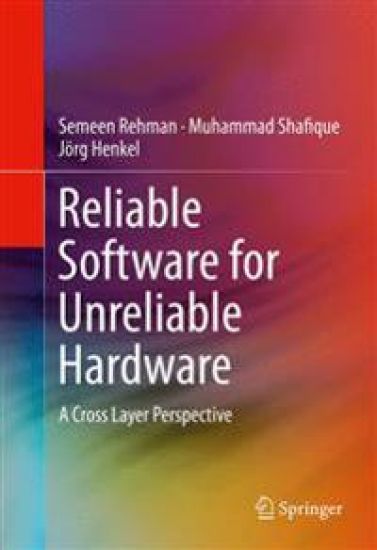
This book describes novel software concepts to increase reliability under user-defined constraints. The authors’ approach bridges, for the first time, the reliability gap between hardware and software. Readers will learn how to achieve increased soft error resilience on unreliable hardware, while exploiting the inherent error masking characteristics and error (stemming from soft errors, aging, and process variations) mitigations potential at different software layers.
This book provides its readers with the means to implement energy-efficient video systems, by using different optimization approaches at multiple abstraction levels. The authors evaluate the complete video system with a motive to optimize its different software and hardware components in synergy, increase the throughput-per-watt, and address reliability issues. Subsequently, this book provides algorithmic and architectural enhancements, best practices and deployment models for new video systems, while considering new implementation paradigms of hardware accelerators, parallelism for heterogeneous multi- and many-core systems, and systems with long life-cycles. Particular emphasis is given to the current video encoding industry standard H.264/AVC, and one of the latest video encoders (High Efficiency Video Coding, HEVC).
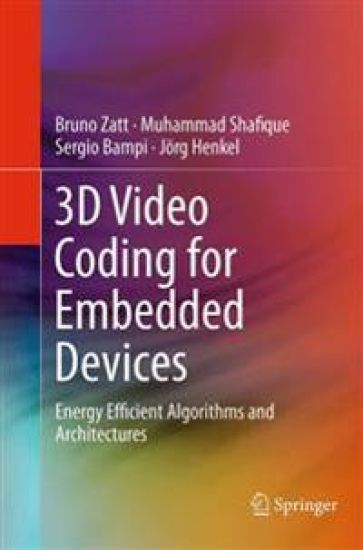
This book shows readers how to develop energy-efficient algorithms and hardware architectures to enable high-definition 3D video coding on resource-constrained embedded devices. Users of the Multiview Video Coding (MVC) standard face the challenge of exploiting its 3D video-specific coding tools for increasing compression efficiency at the cost of increasing computational complexity and, consequently, the energy consumption. This book enables readers to reduce the multiview video coding energy consumption through jointly considering the algorithmic and architectural levels. Coverage includes an introduction to 3D videos and an extensive discussion of the current state-of-the-art of 3D video coding, as well as energy-efficient algorithms for 3D video coding and energy-efficient hardware architecture for 3D video coding.
This book describes novel software concepts to increase reliability under user-defined constraints. The authors’ approach bridges, for the first time, the reliability gap between hardware and software. Readers will learn how to achieve increased soft error resilience on unreliable hardware, while exploiting the inherent error masking characteristics and error (stemming from soft errors, aging, and process variations) mitigations potential at different software layers.
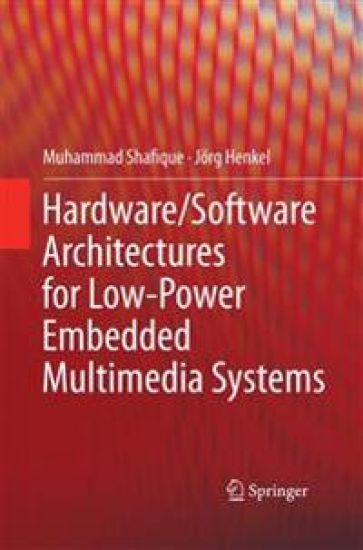
This book presents techniques for energy reduction in adaptive embedded multimedia systems, based on dynamically reconfigurable processors. The approach described will enable designers to meet performance/area constraints, while minimizing video quality degradation, under various, run-time scenarios. Emphasis is placed on implementing power/energy reduction at various abstraction levels. To enable this, novel techniques for adaptive energy management at both processor architecture and application architecture levels are presented, such that both hardware and software adapt together, minimizing overall energy consumption under unpredictable, design-/compile-time scenarios.
This book shows readers how to develop energy-efficient algorithms and hardware architectures to enable high-definition 3D video coding on resource-constrained embedded devices. Users of the Multiview Video Coding (MVC) standard face the challenge of exploiting its 3D video-specific coding tools for increasing compression efficiency at the cost of increasing computational complexity and, consequently, the energy consumption. This book enables readers to reduce the multiview video coding energy consumption through jointly considering the algorithmic and architectural levels. Coverage includes an introduction to 3D videos and an extensive discussion of the current state-of-the-art of 3D video coding, as well as energy-efficient algorithms for 3D video coding and energy-efficient hardware architecture for 3D video coding.
This book presents techniques for energy reduction in adaptive embedded multimedia systems, based on dynamically reconfigurable processors. The approach described will enable designers to meet performance/area constraints, while minimizing video quality degradation, under various, run-time scenarios. Emphasis is placed on implementing power/energy reduction at various abstraction levels. To enable this, novel techniques for adaptive energy management at both processor architecture and application architecture levels are presented, such that both hardware and software adapt together, minimizing overall energy consumption under unpredictable, design-/compile-time scenarios.