Kirjailija
Murray Bookchin
Kirjat ja teokset yhdessä paikassa: 21 kirjaa, julkaisuja vuosilta 1970-2025, suosituimpien joukossa From Urbanization to Cities: The Politics of Democratic Municipalism. Vertaile teosten hintoja ja tarkista saatavuus suomalaisista kirjakaupoista.
21 kirjaa
Kirjojen julkaisuhaarukka 1970-2025.
Visionary essays from a founder of the modern ecology movement.In this collection of essays, Murray Bookchin's vision for an ecological society remains central as he addresses questions of urbanism and city planning, technology, self-management, energy, utopianism, and more. Throughout, he opposes efforts to reduce ecology to a toothless "environmentalism," a task as vital today as when these essays were first published. Written between 1969 and 1979, the essays in this collection represent a fascinating and fertile period in Bookchin's life. Coming out of the unfulfilled promise of the sixties and trying to develop a revolutionary critique of social life that avoided the pitfalls of Marxism, he was entering his creative intellectual peak. He was laying the foundations of a truly social ecology: a society based on decentralization, interdependence, democratic self-management, mutual aid, and solidarity. Presented with clarity and fervor, these key works contain the kernels of concerns that would occupy him until his death in 2006. This edition also includes a new foreword by Dan Chodorkoff, someone who was with Bookchin at the founding of his Institute for Social Ecology and who understand his work better than anyone.
Breathing new life into revolutionary ideas.According to Murray Bookchin, a humane solution to the climate crisis will require replacing industrial capitalism with an egalitarian, ecological society; decentralized democratic communities; and sustainable technologies. Drawing on rich traditions of ecological science, anthropology, history, utopian philosophy, and ethics, Remaking Society offers a coherent framework for social and ecological reconstruction. This innovative work on nature and society provides readers with clear strategies for averting disaster.In their foreword to this new edition of Remaking Society, Marina Sitrin and Debbie Bookchin show that remaking is a continuing project: "If hierarchy has deeply wounded our relationships with each other and the natural world, capitalism has plunged a knife that much more deeply into the wound. Capitalism, Bookchin] believes, has distorted every aspect of political, social, and even personal life.... Our challenge then is to build movements everywhere that will preserve and expand our innate creativity and eradicate any tendencies toward hierarchy, status, or other forms of domination."
Six incisive essays from the father of social ecology.Murray Bookchin's frank assessment of the disaster we are heading toward at increasing speed is as much a work of ethics as it is of environmentalism. The six essays that comprise it share the view that, as he puts it, "our ideas and our practice must be imbued with a deep sense of ethical commitment." Whether he is critiquing the market economy, the state, or the idea--common to both capitalists and certain left materialists--that human beings are motivated solely by greed and self-interest, Bookchin ever reminds us of the ineffable values of freedom, self-consciousness, and social harmony.Though first published in 1986, Bookchin's framework still applies. The moral relativism of the 1980s--the politics of lesser-evils and risk vs benefit calculations--has morphed into what we now refer to as "both-sidesism" and the risk vs benefit calculations of yesterday are the 100,000 acre burn scars seen throughout the American west today. Beyond moral relativism or moral absolutism is an ecologically based ethics--one that sees our selfhood, reason, and freedom as stemming from nature's variety and resilience. Bookchin's social ecology refuses to separate society from nature. As such one can consider it a philosophy of participation--we cannot develop ecocommunities that aren't participatory. We can't save ourselves and the planet without an ethics of freedom. This edition, with a new introduction by Bookchin scholar Andy Price, is a breath of fresh air for a left that seems to have forgotten basic truths.
Originally published in 1962, Our Synthetic Environment explores the negative effects that chemicals and other toxins in the environment have on human health. From the degradation of our food and soil due to industrial agricultural methods, to how pollution and radiation are the causes of illnesses like cancer, this book was visionary in its anticipation of many of the ecological problems our planet currently faces. Written by one of the leading eco-thinkers of the twentieth century, Our Synthetic Environment is as vital a read today as it was when it was first published.This new edition of Our Synthetic Environment features an introduction by Bill McKibben.

What is nature? What is humanity's place in nature? And what is the relationship of society to the natural world? In an era of ecological breakdown, answering these questions has become of momentous importance for our everyday lives and for the future that we and other life-forms face. In the essays of The Philosophy of Social Ecology, Murray Bookchin confronts these questions headon: invoking the ideas of mutualism, self-organization, and unity indiversity, in the service of ever expanding freedom. Refreshingly polemical and deeply philosophical, they take issue with technocratic and mechanistic ways of understanding and relating to, and within, nature. More importantly, they develop a solid, historically and politically based ethical foundation for social ecology, the field that Bookchin himself created and that offers us hope in the midst of our climate catastrophe.

From Urbanization to Cities: The Politics of Democratic Municipalism
Murray Bookchin
AK PRESS
2022
nidottu
From Urbanization to Cities is a sweeping history of the city, not as a destination for capitalist exchange and individual gratification but as a locus for directly democratic politics. Just as ecosystems rely on participation and mutualism, so must cities--and their citizens--rediscover these qualities, establishing harmonious and ethical social relations. Democratic municipalism is an emancipatory philosophy of self-determination, where politics becomes an everyday act in which ordinary people and local communities take the power of decision making into their own hands. From the Paris Commune to the Kurdish-led revolution in northeast Syria, democratic municipalism is a tool for wresting power from the nation-state, allowing capitalist urbanization to give way to humanly scaled, ecological, and egalitarian societies.
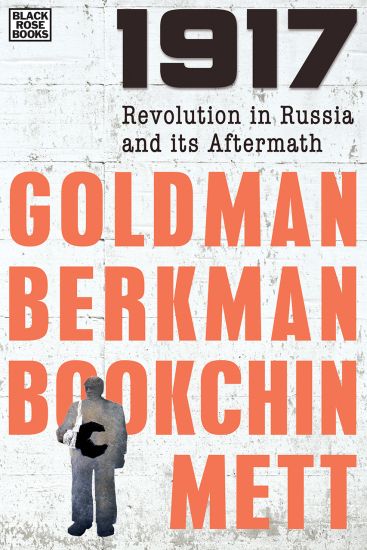
1917 – Revolution in Russia and its Aftermath
Emma Goldman; Alexander Berkman; Murray Bookchin; Ida Mett
Black Rose Books
2018
sidottu
Upon their scandalous deportation from the United States in 1919, famous anarchist writers and activists Emma Goldman and Alexander Berkman were greeted like heroes by the new Bolshevik government in Russia. Berkman described it as "the most sublime day of my life." And yet he would flee the country after only two years. Belarus-born Ida Mett, who went through a similar experience at the time, also wrote a harrowing account of the Red Army's brutal massacre at the Kronstadt Uprising before she too went into exile. How did each of these figures become so deeply disillusioned with Russia so quickly? And why, within a few years, did they all leave the country forever? 1917 offers a unique alternative perspective on the early years of the Russian Revolution through the narrative perspective of these three eyewitnesses. Featuring an introduction by Murray Bookchin, this book emphasizes the rarely discussed anarchist hopes for a democratic October revolution, while also critiquing the increasingly authoritarian responses of Bolshevik leaders at the time. Published for the centennial of the Russian revolutions, 1917 contains four essays by Emma Goldman, Alexander Berkman, Ida Mett, and Bookchin, as well as a poem by Dan Georgakas, that analyze, assess, celebrate, and bemoan both the wild successes and the bitter failures of the revolution.


From Athens to New York, recent mass movements around the world have challenged austerity and authoritarianism with expressions of real democracy. For more than forty years, Murray Bookchin developed these democratic aspirations into a new left politics based on popular assemblies, influencing a wide range of political thinkers and social movements.With a foreword by the best-selling author of The Dispossessed, Ursula K. Le Guin, The Next Revolution brings together Bookchin's essays on freedom and direct democracy for the first time, offering a bold political vision that can move us from protest to social transformation. A pioneering voice in the ecology and anarchist movements, he is the author of The Ecology of Freedom and Post-Scarcity Anarchism among many other books.
"The very notion of the domination of nature by man stems from the very real domination of human by human." With this succinct formulation, Murray Bookchin launches his most ambitious work, The Ecology of Freedom. An engaging and extremely readable book of breathtaking scope, its inspired synthesis of ecology, anthropology and political theory traces our conflicting legacies of hierarchy and freedom from the first emergence of human culture to today's globalized capitalism, constantly pointing the way to a sane, sustainable ecological future.Murray Bookchin, cofounder of the Institute for Social Ecology, has been an active voice in the ecology and anarchist movements for more than 40 years. The author of numerous books and articles, he lives in Burlington, Vermont.In Oakland, California on March 24, 2015 a fire destroyed the AK Press warehouse along with several other businesses. Please consider visiting the AK Press website to learn more about the fundraiser to help them and their neighbors.
In this series of essays, Murray Bookchin balances his ecological and anarchist vision with the promising opportunities of a "post-scarcity" era. Technological advances during the 20th century have expanded production in the pursuit of corporate profit at the expense of human need and ecological sustainability. New possibilities for human freedom must combine an ecological outlook with the dissolution of hierarchical social relations, capitalism and canonical political orientation. Bookchin's utopian vision, rooted in the realities of contemporary society, remains refreshingly pragmatic. "Book-chin makes a trenchant analysis of modern society and offers a pointed, provocative discussion of the ecological crisis."-"Library JournalMurray Bookchin has been an active voice in the ecology and anarchist movements for more than 40 years.

Murray Bookchin has been a dynamic revolutionary propagandist since the 1930s when, as a teenager, he orated before socialist crowds in New York City and engaged in support work for those fighting Franco in the Spanish Civil War.Now, for the first time in book form, this volume presents a series of exciting and engaged interviews with, and essays from, the founder of social ecology.This expansive collection ranges over, amongst others, Bookchin's account of his teenage years as a young Communist during the Great Depression, his experiences of the 1960s and reflections on that decade's lessons, his vision of a libertarian communist society, libertarian politics, the future of anarchism, and the unity of theory and practice. He goes on to assess the crisis of radicalism today and defends the need for a revolutionary Left. Finally, he states what is to be valued in both anarchism and Marxism in building such a Left and offers guidelines for forming a new revolutionary social movement.


A useful corrective to simplistic thinking about the human predicament.--"Canadian Book Review Annual" "Bookchin expands upon the concept of natural evolution and delivers it from the trap of mechanistic thinking."--"Imprint"