Kirjojen hintavertailu. Mukana 12 390 323 kirjaa ja 12 kauppaa.

Kirjailija

Myron W Evans

Kirjat ja teokset yhdessä paikassa: 8 kirjaa, julkaisuja vuosilta 1993-2016, suosituimpien joukossa Phase In Optics. Vertaile teosten hintoja ja tarkista saatavuus suomalaisista kirjakaupoista.

Mukana myös kirjoitusasut: Myron W. Evans

8 kirjaa

Kirjojen julkaisuhaarukka 1993-2016.

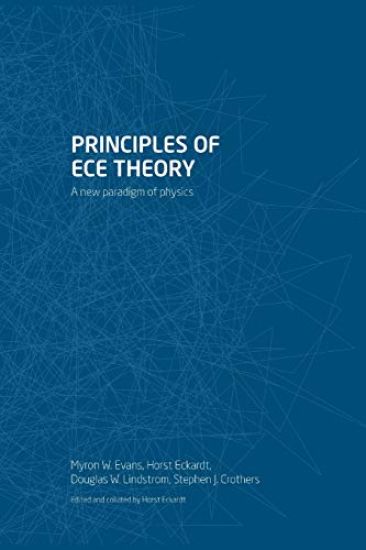
Principles of ECE Theory

Principles of ECE Theory

Myron W. Evans

New Generation Publishing
2016
pokkari
This monograph consists of nine chapters which develop the well known Einstein Cartan Evans (ECE and ECE2) unified field theory which has swept the world of science in step with the knowledge revolution. It systematically develops the ECE theory from geometrical first principles and applies it to the unification of gravitation and electrodynamics and the unification of quantum mechanics and general relativity in nine chapters as follows. 1) "Basics of Cartan Geometry"; 2) "Electrodynamics and Gravitation; 3) "ECE Theory and Beltrami Fields"; 4) "Photon Mass and the B(3) field"; 5) "Unification of Quantum Mechanics and Gravitation"; 6) "Antisymmetry"; 7) "Energy from Spacetime and Low Energy Nuclear Reactions"; 8) "ECE Cosmology "; 9) "Relativistic Cosmology and Einstein's Gravitational Waves". The monograph has been translated into Spanish by Alex Hill (Spanish language section of www.aias.us. It has already been read tens of thousands of times off www.aias.us and www.upitec.org. Both sites are archived permanently on www.archive.org and www.webarchive.org.ukAbout the Authors Myron Evans ("Marquis Who's Who" over thirty editions online) is a Civil List Pensioner and author of about two thousand publications and broadcasts. He is perhaps best known for the Einstein Cartan Evans (ECE and ECE2) unified field theory, which has been studied open source tens of millions of times. Horst Eckardt (Marquis world edition online) is a well known author and co author of many of the ECE and ECE2 papers on www.aias.us and www.upitec.org. He is primarily interested in sources of new energy and is also a theoretical physicist and chemist. He is a leading scholar of ECE physics. Douglas Lindstrom (Marquis world edition online) is primarily interested in new forms of energy and worked in government facilities in Canada developing new materials. He is a well known author of several of the ECE papers, and is a leading ECE scholar. Stephen Crothers is probably the leading scholar of conventional Einsteinian general relativity and is a well known author and lecturer. He is an internationally renowned and definitive critic of the methods used to solve the conventional Einstein field equation.
Classical And Quantum Electrodynamics And The B(3) Field

Classical And Quantum Electrodynamics And The B(3) Field

Lawrence Barr Crowell; Myron W Evans

World Scientific Publishing Co Pte Ltd
2001
sidottu
It is well known that classical electrodynamics is riddled with internal inconsistencies springing from the fact that it is a linear, Abelian theory in which the potentials are unphysical. This volume offers a self-consistent hypothesis which removes some of these problems, as well as builds a framework on which linear and nonlinear optics are treated as a non-Abelian gauge field theory based on the emergence of the fundamental magnetizing field of radiation, the B(3) field.
Dielectric Relaxation And Dynamics Of Polar Molecules

Dielectric Relaxation And Dynamics Of Polar Molecules

Myron W Evans; Vladimir I Gaiduk

World Scientific Publishing Co Pte Ltd
1999
sidottu
The topics covered in this book provide a qualitative and sometimes quantitative classic description of the wide-band 0-THz dielectric spectra of polar liquids, molecular libration-rotation (which is the reason for dielectric loss and absorption of electromagnetic waves), simple molecular models differing by the intermolecular-potential profiles, and present a comparison between the theoretical and experimental dependencies and derivation of the main results. A new feature is the application of a number of analytical models to different substances, including strongly absorbing nonassociating liquids, liquid water, water bound by macromolecules, and gas-like liquids. The presentation of the theory in this book is also new. It is based on the dynamic method in which the Brownian reorientations are considered implicitly, without direct solution of stochastic equations. This approach simplifies the theory. Senior students and experimentalists will find many of the results valuable.
Phase In Optics

Phase In Optics

Myron W Evans; Antonin Luks; Jan Perina; Vlasta Perinova

World Scientific Publishing Co Pte Ltd
1998
sidottu
This book is devoted to the classical and quantum phases in wave and particle optics from the viewpoint of both theory and applications. Wave and beam light optics are reviewed in considerable detail, featuring optical imaging and holography in linear optics and phase conjugation methods in nonlinear optics. Photon optics is embodied here as quantum optics with the modes treated as quantum harmonic oscillators. The importance of the Wigner function for the phase space description in the context of canonical quantization is respected and the method of quasidistributions related to operator orderings in the second-quantized theory is exposed. The history of the quantum phase problem, characterized by renewed interest in the solution to the problem, is included and brought up to date. Approaches based on exponential phase operators, discrete phase states, the enlargement of the Hilbert space of the harmonic oscillator leading to the phase representations and distributions, together with solutions motivated by the quasidistributions, are introduced. The operational approach to the quantum phase is contrasted with the previous formalisms. The results of the study of the coherent states and the ordinary squeezed states from the viewpoint of the quantum phase and those of the analysis of the quantum statistics of phase-related special states of the light field are provided. The quantum phase is also treated with respect to quantum interferometry, particle interferometry, nonlinear optical processes, and quantum nondemolition measurements.The book will prove indispensable to research workers in general optics, quantum optics and electronics, optoelectronics, and nonlinear optics, as well as to students of physics, optics, optoelectronics, photonics, and optical engineering.
Computational Methods In Quantum Chemistry, Volume 2: Quantum Chemistry

Computational Methods In Quantum Chemistry, Volume 2: Quantum Chemistry

Myron W Evans; Ahmed Hasanein

World Scientific Publishing Co Pte Ltd
1996
sidottu
This book provides a comprehensive account, from first principles, of the methods of numerical quantum mechanics, beginning with formulations and fundamental postulates. The development continues with that of the Hamiltonian and angular momentum operators, and with methods of approximating the solutions of the Schroedinger equation with variational and perturbation methods.Chapter 3 is a description of the Hartree-Fock self-consistent field method, which is developed systematically for atoms. The Born-Oppenheimer approximation is introduced, and the numerical methods presented one by one thereafter in a logically consistent way that should be accessible to undergraduates. These include LCAO, Hartree-Fock-SCF method for molecules, Roothaan LCAO-MO-SCF method, and electron correlation energy.Chapter 4 is devoted to the more sophisticated computational methods in quantum chemistry, with an introduction to topics that include: the zero differential overlap approximation; Huckel MO theory of conjugated molecules; Pariser-Parr-Pople MO method; extended Huckel theory; neglect of differential overlap methods; invariance in space requirements; CNDO; INDO; NDDO; MINDO; MNDO; AM1; MNDO-PM3; SAM1; SINDO1; CNDO/S; PCILO,Xa; and ab initio methods.This is followed by an introduction to Moller-Plesset perturbation theory of many electrons, and coupled perturbed Hartree Fock theory, with a description of the coupled cluster method. Finally Chapter 5 applies these methods to problems of contemporary interest.The book is designed to be a junior/senior level text in computational quantum mechanics, suitable for undergraduates and graduates in chemistry, physics, computer science, and associated disciplines.
Photomagneton And Quantum Field Theory, The - Volume 1 Of Quantum Chemistry

Photomagneton And Quantum Field Theory, The - Volume 1 Of Quantum Chemistry

Myron W Evans; Ahmed Hasanein

World Scientific Publishing Co Pte Ltd
1994
sidottu
This first volume of this two-volume set deals with the important recent discovery of the photomagneton of electromagnetic radiation, a discovery which is fundamental in quantum field theory and in quantum mechanics in matter. The photomagneton is the elementary quantum of magnetic flux density carried by the individual photon in free space, and is generated directly by the intrinsic angular momentum of the free photon. The volume develops the theory of the photomagneton in a series of papers, which cover all the major aspects of the theory, from classical electrodynamics to the relativistic quantum field. Several suggestions are given for experimental tests, and the available experimental evidence is discussed in detail. The overall conclusion of the series of papers is that the photomagneton, which is observable experimentally in magneto-optical phenomena, indicates the presence in free space of a novel, longitudinal, magnetic flux density, linked ineluctably to the usual transverse components. If the photomagneton is not observed, then a paradox would have emerged at the most fundamental electrodynamical level, necessitating a modification of the Maxwell equations themselves.
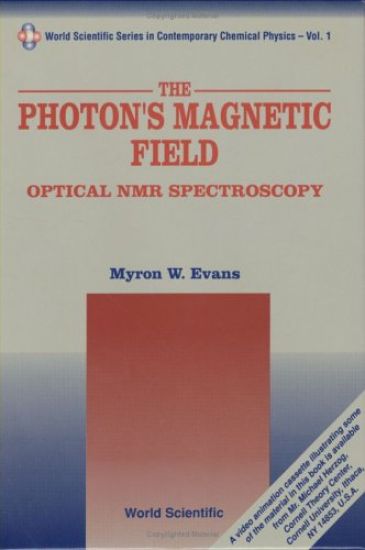
Photon's Magnetic Field, The: Optical Nmr Spectroscopy

Photon's Magnetic Field, The: Optical Nmr Spectroscopy

Myron W Evans

World Scientific Publishing Co Pte Ltd
1993
sidottu
This book is a collection of papers on a fundamentally new concept in physics — the photon's magnetic field, Bp. It discusses various applications of Bp to predict the existence of new magneto-optic phenomena and to reinterpret some of the fundamentals of optics in terms of Bp of the photon. One of these new phenomena, optical NMR spectroscopy, has already been verified experimentally, leading to a new analytical technique of widespread potential utility.