Kirjojen hintavertailu. Mukana 12 595 353 kirjaa ja 12 kauppaa.

Kirjailija

Naomi Cahn

Kirjat ja teokset yhdessä paikassa: 14 kirjaa, julkaisuja vuosilta 1997-2027, suosituimpien joukossa Aging While Female. Vertaile teosten hintoja ja tarkista saatavuus suomalaisista kirjakaupoista.

14 kirjaa

Kirjojen julkaisuhaarukka 1997-2027.

Aging While Female

Aging While Female

Naomi Cahn; Nina A. Kohn

OXFORD UNIVERSITY PRESS INC
2027
sidottu
An illuminating exploration of how the law shapes the experience of aging—and why it matters most for women. What does it mean to grow older as a woman in the United States? Why does the answer differ so sharply for men? And what does the law have to do with it? Aging While Female exposes the powerful ways the law influences women's lives as they age, affecting everything from longevity and health to financial security and where, how, and with whom they spend their final years. Just as compellingly, it exposes how the law contributes to a vast gap between the experiences of older women and older men, leaving women poorer, more burdened with care duties, and with narrower life choices. In Aging While Female, Naomi Cahn and Nina A. Kohn reveal a striking paradox: American law protects older women from gender inequality while simultaneously creating and reinforcing it. To uncover this hidden dynamic, Cahn and Kohn explore seven key roles older women play in American society and examine the legal structures tied to each. Weaving together rigorous research with vivid first-person narratives, they show that gender differences in aging are not simply "the way things are" or the result of personal choices, they are shaped by incentives and structures embedded in our laws. Cahn and Kohn argue that these outcomes are not inevitable. They offer concrete, actionable reforms to ensure that aging—especially aging while female—can be a more just, equitable, and fulfilling experience for all Americans.
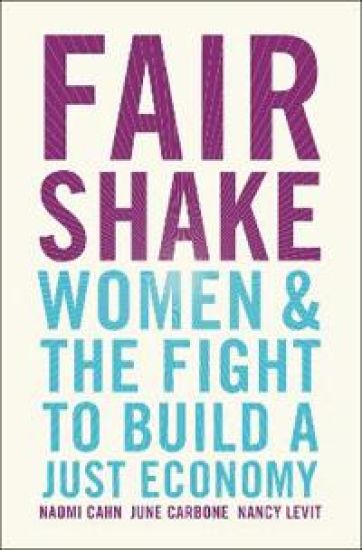
Fair Shake

Fair Shake

Naomi Cahn; June Carbone; Nancy Levit

SIMON SCHUSTER
2025
pokkari
A stirring, comprehensive look at the state of women in the workforce—why women’s progress has stalled, how our economy fosters unproductive competition, and how we can fix the system that holds women back.In an era of supposed equality, women are falling behind in the workplace faster than before, a trend exacerbated by Covid-19. Even with more women in the workforce than in decades past, wage gaps continue to increase. It is the most educated women who have fallen the furthest from behind. Blue-collar women hold the most insecure and badly paid jobs in our economy. And even as we celebrate high-profile representation—women on the board of Fortune 500 companies and our first female vice president—women have limited recourse when they experience harassment and discrimination. Fair Shake: Women and the Fight to Build a Just Economy explains that the system that governs our economy—a winner-take-all economy—is the root cause of these myriad problems. The WTA self-selects aggressive, cutthroat business tactics, which creates a feedback loop that sidelines women. The authors, three legal scholars, call this feedback loop “the triple bind”: if women don’t compete on the same terms as men, they lose; if women do compete on the same terms as men, they’re punished more harshly for their sharp elbows or actual misdeeds; and when women see that they can’t win on the same terms as men, they take themselves out of the game (as if they haven’t been pushed out already). With odds like these stacked against them, it’s no wonder women feel like, no matter how hard they work, they can’t get ahead. Drawing on rich storytelling often found in legal documents, Fair Shake makes a compelling case for why existing laws fail to protect women. It not only diagnoses the problem of what’s wrong with the modern economy, but shows how, with awareness and collective action, we can build a truly just economy for all.
Hot Flash

Hot Flash

Bridget J. Crawford; Naomi Cahn; Emily Gold Waldman

STANFORD UNIVERSITY PRESS
2024
sidottu
More than half the population will experience menopause; it is time for the law to acknowledge it. Menopause is a stage of life that half the population will inevitably experience. But it remains one of the last great taboo topics for discussion, even among close friends and family members. Silence and stigmas around many aspects of reproductive health—from menstruation to infertility to miscarriage to abortion—have historically created the conditions in which bias and discrimination can flourish. Menopause exemplifies that phenomenon, and in Hot Flash, authors Emily Gold Waldman, Bridget Crawford, and Naomi Cahn set out to replace the silence surrounding menopause with a deeper understanding. Hot Flash explores the culturally specific stereotypes that surround menopause as well as how menopause is treated in law and medicine. The book contextualizes menopause as one of several stages in a person's reproductive life. Taking U.S. law regarding pregnancy and breastfeeding as an entry point, the authors suggest changes in existing legislation and workplace policies that would incorporate menopause as well. More broadly, they push us to imagine how law can support a more equitable future. A broader framework further enables the authors to explore menopause discrimination as it is experienced by trans men and gender nonbinary people. They ultimately make the case for a new wave of intersectional feminism that encompasses gender, disability, age, and race.
Fair Shake

Fair Shake

Naomi Cahn; June Carbone; Nancy Levit

SIMON SCHUSTER
2024
sidottu
A stirring, comprehensive look at the state of women in the workforce—why women’s progress has stalled, how our economy fosters unproductive competition, and how we can fix the system that holds women back. In an era of supposed great equality, women are still falling behind in the workplace. Even with more women in the workforce than in decades past, wage gaps continue to increase. It is the most educated women who have fallen the furthest behind. Blue-collar women hold the most insecure and badly paid jobs in our economy. And even as we celebrate high-profile representation—women on the board of Fortune 500 companies and our first female vice president—women have limited recourse when they experience harassment and discrimination.Fair Shake: Women and the Fight to Build a Just Economy explains that the system that governs our economy—a winner-take-all economy—is the root cause of these myriad problems. The WTA economy self-selects for aggressive, cutthroat business tactics, which creates a feedback loop that sidelines women. The authors, three legal scholars, call this feedback loop “the triple bind”: if women don’t compete on the same terms as men, they lose; if women do compete on the same terms as men, they’re punished more harshly for their sharp elbows or actual misdeeds; and when women see that they can’t win on the same terms as men, they take themselves out of the game (if they haven’t been pushed out already). With odds like these stacked against them, it’s no wonder women feel like, no matter how hard they work, they can’t get ahead.Fair Shake is not a “fix the woman” book; it’s a “fix the system” book. It not only diagnoses the problem of what's wrong with the modern economy, but shows how, with awareness and collective action, we can build a truly just economy for all.
Fair Shake: Women and the Fight to Build a Just Economy

Fair Shake: Women and the Fight to Build a Just Economy

June Carbone; Naomi Cahn; Nancy Levit

Simon Schuster Audio
2024
cd
A stirring, comprehensive look at the state of women in the workforce--why women's progress has stalled, how our economy fosters unproductive competition, and how we can fix the system that holds women back.In the #MeToo era, when gender equality is at the forefront of the conversation, women are still falling behind in the workplace faster than ever before; this was true before COVID, and even more true after. Fair Shake explains that the system that governs our economy--a winner-takes-all economy--is the cause. The WTA economy self-selects for aggressive, cutthroat business tactics, which creates a feedback loop that sidelines women. The book explores what legal scholars determine the "triple bind" including: -If women don't compete on the same terms as men, they lose. -If women do compete on the same terms as men, they lose. -When women see that they can't win on the same terms as men, they take themselves out of the game (if they haven't been pushed out already). Fair Shake offers a timely, practical view of women in the workforce today--what holds them back and what stops them from entering at all. Using legal cases throughout, Naomi Cahn offers rich, detailed storytelling to demonstrate how our laws fail to protect women. This book is the much-needed wake-up call to make the lasting changes required for gender equality in the workplace.
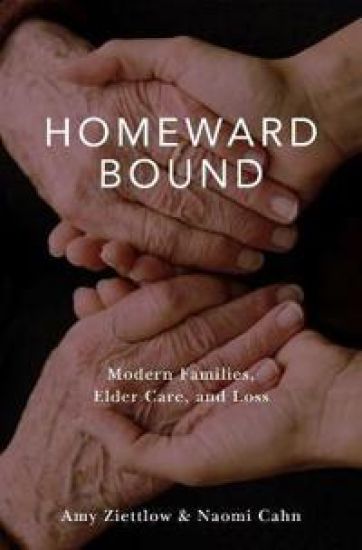
Homeward Bound

Homeward Bound

Amy Ziettlow; Naomi Cahn

Oxford University Press Inc
2017
sidottu
Homeward Bound shows that as family structure becomes more complex, so too does elder care, and existing institutions and legal approaches are not prepared to handle those complexities. As 79 million American Baby Boomers approach old age, their diverse family structures mean the burden of care will fall on a different cast of family members than in the past. Our current approaches are based on an outdated caregiving model that presumes life-long connection between the parents and offspring, with the existence of high internal norm cohesion among family members providing a valuable safety net for caregiving. Single parent and remarried parent-led families are far more complicated, fragile, and point to the need for increased formal support from the religious, medical, legal, and public policy communities. We base our analysis on in-depth, qualitative interviews with surviving grown children and stepchildren whose mother, father, stepparent, or ex-stepparent died. Their stories illustrate the profound ways that the caregiving, mourning, and inheritance process has changed in ways not adequately reflected in formal legal, medical, and religious tools. The solutions center on awareness and preparation: providing more support for individual planning for incapacity and death and, even more importantly, creating legal, political, and social planning for the "graying of America" at a time of increasingly complex familial ties.
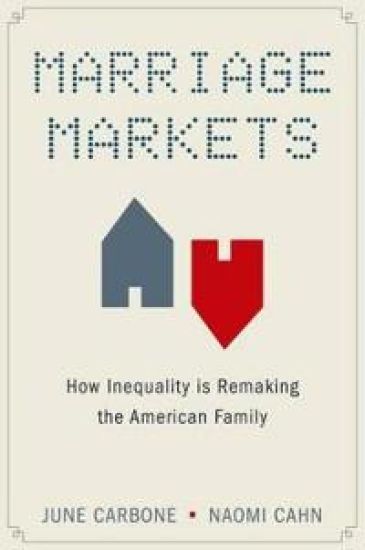
Marriage Markets

Marriage Markets

June Carbone; Naomi Cahn

Oxford University Press Inc
2015
nidottu
There was a time when the phrase "American family" conjured up a single, specific image: a breadwinner dad, a homemaker mom, and their 2.5 kids living comfortable lives in a middle-class suburb. Today, that image has been shattered, due in part to skyrocketing divorce rates, single parenthood, and increased out-of-wedlock births. But whether it is conservatives bewailing the wages of moral decline and women's liberation, or progressives celebrating the result of women's greater freedom and changing sexual mores, most Americans fail to identify the root factor driving the changes: economic inequality that is remaking the American family along class lines. In Marriage Markets, June Carbone and Naomi Cahn examine how macroeconomic forces are transforming our most intimate and important spheres, and how working class and lower income families have paid the highest price. Just like health, education, and seemingly every other advantage in life, a stable two-parent home has become a luxury that only the well-off can afford. The best educated and most prosperous have the most stable families, while working class families have seen the greatest increase in relationship instability. Why is this so? The book provides the answer: greater economic inequality has profoundly changed marriage markets, the way men and women match up when they search for a life partner. It has produced a larger group of high-income men than women; written off the men at the bottom because of chronic unemployment, incarceration, and substance abuse; and left a larger group of women with a smaller group of comparable men in the middle. The failure to see marriage as a market affected by supply and demand has obscured any meaningful analysis of the way that societal changes influence culture. Only policies that redress the balance between men and women through greater access to education, stable employment, and opportunities for social mobility can produce a culture that encourages commitment and investment in family life. A rigorous and enlightening account of why American families have changed so much in recent decades, Marriage Markets cuts through the ideological and moralistic rhetoric that drives our current debate. It offers critically needed solutions for a problem that will haunt America for generations to come.
Marriage Markets

Marriage Markets

June Carbone; Naomi Cahn

Oxford University Press Inc
2014
sidottu
Over the past four decades, the American family has undergone a radical transformation. Skyrocketing rates of divorce, single parenthood, and couples with children out of wedlock have all worked to undermine an idealized family model that took root in the 1950s and has served as a beacon for traditionalists ever since. But what are the causes of this change? Conservatives blame it on moral decline and women's liberation. Progressives often attribute it to women's greater freedom and changing sexual mores, but they typically paint these trends in a positive light. In Family Classes, Naomi Cahn and June Carbone contend that these views miss the forest for the trees. Armed with authoritative evidence, they show that the changing structure of our economy is the root cause of the transformation, and that working class and poorer families have paid the highest price. Increasing inequality and instability in the labor market over the past three decades has had a disproportionately negative impact on family stability and marriage rates among working-class and lower-income Americans. In particular, the decline of stable blue collar jobs for men has upended the labor market in the lower deciles of the income chart. Conversely, educated middle class Americans now have the highest rates of both marriage and marital stability despite the fact that they are relatively unlikely to espouse 'traditional values.' In fact, their family stability rate appears to be increasing. That is important because the children of stable two-parent families really do have a leg up in life. They draw from truly fascinating sociological data to drive home their point that economic factors weigh heaviest. For instance, when eligible (i.e., desirable and marriageable) men outnumber eligible women, the marriage and marital stability rates are significantly higher than when the reverse situation occurs - the exact situation we have in America today. Among the educated middle classes, eligible men outnumber eligible women in the area that truly matters--high incomes--and people in that strata therefore have far more stable family lives than working class and poorer Americans. In these latter sectors, men have lost economic ground vis-à-vis women, and family lives have become increasingly unstable in the last two decades. Interestingly, religion and moral values are insignificant factors in generating this difference in comparison to class. To make families stronger, then, we need to increase the level of economic stability in the bottom half of the population. The authors close with a series of policy proposals to address the family-related problems that flow from economic instability. A rigorous and enlightening account of why American families have changed so much since the 1960s, Family Classes cuts through the ideological and moralistic rhetoric that drives our current debate.
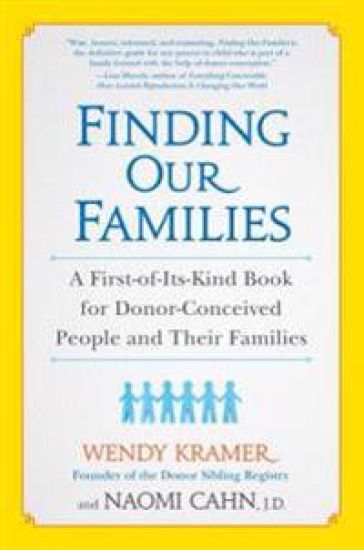
Finding Our Families

Finding Our Families

Wendy Kramer; Naomi Cahn

Avery Publishing Group Inc.,U.S.
2013
pokkari
The first comprehensive book that offers invaluable step-by-step advice for families with donor-conceived children. Wendy Kramer, founder and director of the Donor Sibling Registry, and Naomi Cahn, family and reproductive law professor, have compiled a comprehensive and thorough guide for the growing community of families with donor-conceived children. Kramer and Cahn believe that all donor-conceived children's desire to know their genetic family must be honored, and in Finding Our Families, they offer advice on how to foster healthy relationships within immediate families and their larger donor family networks based on openness and acceptance. With honesty and compassion, the authors offer thoughtful strategies and inspirational stories to help parents answer their own, and their children's, questions and concerns that will surely arise, including: How to support your children's curiosity and desire to know about their ancestry and genetic and medical background.How to help children integrate their birth story into a healthy self-image.How to help your children search for their donor or half siblings if and when they express interest in doing so.Finding Our Families opens up the lives of donor-conceived people who may be coping with uncertainty, thriving despite it, and finding novel ways to connect in this uncharted territory as they navigate the challenges and rewards of the world of donor conception.
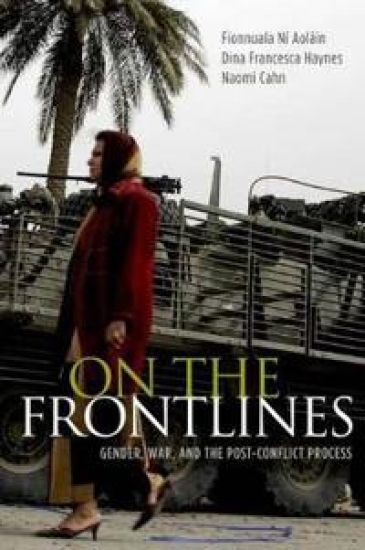
On the Frontlines

On the Frontlines

Fionnuala Ní Aoláin; Dina Francesca Haynes; Naomi Cahn

Oxford University Press Inc
2011
nidottu
Gender oppression has been a feature of war and conflict throughout human history, yet until fairly recently, little attention was devoted to addressing the consequences of violence and discrimination experienced by women in post-conflict states. Thankfully, that is changing. Today, in a variety of post-conflict settings--the former Yugoslavia, Afghanistan, Colombia, Northern Ireland --international advocates for women's rights have focused bringing issues of sexual violence, discrimination and exclusion into peace-making processes. In On the Frontlines, Fionnuala Ní Aoláin, Dina Francesca Haynes, and Naomi Cahn consider such policies in a range of cases and assess the extent to which they have had success in improving women's lives. They argue that there has been too little success, and that this is in part a product of a focus on schematic policies like straightforward political incorporation rather than a broader and deeper attempt to alter the cultures and societies that are at the root of much of the violence and exclusions experienced by women. They contend that this broader approach would not just benefit women, however. Gender mainstreaming and increased gender equality has a direct correlation with state stability and functions to preclude further conflict. If we are to have any success in stabilizing failing states, gender needs to move to fore of our efforts. With this in mind, they examine the efforts of transnational organizations, states and civil society in multiple jurisdictions to place gender at the forefront of all post-conflict processes. They offer concrete analysis and practical solutions to ensuring gender centrality in all aspects of peace making and peace enforcement.
On the Frontlines

On the Frontlines

Fionnuala Ní Aoláin; Dina Francesca Haynes; Naomi Cahn

Oxford University Press Inc
2011
sidottu
Gender oppression has been a feature of war and conflict throughout human history, yet until fairly recently, little attention was devoted to addressing the consequences of violence and discrimination experienced by women in post-conflict states. Thankfully, that is changing. Today, in a variety of post-conflict settings--the former Yugoslavia, Afghanistan, Colombia, Northern Ireland --international advocates for women's rights have focused bringing issues of sexual violence, discrimination and exclusion into peace-making processes. In On the Frontlines, Fionnuala Ní Aoláin, Dina Francesca Haynes, and Naomi Cahn consider such policies in a range of cases and assess the extent to which they have had success in improving women's lives. They argue that there has been too little success, and that this is in part a product of a focus on schematic policies like straightforward political incorporation rather than a broader and deeper attempt to alter the cultures and societies that are at the root of much of the violence and exclusions experienced by women. They contend that this broader approach would not just benefit women, however. Gender mainstreaming and increased gender equality has a direct correlation with state stability and functions to preclude further conflict. If we are to have any success in stabilizing failing states, gender needs to move to fore of our efforts. With this in mind, they examine the efforts of transnational organizations, states and civil society in multiple jurisdictions to place gender at the forefront of all post-conflict processes. They offer concrete analysis and practical solutions to ensuring gender centrality in all aspects of peace making and peace enforcement.
Red Families v. Blue Families

Red Families v. Blue Families

Naomi Cahn; June Carbone

Oxford University Press Inc
2011
nidottu
Red Families v. Blue Families identifies a new family model geared for the post-industrial economy. Rooted in the urban middle class, the coasts and the "blue states" in the last three presidential elections, the Blue Family Paradigm emphasizes the importance of women's as well as men's workforce participation, egalitarian gender roles, and the delay of family formation until both parents are emotionally and financially ready. By contrast, the Red Family Paradigm--associated with the Bible Belt, the mountain west, and rural America--rejects these new family norms, viewing the change in moral and sexual values as a crisis. In this world, the prospect of teen childbirth is the necessary deterrent to premarital sex, marriage is a sacred undertaking between a man and a woman, and divorce is society's greatest moral challenge. Yet, the changing economy is rapidly eliminating the stable, blue collar jobs that have historically supported young families, and early marriage and childbearing derail the education needed to prosper. The result is that the areas of the country most committed to traditional values have the highest divorce and teen pregnancy rates, fueling greater calls to reinstill traditional values. Featuring the groundbreaking research first hailed in The New Yorker, this penetrating book will transform our understanding of contemporary American culture and law. The authors show how the Red-Blue divide goes much deeper than this value system conflict--the Red States have increasingly said "no" to Blue State legal norms, and, as a result, family law has been rent in two. The authors close with a consideration of where these different family systems still overlap, and suggest solutions that permit rebuilding support for both types of families in changing economic circumstances. Incorporating results from the 2008 election, Red Families v. Blue Families will reshape the debate surrounding the culture wars and the emergence of red and blue America.
Red Families v. Blue Families

Red Families v. Blue Families

Naomi Cahn; June Carbone

Oxford University Press Inc
2010
sidottu
Red Families v. Blue Families identifies a new family model geared for the post-industrial economy. Rooted in the urban middle class, the coasts and the "blue states" in the last three presidential elections, the Blue Family Paradigm emphasizes the importance of women's as well as men's workforce participation, egalitarian gender roles, and the delay of family formation until both parents are emotionally and financially ready. By contrast, the Red Family Paradigm--associated with the Bible Belt, the mountain west, and rural America--rejects these new family norms, viewing the change in moral and sexual values as a crisis. In this world, the prospect of teen childbirth is the necessary deterrent to premarital sex, marriage is a sacred undertaking between a man and a woman, and divorce is society's greatest moral challenge. Yet, the changing economy is rapidly eliminating the stable, blue collar jobs that have historically supported young families, and early marriage and childbearing derail the education needed to prosper. The result is that the areas of the country most committed to traditional values have the highest divorce and teen pregnancy rates, fueling greater calls to reinstill traditional values. Featuring the groundbreaking research first hailed in The New Yorker, this penetrating book will transform our understanding of contemporary American culture and law. The authors show how the Red-Blue divide goes much deeper than this value system conflict--the Red States have increasingly said "no" to Blue State legal norms, and, as a result, family law has been rent in two. The authors close with a consideration of where these different family systems still overlap, and suggest solutions that permit rebuilding support for both types of families in changing economic circumstances. Incorporating results from the 2008 election, Red Families v. Blue Families will reshape the debate surrounding the culture wars and the emergence of red and blue America.
Confinements

Confinements

Helena Michie; Naomi Cahn

Rutgers University Press
1997
nidottu
When a woman in the United States becomes pregnant or tries to become pregnant, she enters a world of information, technology, and expertise. Suddenly her body becomes public in a new way: medicine, law, and popular culture all offer her sometimes contradictory "expert" advice. Confinements explores the advice offered to pregnant and infertile women by examining assumptions about femininity, class, and the reproductive body that structure the language of expertise. Even advice books written from a specifically countercultural or feminist point of view often attempt to police the way women think about their bodies.Confinements argues that our perceptions about both pregnancy and infertility are limited by our culture's battles over the meaning of choice and control, arguments over what is natural or unnatural, and the troubled relationship between reproduction and the domestic sphere. The book breaks new ground in its analysis of gender, health, and reproduction.