Kirjojen hintavertailu. Mukana 12 595 353 kirjaa ja 12 kauppaa.

Kirjailija

Naomi Oreskes

Kirjat ja teokset yhdessä paikassa: 14 kirjaa, julkaisuja vuosilta 1999-2025, suosituimpien joukossa Merchants of Doubt. Vertaile teosten hintoja ja tarkista saatavuus suomalaisista kirjakaupoista.

14 kirjaa

Kirjojen julkaisuhaarukka 1999-2025.

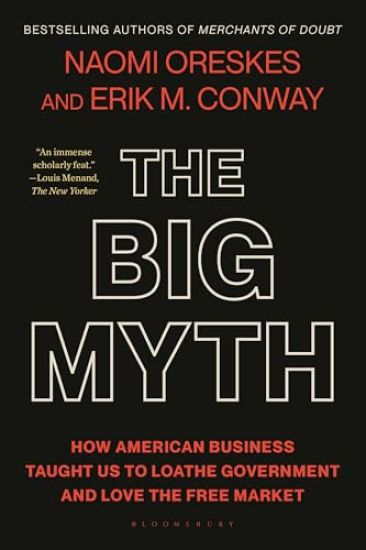
The Big Myth

The Big Myth

Naomi Oreskes; Erik M. Conway

BLOOMSBURY PUBLISHING USA
2025
nidottu
"An immense scholarly feat."-New Yorker * " A] scorching indictment of free market fundamentalism . . . and how we can change, before it's too late."-Esquire With a New Afterword by the Authors. The bestselling authors of Merchants of Doubt offer a profound, startling history of one of America's most tenacious-and destructive-false ideas: the myth of the "free market." In their landmark book Merchants of Doubt, Naomi Oreskes and Erik M. Conway revealed the origins of climate change denial. Now, they unfold the truth about another disastrous dogma: the "magic of the marketplace." In the early 20th century, business elites, trade associations, wealthy powerbrokers, and media allies set out to build a new American orthodoxy: down with "big government" and up with unfettered markets. With trenchant archival evidence, Oreskes and Conway document campaigns to rewrite textbooks, combat unions, and defend child labor. They detail the ploys that turned hardline economists Friedrich von Hayek and Milton Friedman into household names; recount the libertarian roots of the Little House on the Prairie books; and tune into the General Electric-sponsored TV show that beamed free-market doctrine to millions and launched Ronald Reagan's political career. By the 1970s, this propaganda was succeeding. Free market ideology would define the next half-century across Republican and Democratic administrations, giving us a housing crisis, the opioid scourge, climate destruction, and a baleful response to the Covid-19 pandemic. Only by understanding this history can we imagine a future where markets will serve, not stifle, democracy.
Science on a Mission

Science on a Mission

Naomi Oreskes

THE UNIVERSITY OF CHICAGO PRESS
2022
nidottu
A vivid portrait of how Naval oversight shaped American oceanography, revealing what difference it makes who pays for science. What difference does it make who pays for science? Some might say none. If scientists seek to discover fundamental truths about the world, and they do so in an objective manner using well-established methods, then how could it matter who’s footing the bill? History, however, suggests otherwise. In science, as elsewhere, money is power. Tracing the recent history of oceanography, Naomi Oreskes discloses dramatic changes in American ocean science since the Cold War, uncovering how and why it changed. Much of it has to do with who pays. After World War II, the US military turned to a new, uncharted theater of warfare: the deep sea. The earth sciences—particularly physical oceanography and marine geophysics—became essential to the US Navy, which poured unprecedented money and logistical support into their study. Science on a Mission brings to light how this influx of military funding was both enabling and constricting: it resulted in the creation of important domains of knowledge but also significant, lasting, and consequential domains of ignorance. As Oreskes delves into the role of patronage in the history of science, what emerges is a vivid portrait of how naval oversight transformed what we know about the sea. It is a detailed, sweeping history that illuminates the ways funding shapes the subject, scope, and tenor of scientific work, and it raises profound questions about the purpose and character of American science. What difference does it make who pays? The short answer is: a lot.
Varför ska man lita på vetenskapen?

Varför ska man lita på vetenskapen?

Naomi Oreskes

Bokförlaget Thales
2021
nidottu
Har forskarna rätt när de säger att vacciner är säkra? Ska vi tro på de experter som varnar oss för den globala uppvärmningen? Forskare är ju bara människor som kan ta fel, som har egna fördomar och intressen som påverkar hur de tänker och vad de säger. Naomi Oreskes försvarar vetenskapen utan att förneka dess sociala och mänskliga karaktär. Tvärtom är det vetenskapens sociala natur som är dess styrka och som ger oss anledning att lita på den. Med konkreta exempel visar hon hur forskningen ibland går vilse men också hur en öppen och diversifierad forskningsgemenskap avslöjar och korrigerar misstag. Naomi Oreskes är professor i vetenskapshistoria vid Harvard. Hennes mest kända verk (skrivet tillsammans med Erik Conway) är Merchants of Doubt som handlar om hur en handfull forskare, från 50-talet och in i vår tid, fördunklade sanningen om frågor från tobaksrök till global uppvärmning, och därmed försenade och försvårade viktiga politiska beslut. I den här boken utvecklar hon de tankar om en välfungerande vetenskap som skisserades i det tidigare verket.
Science on a Mission

Science on a Mission

Naomi Oreskes

University of Chicago Press
2021
sidottu
What difference does it make who pays for science? Some might say none. If scientists seek to discover fundamental truths about the world, and they do so in an objective manner using well-established methods, then how could it matter who's footing the bill? History, however, suggests otherwise. In science, as elsewhere, money is power. Tracing the recent history of oceanography, Naomi Oreskes discloses dramatic changes in American ocean science since the Cold War, uncovering how and why it changed. Much of it has to do with who pays. After World War II, the US military turned to a new, uncharted theater of warfare: the deep sea. The earth sciences--particularly physical oceanography and marine geophysics--became essential to the US navy, who poured unprecedented money and logistical support into their study. Science on a Mission brings to light how the influx of such military funding was both enabling and constricting: it resulted in the creation of important domains of knowledge, but also significant, lasting, and consequential domains of ignorance. As Oreskes delves into the role of patronage in the history of science, what emerges is a vivid portrait of how naval oversight transformed what we know about the sea. It is a detailed, sweeping history that illuminates the ways in which funding shapes the subject, scope, and tenor of scientific work, and it raises profound questions over the purpose and character of American science. What difference does it make who pays? The short answer is: a lot.
Why Trust Science?

Why Trust Science?

Naomi Oreskes

Princeton University Press
2021
pokkari
Why the social character of scientific knowledge makes it trustworthyAre doctors right when they tell us vaccines are safe? Should we take climate experts at their word when they warn us about the perils of global warming? Why should we trust science when so many of our political leaders don't? Naomi Oreskes offers a bold and compelling defense of science, revealing why the social character of scientific knowledge is its greatest strength—and the greatest reason we can trust it. Tracing the history and philosophy of science from the late nineteenth century to today, this timely and provocative book features a new preface by Oreskes and critical responses by climate experts Ottmar Edenhofer and Martin Kowarsch, political scientist Jon Krosnick, philosopher of science Marc Lange, and science historian Susan Lindee, as well as a foreword by political theorist Stephen Macedo.
Why Trust Science?

Why Trust Science?

Naomi Oreskes

PRINCETON UNIVERSITY PRESS
2019
sidottu
Why the social character of scientific knowledge makes it trustworthyDo doctors really know what they are talking about when they tell us vaccines are safe? Should we take climate experts at their word when they warn us about the perils of global warming? Why should we trust science when our own politicians don't? In this landmark book, Naomi Oreskes offers a bold and compelling defense of science, revealing why the social character of scientific knowledge is its greatest strength—and the greatest reason we can trust it.Tracing the history and philosophy of science from the late nineteenth century to today, Oreskes explains that, contrary to popular belief, there is no single scientific method. Rather, the trustworthiness of scientific claims derives from the social process by which they are rigorously vetted. This process is not perfect—nothing ever is when humans are involved—but she draws vital lessons from cases where scientists got it wrong. Oreskes shows how consensus is a crucial indicator of when a scientific matter has been settled, and when the knowledge produced is likely to be trustworthy.Based on the Tanner Lectures on Human Values at Princeton University, this timely and provocative book features critical responses by climate experts Ottmar Edenhofer and Martin Kowarsch, political scientist Jon Krosnick, philosopher of science Marc Lange, and science historian Susan Lindee, as well as a foreword by political theorist Stephen Macedo.
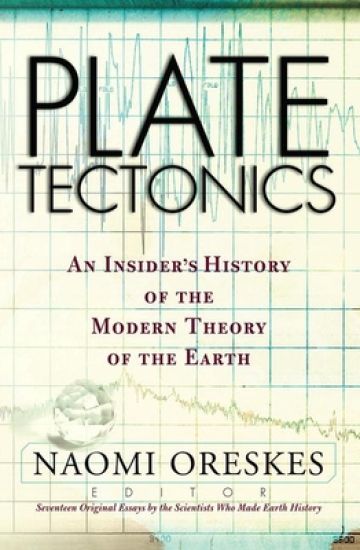
Plate Tectonics

Plate Tectonics

Naomi Oreskes

CRC Press
2019
sidottu
Can anyone today imagine the earth without its puzzle-piece construction of plate tectonics? The very term, "plate tectonics," coined only thirty-five years ago, is now part of the vernacular, part of everyone's understanding of the way the earth works.The theory, research, data collection, and analysis that came together in the late 1960's to cons
Discerning Experts

Discerning Experts

Michael Oppenheimer; Naomi Oreskes; Dale Jamieson; Keynyn Brysse; Jessica O'Reilly; Matthew Shindell; Milena Wazeck

University of Chicago Press
2019
pokkari
How do scientists evaluate environmental knowledge for public policy? Discerning Experts examines three sets of landmark environmental assessments involving acid rain, ozone depletion, and sea level rise, exploring how experts judge scientific evidence and determine what the scientific facts are. The three case studies also explore how scientists come to agreement on contested issues, why consensus is considered important, and what factors contribute to confusion, bias, and error, and how scientists understand and navigate the boundaries between science and policy. The authors also suggest strategies for improving the assessment process. As the first study of the internal workings of large environmental assessments, this book explores the strengths and weaknesses of the assessment process and explains what it can—and cannot—be expected to contribute to public policy and the common good.
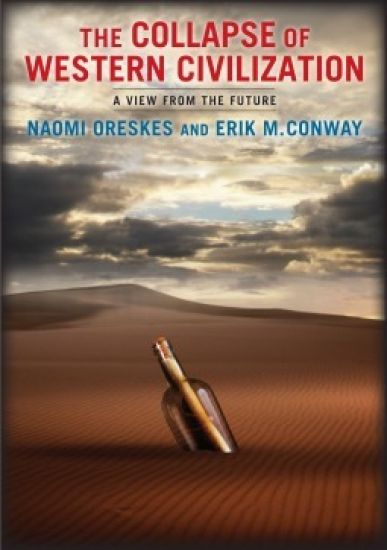
The Collapse of Western Civilization

The Collapse of Western Civilization

Naomi Oreskes; Erik Conway

Columbia University Press
2014
pokkari
The year is 2393, and the world is almost unrecognizable. Clear warnings of climate catastrophe went ignored for decades, leading to soaring temperatures, rising sea levels, widespread drought and-finally-the disaster now known as the Great Collapse of 2093, when the disintegration of the West Antarctica Ice Sheet led to mass migration and a complete reshuffling of the global order. Writing from the Second People's Republic of China on the 300th anniversary of the Great Collapse, a senior scholar presents a gripping and deeply disturbing account of how the children of the Enlightenment-the political and economic elites of the so-called advanced industrial societies-failed to act, and so brought about the collapse of Western civilization. In this haunting, provocative work of science-based fiction, Naomi Oreskes and Eric M. Conway imagine a world devastated by climate change. Dramatizing the science in ways traditional nonfiction cannot, the book reasserts the importance of scientists and the work they do and reveals the self-serving interests of the so called "carbon combustion complex" that have turned the practice of science into political fodder. Based on sound scholarship and yet unafraid to speak boldly, this book provides a welcome moment of clarity amid the cacophony of climate change literature.
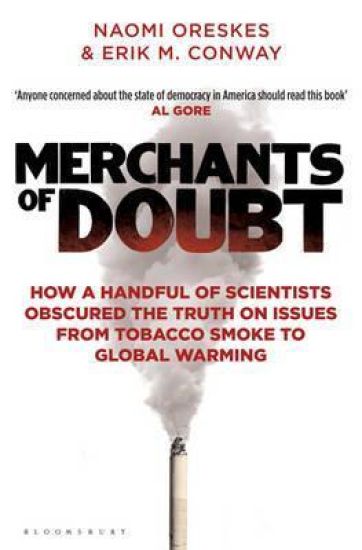
Merchants of Doubt

Merchants of Doubt

Erik M. Conway; Naomi Oreskes

Bloomsbury Publishing PLC
2012
nidottu
The U.S. scientific community has long led the world in research on such areas as public health, environmental science, and issues affecting quality of life. Our scientists have produced landmark studies on the dangers of DDT, tobacco smoke, acid rain, and global warming. But at the same time, a small yet potent subset of this community leads the world in vehement denial of these dangers.Merchants of Doubt tells the story of how a loose-knit group of high-level scientists and scientific advisers, with deep connections in politics and industry, ran effective campaigns to mislead the public and deny well-established scientific knowledge over four decades. Remarkably, the same individuals surface repeatedly - some of the same figures who have claimed that the science of global warming is "not settled" denied the truth of studies linking smoking to lung cancer, coal smoke to acid rain, and CFCs to the ozone hole. "Doubt is our product," wrote one tobacco executive. These 'experts' supplied it. Naomi Oreskes and Erik M. Conway, historians of science, roll back the rug on this dark corner of the American scientific community, showing how ideology and corporate interests, aided by a too-compliant media, have skewed public understanding of some of the most pressing issues of our era.
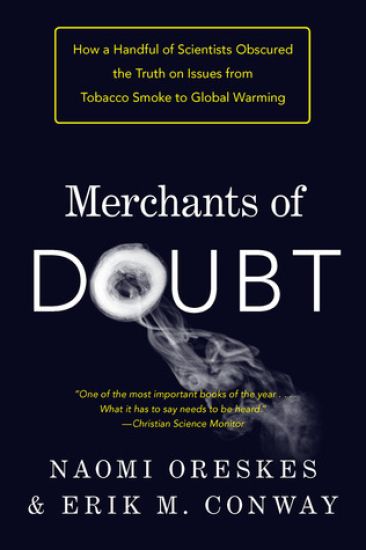
Merchants of Doubt

Merchants of Doubt

Naomi Oreskes; Erik M. Conway

Bloomsbury Press
2011
pokkari
"Merchants of Doubt should finally put to rest the question of whether the science of climate change is settled. It is, and we ignore this message at our peril."-Elizabeth Kolbert "Brilliantly reported andwritten with brutal clarity."-Huffington Post Now a powerful documentary from the acclaimed director of Food Inc., Merchants of Doubt was one of the most talked-about climate change books of recent years, for reasons easy to understand: It tells the controversial story of how a loose-knit group of high-level scientists and scientific advisers, with deep connections in politics and industry, ran effective campaigns to mislead the public and deny well-established scientific knowledge over four decades. The same individuals who claim the science of global warming is "not settled" have also denied the truth about studies linking smoking to lung cancer, coal smoke to acid rain, and CFCs to the ozone hole. "Doubt is our product," wrote one tobacco executive. These "experts" supplied it.
Plate Tectonics

Plate Tectonics

Naomi Oreskes

Westview Press Inc
2003
pokkari
Can anyone today imagine the earth without its puzzle-piece construction of plate tectonics? The very term, "plate tectonics," coined only thirty-five years ago, is now part of the vernacular, part of everyone's understanding of the way the earth works.The theory, research, data collection, and analysis that came together in the late 1960's to constitute plate tectonics is one of the great scientific breakthroughs of the 20th century. Scholarly books have been written about tectonics, but none by the key scientists-players themselves. In Plate Tectonics , editor Naomi Oreskes has assembled those scientists who played crucial roles in developing the theory to tell - for the first time, and in their own words - the stories of their involvement in the extraordinary confrimation of the theory.The book opens with an overview of the history of plate tectonics, including in-context definitions of the key terms that are discussed throughout the book. Oreskes explains how the forerunners of the theory, Wegener and du Toit, raised questions that were finally answered thirty years later, and how scientists working at the key academic institutions - Cambridge and Princeton Universities, Columbia University's Lamont Doherty Geological Observatory, and the University of California-San Diego's Scripps Institution of Oceanography - competed and collaborated until the theory coalesced.
The Rejection of Continental Drift

The Rejection of Continental Drift

Naomi Oreskes

Oxford University Press Inc
1999
nidottu
In the early 20th century, American earth scientists vociferously opposed the new, and highly radical, notion of continental drift. Yet 50 years later the same idea was heralded as a major scientific breakthrough, and today continental drift is accepted as a scientific fact. Why did American geologists reject so adamantly an idea that is now considered a cornerstone of the discipline? And why did they react so much more negatively than their European counterparts? This book, based primarily on archival resources, provides answers to these questions. It complements existing work on continental drift and the emergence of the theory of plate tectonics by providing the first detailed historical account of the American geological community in the 1920s. It also challenges previous historical work on this episode, much of which ascribes the rejection of continental drift to the lack of an adequate causal mechanism. Instead, the author shows that the rejection was largely based on the view that continental drift challenged the basic methodological principles and standards of practice in American earth science. In uncovering the historical roots of this debate, the author seeks to clarify the relationship between scientific practice and theory while also providing a test case for related philosophical questions.