Kirjojen hintavertailu. Mukana 12 272 513 kirjaa ja 12 kauppaa.

Kirjailija

Naomi S. Baron

Kirjat ja teokset yhdessä paikassa: 8 kirjaa, julkaisuja vuosilta 2000-2026, suosituimpien joukossa How We Read Now. Vertaile teosten hintoja ja tarkista saatavuus suomalaisista kirjakaupoista.

8 kirjaa

Kirjojen julkaisuhaarukka 2000-2026.

Reader Bot

Reader Bot

Naomi S. Baron

STANFORD UNIVERSITY PRESS
2026
sidottu
What happens to human reading when AI bots can do it for us? Explosive developments in artificial intelligence have awed everyday users with the technology's ability to draw, do computer coding, and especially to write. Those AI-generated essays and poems, legal briefs and responses to requests for information are all visible evidence of large language models at work. What we don't see is the critical prior step: before it can write, AI needs to read. While AI's written outcomes are remarkably similar to what a diligent student, lawyer, or researcher might produce, AI doesn't read the way that humans do. Now that AI is proving an adept reader, what happens to our own reading skills and motivations—especially at a time when both voluntary and school reading are increasingly on the decline? We have learned that when we let chatbots write for us, there are pros and cons to handing over our virtual pens. It's critical that we also think through the consequences of relinquishing reading—a deeply human activity—to bots. What do we stand to gain and lose when we let AI read for us? Tracing the intersecting trajectories of AI and reading, Reader Bot tackles this vital question, revealing why we must be thoughtful about how we welcome AI-as-reader into our lives.
Who Wrote This?

Who Wrote This?

Naomi S. Baron

STANFORD UNIVERSITY PRESS
2025
pokkari
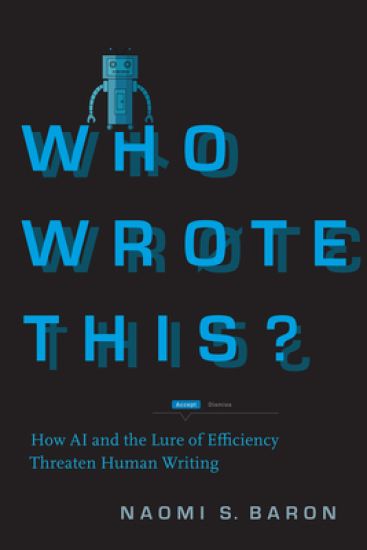
Would you read this book if a computer wrote it? Would you even know? And why would it matter? Today's eerily impressive artificial intelligence writing tools present us with a crucial challenge: As writers, do we unthinkingly adopt AI's time-saving advantages or do we stop to weigh what we gain and lose when heeding its siren call? To understand how AI is redefining what it means to write and think, linguist and educator Naomi S. Baron leads us on a journey connecting the dots between human literacy and today's technology. From nineteenth-century lessons in composition, to mathematician Alan Turing's work creating a machine for deciphering war-time messages, to contemporary engines like ChatGPT, Baron gives readers a spirited overview of the emergence of both literacy and AI, and a glimpse of their possible future. As the technology becomes increasingly sophisticated and fluent, it's tempting to take the easy way out and let AI do the work for us. Baron cautions that such efficiency isn't always in our interest. As AI plies us with suggestions or full-blown text, we risk losing not just our technical skills but the power of writing as a springboard for personal reflection and unique expression. Funny, informed, and conversational, Who Wrote This? urges us as individuals and as communities to make conscious choices about the extent to which we collaborate with AI. The technology is here to stay. Baron shows us how to work with AI and how to spot where it risks diminishing the valuable cognitive and social benefits of being literate.
Who Wrote This?

Who Wrote This?

Naomi S. Baron

STANFORD UNIVERSITY PRESS
2023
sidottu
Would you read this book if a computer wrote it? Would you even know? And why would it matter? Today's eerily impressive artificial intelligence writing tools present us with a crucial challenge: As writers, do we unthinkingly adopt AI's time-saving advantages or do we stop to weigh what we gain and lose when heeding its siren call? To understand how AI is redefining what it means to write and think, linguist and educator Naomi S. Baron leads us on a journey connecting the dots between human literacy and today's technology. From nineteenth-century lessons in composition, to mathematician Alan Turing's work creating a machine for deciphering war-time messages, to contemporary engines like ChatGPT, Baron gives readers a spirited overview of the emergence of both literacy and AI, and a glimpse of their possible future. As the technology becomes increasingly sophisticated and fluent, it's tempting to take the easy way out and let AI do the work for us. Baron cautions that such efficiency isn't always in our interest. As AI plies us with suggestions or full-blown text, we risk losing not just our technical skills but the power of writing as a springboard for personal reflection and unique expression. Funny, informed, and conversational, Who Wrote This? urges us as individuals and as communities to make conscious choices about the extent to which we collaborate with AI. The technology is here to stay. Baron shows us how to work with AI and how to spot where it risks diminishing the valuable cognitive and social benefits of being literate.
How We Read Now

How We Read Now

Naomi S. Baron

Oxford University Press Inc
2021
sidottu
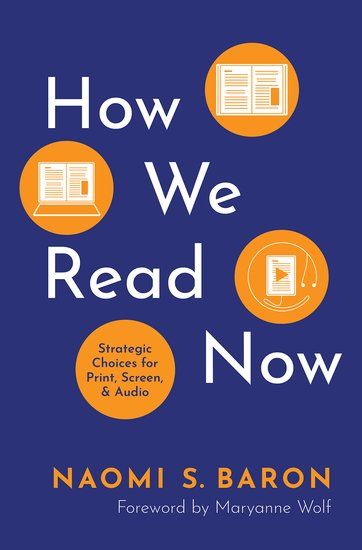
An engaging and authoritative guide to the impact of reading medium on learning, from a foremost expert in the field We face constant choices about how we read. Educators must select classroom materials. College students weigh their textbook options. Parents make decisions for their children. The digital revolution has transformed reading, and with the recent turn to remote learning, onscreen reading may seem like the only viable option. Yet selecting digital is often based on cost or convenience, not on educational evidence. Now more than ever it is imperative to understand how reading medium actually impacts learning--and what strategies we need in order to read effectively in all formats. In How We Read Now, Naomi Baron draws on a wealth of knowledge and research to explain important differences in the way we concentrate, understand, and remember across multiple formats. Mobilizing work from international scholarship along with findings from her own studies of reading practices, Baron addresses key challenges--from student complaints that print is boring to the hazards of digital reading for critical thinking. Rather than arguing for one format over another, she explains how we read and learn in different settings, shedding new light on the current state of reading. The book then crucially connects research insights to concrete applications, offering practical approaches for maximizing learning with print, digital text, audio, and video. Since screens and audio are now entrenched--and invaluable-platforms for reading, we need to rethink ways of helping readers at all stages use them more wisely. How We Read Now shows us how to do that.
Words Onscreen

Words Onscreen

Naomi S. Baron

Oxford University Press Inc
2016
nidottu
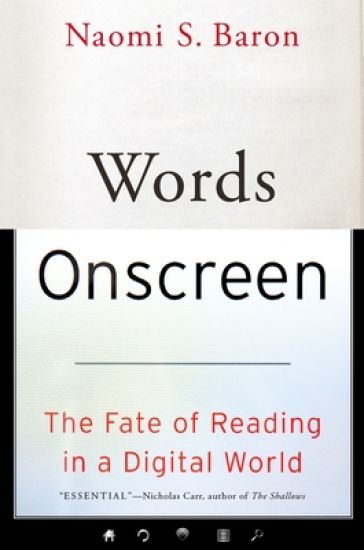
People have been reading on computer screens for several decades now, predating popularization of personal computers and widespread use of the internet. But it was the rise of eReaders and tablets that caused digital reading to explode. In 2007, Amazon introduced its first Kindle. Three years later, Apple debuted the iPad. Meanwhile, as mobile phone technology improved and smartphones proliferated, the phone became another vital reading platform. In Words Onscreen, Naomi Baron, an expert on language and technology, explores how technology is reshaping our understanding of what it means to read. Digital reading is increasingly popular. Reading onscreen has many virtues, including convenience, potential cost-savings, and the opportunity to bring free access to books and other written materials to people around the world. Yet, Baron argues, the virtues of eReading are matched with drawbacks. Users are easily distracted by other temptations on their devices, multitasking is rampant, and screens coax us to skim rather than read in-depth. What is more, if the way we read is changing, so is the way we write. In response to changing reading habits, many authors and publishers are producing shorter works and ones that don't require reflection or close reading. In her tour through the new world of eReading, Baron weights the value of reading physical print versus online text, including the question of what long-standing benefits of reading might be lost if we go overwhelmingly digital. She also probes how the internet is shifting reading from being a solitary experience to a social one, and the reasons why eReading has taken off in some countries, especially the United States and United Kingdom, but not others, like France and Japan. Reaching past the hype on both sides of the discussion, Baron draws upon her own cross-cultural studies to offer a clear-eyed and balanced analysis of the ways technology is affecting the ways we read today--and what the future might bring.
Words Onscreen

Words Onscreen

Naomi S. Baron

Oxford University Press Inc
2015
sidottu
People have been reading on computer screens for several decades now, predating popularization of personal computers and widespread use of the internet. But it was the rise of eReaders and tablets that caused digital reading to explode. In 2007, Amazon introduced its first Kindle. Three years later, Apple debuted the iPad. Meanwhile, as mobile phone technology improved and smartphones proliferated, the phone became another vital reading platform. In Words Onscreen, Naomi Baron, an expert on language and technology, explores how technology is reshaping our understanding of what it means to read. Digital reading is increasingly popular. Reading onscreen has many virtues, including convenience, potential cost-savings, and the opportunity to bring free access to books and other written materials to people around the world. Yet, Baron argues, the virtues of eReading are matched with drawbacks. Users are easily distracted by other temptations on their devices, multitasking is rampant, and screens coax us to skim rather than read in-depth. What is more, if the way we read is changing, so is the way we write. In response to changing reading habits, many authors and publishers are producing shorter works and ones that don't require reflection or close reading. In her tour through the new world of eReading, Baron weights the value of reading physical print versus online text, including the question of what long-standing benefits of reading might be lost if we go overwhelmingly digital. She also probes how the internet is shifting reading from being a solitary experience to a social one, and the reasons why eReading has taken off in some countries, especially the United States and United Kingdom, but not others, like France and Japan. Reaching past the hype on both sides of the discussion, Baron draws upon her own cross-cultural studies to offer a clear-eyed and balanced analysis of the ways technology is affecting the ways we read today--and what the future might bring.
Alphabet to Email

Alphabet to Email

Naomi S. Baron

Routledge
2001
nidottu
In Alphabet to Email Naomi Baron takes us on a fascinating and often entertaining journey through the history of the English language, showing how technology - especially email - is gradually stripping language of its formality.Drawing together strands of thinking about writing, speech, pedagogy, technology, and globalization, Naomi Baron explores the ever-changing relationship between speech and writing and considers the implications of current language trends on the future of written English.Alphabet to Email will appeal to anyone who is curious about how the English language has changed over the centuries and where it might be going.
Alphabet to Email

Alphabet to Email

Naomi S. Baron

Routledge
2000
sidottu
In Alphabet to Email Naomi Baron takes us on a fascinating and often entertaining journey through the history of the English language, showing how technology - especially email - is gradually stripping language of its formality.Drawing together strands of thinking about writing, speech, pedagogy, technology, and globalization, Naomi Baron explores the ever-changing relationship between speech and writing and considers the implications of current language trends on the future of written English.Alphabet to Email will appeal to anyone who is curious about how the English language has changed over the centuries and where it might be going.