Kirjojen hintavertailu. Mukana 12 595 353 kirjaa ja 12 kauppaa.

Kirjailija

Narendra Ahuja

Kirjat ja teokset yhdessä paikassa: 3 kirjaa, julkaisuja vuosilta 2001-2012, suosituimpien joukossa Motion and Structure from Image Sequences. Vertaile teosten hintoja ja tarkista saatavuus suomalaisista kirjakaupoista.

3 kirjaa

Kirjojen julkaisuhaarukka 2001-2012.

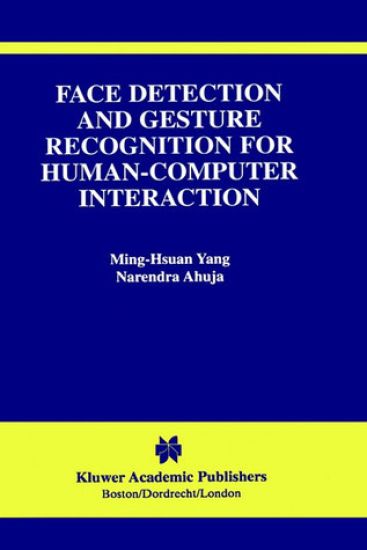
Face Detection and Gesture Recognition for Human-Computer Interaction

Face Detection and Gesture Recognition for Human-Computer Interaction

Ming-Hsuan Yang; Narendra Ahuja

Springer-Verlag New York Inc.
2012
nidottu
Traditionally, scientific fields have defined boundaries, and scientists work on research problems within those boundaries. However, from time to time those boundaries get shifted or blurred to evolve new fields. For instance, the original goal of computer vision was to understand a single image of a scene, by identifying objects, their structure, and spatial arrangements. This has been referred to as image understanding. Recently, computer vision has gradually been making the transition away from understanding single images to analyzing image sequences, or video understanding. Video understanding deals with understanding of video sequences, e. g. , recognition of gestures, activities, facial expressions, etc. The main shift in the classic paradigm has been from the recognition of static objects in the scene to motion-based recognition of actions and events. Video understanding has overlapping research problems with other fields, therefore blurring the fixed boundaries. Computer graphics, image processing, and video databases have obvious overlap with computer vision. The main goal of computer graphics is to gener­ ate and animate realistic looking images, and videos. Researchers in computer graphics are increasingly employing techniques from computer vision to gen­ erate the synthetic imagery. A good example of this is image-based rendering and modeling techniques, in which geometry, appearance, and lighting is de­ rived from real images using computer vision techniques. Here the shift is from synthesis to analysis followed by synthesis.

Motion and Structure from Image Sequences

Motion and Structure from Image Sequences

Juyang Weng; Thomas S. Huang; Narendra Ahuja

Springer-Verlag Berlin and Heidelberg GmbH Co. K
2011
nidottu
Motion and Structure from Image Sequences is invaluable reading for researchers, graduate students, and practicing engineers dealing with computer vision. It presents a balanced treatment of the theoretical and practical issues, including very recent results - some of which are published here for the first time. The topics covered in detail are: - image matching and optical flow computation - structure from stereo - structure from motion - motion estimation - integration of multiple views - motion modeling and prediction Aspects such as uniqueness of the solution, degeneracy conditions, error analysis, stability, optimality, and robustness are also investigated. These details together with the fact that the algorithms are accessible without necessarily studying the rest of the material, make this book particularly attractive to practitioners.
Face Detection and Gesture Recognition for Human-Computer Interaction
Traditionally, scientific fields have defined boundaries, and scientists work on research problems within those boundaries. However, from time to time those boundaries get shifted or blurred to evolve new fields. For instance, the original goal of computer vision was to understand a single image of a scene, by identifying objects, their structure, and spatial arrangements. This has been referred to as image understanding. Recently, computer vision has gradually been making the transition away from understanding single images to analyzing image sequences, or video understanding. Video understanding deals with understanding of video sequences, e. g. , recognition of gestures, activities, facial expressions, etc. The main shift in the classic paradigm has been from the recognition of static objects in the scene to motion-based recognition of actions and events. Video understanding has overlapping research problems with other fields, therefore blurring the fixed boundaries. Computer graphics, image processing, and video databases have obvious overlap with computer vision. The main goal of computer graphics is to gener­ ate and animate realistic looking images, and videos. Researchers in computer graphics are increasingly employing techniques from computer vision to gen­ erate the synthetic imagery. A good example of this is image-based rendering and modeling techniques, in which geometry, appearance, and lighting is de­ rived from real images using computer vision techniques. Here the shift is from synthesis to analysis followed by synthesis.