Kirjailija
Natalie Fenton
Kirjat ja teokset yhdessä paikassa: 12 kirjaa, julkaisuja vuosilta 1997-2024, suosituimpien joukossa Media, Democracy and Social Change. Vertaile teosten hintoja ja tarkista saatavuus suomalaisista kirjakaupoista.
12 kirjaa
Kirjojen julkaisuhaarukka 1997-2024.
A free media is inextricably linked to a healthy democracy, but in many parts of the world liberal democracies are deemed to be dying or on the demise – a demise that many forms of media have enabled while heralding themselves as democracy’s saviour. The hollowing out of democracy in these ways has left many people questioning the value of (neo)liberal democratic societies. What can we do about it? Democratic Delusions explores the potential of our media and tech systems to be democratic and contribute to a just and transformative democracy. This is only possible, Natalie Fenton argues, by first situating our political systems and mediated worlds within global capitalism. By interrogating different media and their relationship to seven key elements of democracy – power, participation, freedom, equality, public good, trust, and hope – the book asks: What is the response of society when the ability of news media to speak truth to power has been restricted by corporate logic? And, how do we tackle a deep-rooted market logic that shifts public debate towards private interest and marginalizes progressive perspectives? The book explores how these elements can be reimagined through newly conceived media and tech landscapes and, ultimately, what democracy might be in a future mediated world that places more power in the hands of more people. This is essential reading for students and scholars of media and communications, journalism, political communications, political science, and sociology.Also available as an audiobook, narrated by the author.
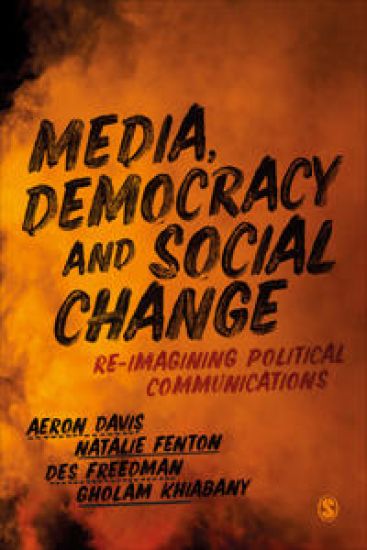
Media, Democracy and Social Change
Aeron Davis; Natalie Fenton; Des Freedman; Gholam Khiabany
SAGE Publications Ltd
2020
sidottu
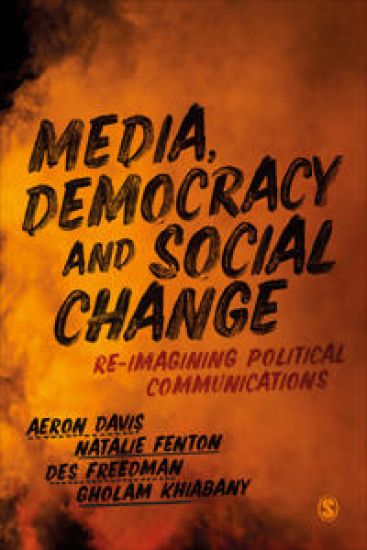
When we are told so regularly that we live in a ‘post truth’ age and are surrounded by ‘fake news’, it can be tempting to think of politics as primarily mediated. Discussion and analysis of public affairs is preoccupied with the power and reach of platforms or the passion and rage of social media exchanges. As important as these issues may be, a focus on the communicative risks downgrading the political. Media, Democracy and Social Change puts politics back into political communications. It shows how within a digital media ecology, the wider context of neoliberal capitalism remains essential for understanding what political communications is, and can hope to be. Tackling broad themes of structural inequality, technological change, political realignment and social transformation, the book explores political communications as it relates to debates around the state, infrastructures, elites, populism, political parties, activism, the legacies of colonialism, and more. It is both an expert introduction to the field of political communications, and a critical intervention to help re-imagine what a democratic politics might mean in a digital age. It will be essential reading for students, researchers and activists. Aeron Davis, Natalie Fenton, Des Freedman and Gholam Khiabany all work at the Department of Media and Communication at Goldsmiths, University of London, where they teach together on the MA in Political Communications.
Media, Democracy and Social Change
Aeron Davis; Natalie Fenton; Des Freedman; Gholam Khiabany
SAGE Publications Ltd
2020
nidottu
When we are told so regularly that we live in a ‘post truth’ age and are surrounded by ‘fake news’, it can be tempting to think of politics as primarily mediated. Discussion and analysis of public affairs is preoccupied with the power and reach of platforms or the passion and rage of social media exchanges. As important as these issues may be, a focus on the communicative risks downgrading the political. Media, Democracy and Social Change puts politics back into political communications. It shows how within a digital media ecology, the wider context of neoliberal capitalism remains essential for understanding what political communications is, and can hope to be. Tackling broad themes of structural inequality, technological change, political realignment and social transformation, the book explores political communications as it relates to debates around the state, infrastructures, elites, populism, political parties, activism, the legacies of colonialism, and more. It is both an expert introduction to the field of political communications, and a critical intervention to help re-imagine what a democratic politics might mean in a digital age. It will be essential reading for students, researchers and activists. Aeron Davis, Natalie Fenton, Des Freedman and Gholam Khiabany all work at the Department of Media and Communication at Goldsmiths, University of London, where they teach together on the MA in Political Communications.
The Media Manifesto
Natalie Fenton; Des Freedman; Justin Schlosberg; Lina Dencik
Polity Press
2020
nidottu
Our media systems are in crisis. Run by unaccountable corporations and dominated by agendas and algorithms that are shrouded in mystery, these formerly trusted sources of information and entertainment have lost their way. As consumers, we have plenty of choice, but as citizens we have an abundance of misinformation and misrepresentation.In this incisive manifesto, four prominent media scholars and activists put forth a roadmap for radical reform of concentrated media power. They argue that we should put media justice, economic democracy and social equality at the heart of our scholarship and our campaigning.The Media Manifesto delivers a sharp analysis of our communications crisis and a passionate call for urgent change. It provides resources of hope for media reform movements across the globe.
The Media Manifesto
Natalie Fenton; Des Freedman; Justin Schlosberg; Lina Dencik
Polity Press
2020
sidottu
Our media systems are in crisis. Run by unaccountable corporations and dominated by agendas and algorithms that are shrouded in mystery, these formerly trusted sources of information and entertainment have lost their way. As consumers, we have plenty of choice, but as citizens we have an abundance of misinformation and misrepresentation.In this incisive manifesto, four prominent media scholars and activists put forth a roadmap for radical reform of concentrated media power. They argue that we should put media justice, economic democracy and social equality at the heart of our scholarship and our campaigning.The Media Manifesto delivers a sharp analysis of our communications crisis and a passionate call for urgent change. It provides resources of hope for media reform movements across the globe.
Digital, Political, Radical is a siren call to the field of media and communications and the study of social and political movements. We must put the politics of transformation at the very heart of our analyses to meet the global challenges of gross inequality and ever-more impoverished democracies. Fenton makes an impassioned plea for re-invigorating critical research on digital media such that it can be explanatory, practical and normative. She dares us to be politically emboldened. She urges us to seek out an emancipatory politics that aims to deepen our democratic horizons. To ask: how can we do democracy better? What are the conditions required to live together well? Then, what is the role of the media and how can we reclaim media, power and politics for progressive ends? Journeying through a range of protest and political movements, Fenton debunks myths of digital media along the way and points us in the direction of newly emergent politics of the Left. Digital, Political, Radical contributes to political debate on contemporary (re)configurations of radical progressive politics through a consideration of how we experience (counter) politics in the digital age and how this may influence our being political.
The growth of the internet has been spectacular. There are now more than 3 billion internet users across the globe, some 40 per cent of the world’s population. The internet’s meteoric rise is a phenomenon of enormous significance for the economic, political and social life of contemporary societies. However, much popular and academic writing about the internet continues to take a celebratory view, assuming that the internet’s potential will be realised in essentially positive and transformative ways. This was especially true in the euphoric moment of the mid-1990s, when many commentators wrote about the internet with awe and wonderment. While this moment may be over, its underlying technocentrism – the belief that technology determines outcomes – lingers on and, with it, a failure to understand the internet in its social, economic and political contexts.Misunderstanding the Internet is a short introduction, encompassing the history, sociology, politics and economics of the internet and its impact on society. This expanded and updated second edition is a polemical, sociologically and historically informed guide to the key claims that have been made about the online world. It aims to challenge both popular myths and existing academic orthodoxies that surround the internet.
Mediating Social Science
Natalie Fenton; Alan Bryman; David Deacon
SAGE Publications Ltd
1997
nidottu
What is the interface between social scientists and the media? How does social science come over in news and current affairs in print and broadcasting media? This book examines issues in reception and production studies to build a holistic approach to the study of media representations. The authors give an accessible and authoritative guide to the mass communication process. They examine media production, the nature of media texts, the role of news sources, the general social and political context of mass communication and the ways in which media outputs are assimilated by audiences. The discussions are developed by an examination of the following areas: the interaction between journalists and social scientists; the publicity seeking activities of universities, research institutes and government departments; the attempts of individual social scientists to get noticed; the social policy environment surrounding social scientific research and its dissemination; pressure from funders; and the public understanding of social science in the news.
Mediating Social Science
Natalie Fenton; Alan Bryman; David Deacon
SAGE Publications Ltd
1997
sidottu
What is the interface between social scientists and the media? How does social science come over in news and current affairs in print and broadcasting media? This book examines issues in reception and production studies to build a holistic approach to the study of media representations. The authors give an accessible and authoritative guide to the mass communication process. They examine media production, the nature of media texts, the role of news sources, the general social and political context of mass communication and the ways in which media outputs are assimilated by audiences. The discussions are developed by an examination of the following areas: the interaction between journalists and social scientists; the publicity seeking activities of universities, research institutes and government departments; the attempts of individual social scientists to get noticed; the social policy environment surrounding social scientific research and its dissemination; pressure from funders; and the public understanding of social science in the news.