

Kirjailija
Nathan Andrews
Kirjat ja teokset yhdessä paikassa: 6 kirjaa, julkaisuja vuosilta 2010-2024, suosituimpien joukossa Dapoxetine Usage Guide. Vertaile teosten hintoja ja tarkista saatavuus suomalaisista kirjakaupoista.
6 kirjaa
Kirjojen julkaisuhaarukka 2010-2024.
This book gives a comprehensive overview of Ghana’s hydrocarbon economy using actor network and assemblage theories to contest the methodological nationalism of mainstream accounts of the resource curse in resource-rich countries. Drawing upon recent field research focused on Ghana’s oil and gas sector and utilizing the theoretical framework of actor network theory, the authors contend that there is an assemblage of political, economic, social and environmental networks, processes, actions, actors, and structures of power that coalesce to determine the extent to which the country’s hydrocarbon resources could be regarded as a "curse" or "blessing." This framing facilitates a better understanding of the variety (and duality) of local and global forces and power structures at play in Ghana’s growing hydrocarbon industry. Giving a nuanced and multi-perspectival analysis of the factors that underlie oil-engendered development in Ghana, this book will be of interest to students and scholars of African political economy, development and the politics of resource extraction.

Lessons from the Book of Acts for: - Organizational Growth and Development - Finding and Retaining Talent - Handling Exponential Growth - Navigating Conflict - Successful Succession Planning Nathan has been in the hospitality and real estate industries for over 30 years. From Oberoi Hotels in Egypt and Iraq through to heading India's first privately developed city Lavasa his roles have been diverse, spanned four continents and over twenty countries. Along the way he has opened multiple luxury hotels, developed food & beverage concepts, operationalized India's first shopping mall, planned and marketed real estate townships, while also setting up educational institutions and theme parks. All this while he has been a part of the local church and seeking to follow the Lord in the marketplace. An alumnus of the Said Business School, Oxford University and a Member of the Institute of Directors. He has an Honorary Doctorate in Hospitality Management and is a Colson Fellow. He is married to Marise and father of Kea.
This book gives a comprehensive overview of Ghana’s hydrocarbon economy using actor network and assemblage theories to contest the methodological nationalism of mainstream accounts of the resource curse in resource-rich countries. Drawing upon recent field research focused on Ghana’s oil and gas sector and utilizing the theoretical framework of actor network theory, the authors contend that there is an assemblage of political, economic, social and environmental networks, processes, actions, actors, and structures of power that coalesce to determine the extent to which the country’s hydrocarbon resources could be regarded as a "curse" or "blessing." This framing facilitates a better understanding of the variety (and duality) of local and global forces and power structures at play in Ghana’s growing hydrocarbon industry. Giving a nuanced and multi-perspectival analysis of the factors that underlie oil-engendered development in Ghana, this book will be of interest to students and scholars of African political economy, development and the politics of resource extraction.
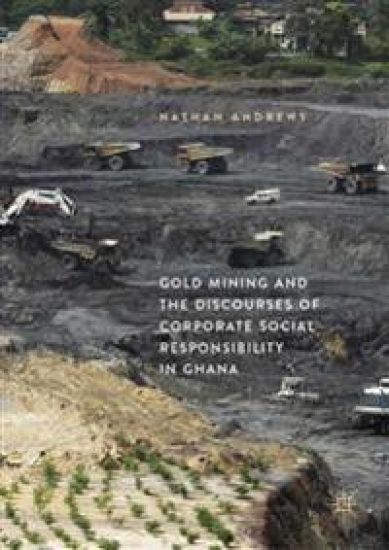
Gold Mining and the Discourses of Corporate Social Responsibility in Ghana
Nathan Andrews
Springer International Publishing AG
2018
sidottu
This book critically examines the practice and meanings of corporate social responsibility (CSR) and how the movement has facilitated a positive and somewhat unquestioned image of the global corporation. Drawing on extensive fieldwork material collected in Ghanaian communities located around the project sites of Newmont Mining Corporation and Kinross Gold Corporation, the monograph employs critical discourse analysis to accentuate how mining corporations use CSR as a discursive alibi to gain legitimacy and dominance over the social order, while determining their own spheres of responsibility and accountability. Hiding behind such notions as ‘social licence to operate’ and ‘best practice,’ corporations are enacted as entities that are morally conscious and socially responsible. Yet, this enactment is contested in host communities, as explored in chapters that examine corporate citizenship, gendered perspectives, and how global CSR norms institutionalize unaccountability.
What Foreign Aid Can and Can't Do in Africa
Nathan Andrews
LAP Lambert Academic Publishing
2010
pokkari