Kirjojen hintavertailu. Mukana 12 466 488 kirjaa ja 12 kauppaa.

Kirjailija

Nathan J. Brown

Kirjat ja teokset yhdessä paikassa: 8 kirjaa, julkaisuja vuosilta 2007-2024, suosituimpien joukossa Autocrats Can't Always Get What They Want. Vertaile teosten hintoja ja tarkista saatavuus suomalaisista kirjakaupoista.

Mukana myös kirjoitusasut: Nathan J Brown

8 kirjaa

Kirjojen julkaisuhaarukka 2007-2024.

Autocrats Can't Always Get What They Want

Autocrats Can't Always Get What They Want

Nathan J Brown; Steven D Schaaf; Samer Anabtawi; Julian G Waller

THE UNIVERSITY OF MICHIGAN PRESS
2024
nidottu
Authoritarianism seems to be everywhere in the political world—even the definition of authoritarianism as any form of non-democratic governance has grown very broad. Attempts to explain authoritarian rule as a function of the interests or needs of the ruler or regime can be misleading. Autocrats Can’t Always Get What They Want argues that to understand how authoritarian systems work we need to look not only at the interests and intentions of those at the top, but also at the inner workings of the various parts of the state. Courts, elections, security force structure, and intelligence gathering are seen as structured and geared toward helping maintain the regime. Yet authoritarian regimes do not all operate the same way in the day-to-day and year-to-year tumble of politics. In Autocrats Can’t Always Get What They Want, the authors find that when state bodies form strong institutional patterns and forge links with key allies both inside the state and outside of it, they can define interests and missions that are different from those at the top of the regime. By focusing on three such structures (parliaments, constitutional courts, and official religious institutions), the book shows that the degree of autonomy realized by a particular part of the state rests on how thoroughly it is institutionalized and how strong its links are with constituencies. Instead of viewing authoritarian governance as something that reduces politics to rulers’ whims and opposition movements, the authors show how it operates—and how much what we call “authoritarianism” varies.
Autocrats Can't Always Get What They Want

Autocrats Can't Always Get What They Want

Nathan J Brown; Steven D Schaaf; Samer Anabtawi; Julian G Waller

THE UNIVERSITY OF MICHIGAN PRESS
2024
sidottu
Authoritarianism seems to be everywhere in the political world—even the definition of authoritarianism as any form of non-democratic governance has grown very broad. Attempts to explain authoritarian rule as a function of the interests or needs of the ruler or regime can be misleading. Autocrats Can’t Always Get What They Want argues that to understand how authoritarian systems work we need to look not only at the interests and intentions of those at the top, but also at the inner workings of the various parts of the state. Courts, elections, security force structure, and intelligence gathering are seen as structured and geared toward helping maintain the regime. Yet authoritarian regimes do not all operate the same way in the day-to-day and year-to-year tumble of politics. In Autocrats Can’t Always Get What They Want, the authors find that when state bodies form strong institutional patterns and forge links with key allies both inside the state and outside of it, they can define interests and missions that are different from those at the top of the regime. By focusing on three such structures (parliaments, constitutional courts, and official religious institutions), the book shows that the degree of autonomy realized by a particular part of the state rests on how thoroughly it is institutionalized and how strong its links are with constituencies. Instead of viewing authoritarian governance as something that reduces politics to rulers’ whims and opposition movements, the authors show how it operates—and how much what we call “authoritarianism” varies.

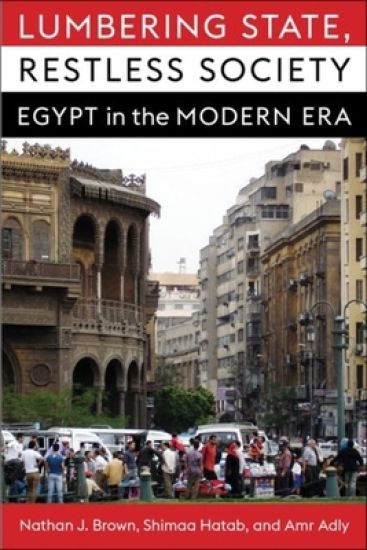
Lumbering State, Restless Society

Lumbering State, Restless Society

Nathan J. Brown; Shimaa Hatab; Amr Adly

Columbia University Press
2021
sidottu
Lumbering State, Restless Society offers a comprehensive and compelling understanding of modern Egypt. Nathan J. Brown, Shimaa Hatab, and Amr Adly guide readers through crucial developments in Egyptian politics, society, and economics from the middle of the twentieth century through the present. Integrating diverse perspectives and areas of expertise, including the tools of comparative politics, the book provides an accessible and clear introduction to the Egypt of today alongside an innovative and rigorous analysis of the country’s history and governance.Brown, Hatab, and Adly highlight ways in which Egypt resembles other societies around the world, drawing from and contributing to broader debates in political science. They trace the emergence of a powerful and intrusive state alongside a society that is increasingly politicized, and they emphasize how the rulers and regimes who have built and steered the state apparatus have also had to retreat and recalibrate. The authors also examine why authoritarianism, corporatism, and socialism have decayed without resulting in a liberal democratic order, and they show why Egyptian politics should not be understood in terms of a single dominant force but rather an interplay among many actors. At once current, insightful, and engaging, Lumbering State, Restless Society delivers a powerful and distinctive account of modern Egypt in the modern world.
Lumbering State, Restless Society

Lumbering State, Restless Society

Nathan J. Brown; Shimaa Hatab; Amr Adly

Columbia University Press
2021
pokkari
Lumbering State, Restless Society offers a comprehensive and compelling understanding of modern Egypt. Nathan J. Brown, Shimaa Hatab, and Amr Adly guide readers through crucial developments in Egyptian politics, society, and economics from the middle of the twentieth century through the present. Integrating diverse perspectives and areas of expertise, including the tools of comparative politics, the book provides an accessible and clear introduction to the Egypt of today alongside an innovative and rigorous analysis of the country’s history and governance.Brown, Hatab, and Adly highlight ways in which Egypt resembles other societies around the world, drawing from and contributing to broader debates in political science. They trace the emergence of a powerful and intrusive state alongside a society that is increasingly politicized, and they emphasize how the rulers and regimes who have built and steered the state apparatus have also had to retreat and recalibrate. The authors also examine why authoritarianism, corporatism, and socialism have decayed without resulting in a liberal democratic order, and they show why Egyptian politics should not be understood in terms of a single dominant force but rather an interplay among many actors. At once current, insightful, and engaging, Lumbering State, Restless Society delivers a powerful and distinctive account of modern Egypt in the modern world.
Arguing Islam after the Revival of Arab Politics

Arguing Islam after the Revival of Arab Politics

Nathan J. Brown

Oxford University Press Inc
2016
sidottu
For much of its modern history, a combination of deep nervousness and profound lack of interest seemed to inhibit or even prevent regular political conversations in the Arab World. Public spaces were devoid of political discussions: public squares in major cities showed no signs of assemblies for political purposes. If one picked up a newspaper, one was more likely to read about the comings and goings of officials rather than any sort of comprehensive political coverage. In the wake of the Arab Spring, newer media and older forms (such as the daily newspaper) have gradually made it easier for Middle East countries to participate in public debates from a variety of ideological perspectives. The state retreat from social welfare commitments have opened opportunities for a host of new informal groups and organizations to operate in areas previously dominated by officially-controlled bodies. These trends have obviously been noticed by social scientists, but scholars who focus on the large-scale political changes tend to edge into a celebratory tone: the changes are seen as potentially democratizing. Arguing Islam after the Revival of Arab Politics presents an understanding the "revived" forms of Arab politics as they really are, and does not speculate about the democratic future these changes could signal. In particular, this book examines various sites of Arab public life to explore how politics operates. Four kinds of public spheres are brought into focus: small group discussions that straddle the public/private divide (such as diwaniyyas in Kuwait or piety groups in Egypt), public spaces of assembly (such as public squares and mosques), media (both new and old), and parliaments (an institution etymologically founded in philosophizing and pontificating rather than legislating). Further, the author gives due attention to the ways in which these spheres interact to explore how these gradations, affirmations, and subversions of hierarchy, status, and power make up the current political landscape of the Middle East. The resulting work is one that is able to bridge disciplinary boundaries, offering understandings of the new political sphere. Designed to speak beyond a scholarly audience, this volume will contribute to broader public understandings of Islam in practice and of Arab politics as those who participate in it experience it.
When Victory Is not an Option

When Victory Is not an Option

Nathan J. Brown

Cornell University Press
2012
pokkari
Throughout the Arab world, Islamist political movements are joining the electoral process. This change alarms some observers and excites other. In recent years, electoral opportunities have opened, and Islamist movements have seized them. But those opportunities, while real, have also been sharply circumscribed. Elections may be freer, but they are not fair. The opposition can run but it generally cannot win. Semiauthoritarian conditions prevail in much of the Arab world, even in the wake of the Arab Spring. How do Islamist movements change when they plunge into freer but unfair elections? How do their organizations (such as the Muslim Brotherhood) and structures evolve? What happens to their core ideological principles? And how might their increased involvement affect the political system? In When Victory Is Not an Option, Nathan J. Brown addresses these questions by focusing on Islamist movements in Egypt, Jordan, Kuwait, and Palestine. He shows that uncertain benefits lead to uncertain changes. Islamists do adapt their organizations and their ideologies do bend—some. But leaders almost always preserve a line of retreat in case the political opening fizzles or fails to deliver what they wish. The result is a cat-and-mouse game between dominant regimes and wily movements. There are possibilities for more significant changes, but to date they remain only possibilities.
When Victory Is not an Option

When Victory Is not an Option

Nathan J. Brown

Cornell University Press
2012
sidottu
Throughout the Arab world, Islamist political movements are joining the electoral process. This change alarms some observers and excites other. In recent years, electoral opportunities have opened, and Islamist movements have seized them. But those opportunities, while real, have also been sharply circumscribed. Elections may be freer, but they are not fair. The opposition can run but it generally cannot win. Semiauthoritarian conditions prevail in much of the Arab world, even in the wake of the Arab Spring. How do Islamist movements change when they plunge into freer but unfair elections? How do their organizations (such as the Muslim Brotherhood) and structures evolve? What happens to their core ideological principles? And how might their increased involvement affect the political system? In When Victory Is Not an Option, Nathan J. Brown addresses these questions by focusing on Islamist movements in Egypt, Jordan, Kuwait, and Palestine. He shows that uncertain benefits lead to uncertain changes. Islamists do adapt their organizations and their ideologies do bend—some. But leaders almost always preserve a line of retreat in case the political opening fizzles or fails to deliver what they wish. The result is a cat-and-mouse game between dominant regimes and wily movements. There are possibilities for more significant changes, but to date they remain only possibilities.
The Rule of Law in the Arab World

The Rule of Law in the Arab World

Nathan J. Brown

Cambridge University Press
2007
pokkari
Nathan Brown's penetrating account of the development and operation of the courts in the Arab world is based on fieldwork in Egypt and the Gulf. The book addresses several important questions. Why, for example, did Egypt's political leaders construct an independent judicial system that limited their own authority? And why does such a system appeal to Arab rulers outside Egypt? While most accounts stress the role of imperialism or liberal ideology, the author maintains that the primary purpose of the system is to provide support for the officially sanctioned order. The model offers similar attractions for other Arab rulers. From the theoretical perspective, the book will contribute to the debates about liberal legality, political change and the relationship between law and society in the developing world. It will be read by scholars of the Middle East, law students and those interested in the history of law and its evolution.