Kirjojen hintavertailu. Mukana 12 508 305 kirjaa ja 12 kauppaa.

Kirjailija

Nathan Keyfitz

Kirjat ja teokset yhdessä paikassa: 7 kirjaa, julkaisuja vuosilta 1984-2015, suosituimpien joukossa Demography Through Problems. Vertaile teosten hintoja ja tarkista saatavuus suomalaisista kirjakaupoista.

7 kirjaa

Kirjojen julkaisuhaarukka 1984-2015.

Mathematical Demography

Mathematical Demography

David P. Smith; Nathan Keyfitz

Springer-Verlag Berlin and Heidelberg GmbH Co. K
2015
nidottu
Mathematical demography is the centerpiece of quantitative social science. The founding works of this field from Roman times to the late Twentieth Century are collected here, in a new edition of a classic work by David R. Smith and Nathan Keyfitz. Commentaries by Smith and Keyfitz have been brought up to date and extended by Kenneth Wachter and Hervé Le Bras, giving a synoptic picture of the leading achievements in formal population studies. Like the original collection, this new edition constitutes an indispensable source for students and scientists alike, and illustrates the deep roots and continuing vitality of mathematical demography.

Mathematical Demography

Mathematical Demography

David P. Smith; Nathan Keyfitz

Springer-Verlag Berlin and Heidelberg GmbH Co. K
2013
sidottu
Mathematical demography is the centerpiece of quantitative social science. The founding works of this field from Roman times to the late Twentieth Century are collected here, in a new edition of a classic work by David R. Smith and Nathan Keyfitz. Commentaries by Smith and Keyfitz have been brought up to date and extended by Kenneth Wachter and Hervé Le Bras, giving a synoptic picture of the leading achievements in formal population studies. Like the original collection, this new edition constitutes an indispensable source for students and scientists alike, and illustrates the deep roots and continuing vitality of mathematical demography.
Demography Through Problems

Demography Through Problems

Nathan Keyfitz; John A. Beekman

Springer-Verlag New York Inc.
2010
nidottu
The book that follows is an experiment in the teaching of population theory and analysis. A sequence of problems where each is a self-contained puzzle, and the successful solution of each which puts the student in a position to tackle the next, is a means of securing the active participation of the learner and so the mastery of a technical subject. How far our questions are the exciting puzzles at which we aimed, and how far the sequence constitutes a rounded course in demography, must be left to the user to judge. One test of a good problem is whether a solution, that may take hours of cogitation, is immediately recognizable once it comes to mind. While algebraic manipulation is required throughout, we have tried to emphasize problems in which there is some substantive point-a conclusion regarding population that can be put into words. Our title, Demography Through Problems, reflects our intention of leading the reader who will actively commit him-or herself through a sequence that will not only teach definitions-in itself a trivial matter-but sharpen intuition on the way that populations behave.
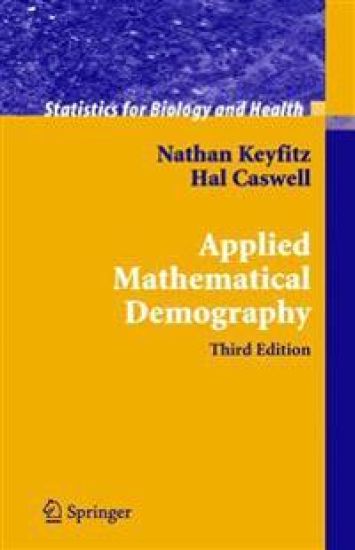
Applied Mathematical Demography

Applied Mathematical Demography

Nathan Keyfitz; Hal Caswell

Springer-Verlag New York Inc.
2010
nidottu
ButIacceptedtheinvitation.Key?tz'ssuggestionthatweincorporatesome of my earlier work on matrix population models seemed like a good way to complement the methods presented in the book, and to expand the range of their applications. I am a demographer of plants and nonhuman animals. Some would call this an oxymoron, since the Greek rootdemos refers to people, and that's us. But there are precedents for taking more inclusive de?nitions of the Greek.Ecologyandeconomics,forexample,bothcomefromtherootoikos, referring to the household. Interpretingdemos as referring to individuals, whether they are persons or not, lets demography apply across species. There is a long tradition of such crossover. Alfred J. Lotka is acknowledged as a founding father of both demography and ecology. Raymond Pearl used demographic methods to analyze the e?ects of toxic substances and cro- ing on fruit ?ies. Lee (1987) compared the density-dependence of the vital rates of human and non-human animals. Today, in studies of senescence, reproduction, and individual heterogeneity, the boundaries between animal and human studies are becoming increasingly blurred (Wachter et al. 1997, Carey 2003, Wachter and Bulatao 2003, Carey and Tuljapurkar 2003).
Applied Mathematical Demography

Applied Mathematical Demography

Nathan Keyfitz; Hal Caswell

Springer-Verlag New York Inc.
2005
sidottu
ButIacceptedtheinvitation.Key?tz'ssuggestionthatweincorporatesome of my earlier work on matrix population models seemed like a good way to complement the methods presented in the book, and to expand the range of their applications. I am a demographer of plants and nonhuman animals. Some would call this an oxymoron, since the Greek rootdemos refers to people, and that's us. But there are precedents for taking more inclusive de?nitions of the Greek.Ecologyandeconomics,forexample,bothcomefromtherootoikos, referring to the household. Interpretingdemos as referring to individuals, whether they are persons or not, lets demography apply across species. There is a long tradition of such crossover. Alfred J. Lotka is acknowledged as a founding father of both demography and ecology. Raymond Pearl used demographic methods to analyze the e?ects of toxic substances and cro- ing on fruit ?ies. Lee (1987) compared the density-dependence of the vital rates of human and non-human animals. Today, in studies of senescence, reproduction, and individual heterogeneity, the boundaries between animal and human studies are becoming increasingly blurred (Wachter et al. 1997, Carey 2003, Wachter and Bulatao 2003, Carey and Tuljapurkar 2003).
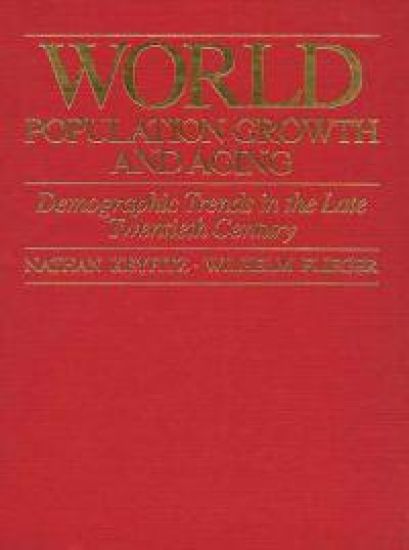
World Population Growth and Aging

World Population Growth and Aging

Nathan Keyfitz; Wilhelm Flieger

University of Chicago Press
1991
sidottu
Drawing data from official sources in 60 countries, as well as from the United Nations and the World Bank, this compendium of statistical information on population, fertility, and mortality treats every one of the UN-recognized countries in at least summary form. With data from 1950 onward and projections through 2020, this volume extends the dataset of Nathan Keyfitz and Wilhelm Flieger's landmark work, World Population: An Analysis of Vital Data (1968), with virtually no overlap. All the life tables, standardized rates, and projections have been generated by uniform methods to ensure easy comparison among countries. More than 800 charts provide a foundation for analyzing the radical demographic changes now taking place: the historic lows of fertility in Germany and other industrial countries, Africa's persistently high fertility, and the worldwide extension of life expectancy. The product of cautious and painstaking labor, this work promises to be an important resource for further demographic research as well as a valuable comparative resource for studies of the status of global social welfare and the environment.
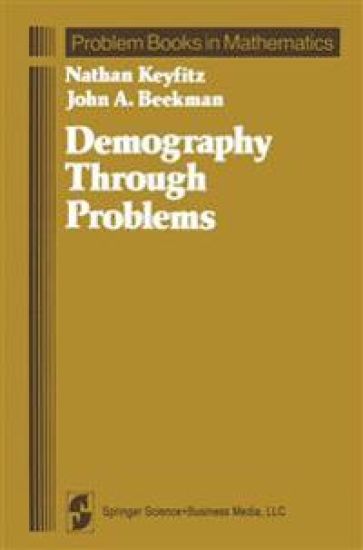
Demography Through Problems

Demography Through Problems

Nathan Keyfitz; John A. Beekman

Springer-Verlag New York Inc.
1984
sidottu
The book that follows is an experiment in the teaching of population theory and analysis. A sequence of problems where each is a self-contained puzzle, and the successful solution of each which puts the student in a position to tackle the next, is a means of securing the active participation of the learner and so the mastery of a technical subject. How far our questions are the exciting puzzles at which we aimed, and how far the sequence constitutes a rounded course in demography, must be left to the user to judge. One test of a good problem is whether a solution, that may take hours of cogitation, is immediately recognizable once it comes to mind. While algebraic manipulation is required throughout, we have tried to emphasize problems in which there is some substantive point-a conclusion regarding population that can be put into words. Our title, Demography Through Problems, reflects our intention of leading the reader who will actively commit him-or herself through a sequence that will not only teach definitions-in itself a trivial matter-but sharpen intuition on the way that populations behave.