Kirjojen hintavertailu. Mukana 12 283 518 kirjaa ja 12 kauppaa.

Kirjailija

Nathan Rotenstreich

Kirjat ja teokset yhdessä paikassa: 19 kirjaa, julkaisuja vuosilta 1963-2011, suosituimpien joukossa Spirit and Man. Vertaile teosten hintoja ja tarkista saatavuus suomalaisista kirjakaupoista.

19 kirjaa

Kirjojen julkaisuhaarukka 1963-2011.

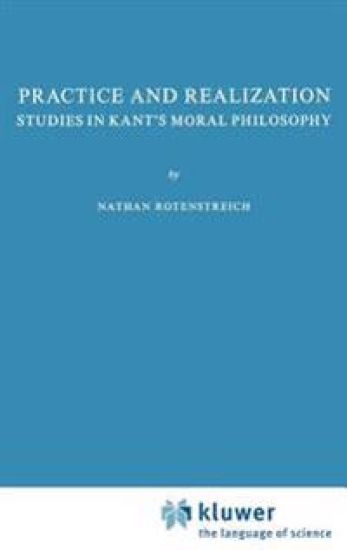
Practice and Realization

Practice and Realization

Nathan Rotenstreich

Springer
2011
nidottu
The present book is an exp]oration of some basic issues of Kant's moral phi­ losophy. The point of departure is the concept offreedom and the self-legisla­ tion of reason. Since self-Iegislation is expressed in the sphere of practice or morality, it is meant to overcome some of the vulnerable aspects of Kant's theoretical philosophy, namely that which Kant himself pointed to and called the 'lucky chance,' in so far as the application of reason to sensuous data is concerned. The book attempts to show that Kant's practical or moral philosophy faces questions which are parallel to those he faced in the sphere ofhis theore­ tical philosophy. The problematic situation of realization of practice is parallel to the problematic situation of application of theory. It is in the line of the problems emerging from Kant's practical philosophy that the present book deals with some of Kant's minor writings, or less-known ones, in­ cluding his writings in the sphere of politics, history and education. The limitations of self-Iegislation - this is the theme of the book. The book is parallel to the author's previous one on Kant: 'Experience and its Systema­ tization - Studies in Kant" (Nijhoff, 1965, 2nd edition 1973), as well as to: "From Substance to Subject -Studies in Hegel" (Nijhoff, 1974). Jerusalem 1978 ABBREVIATIONS As to the references to Kant's major works, the following procedme will be ob­ served: Kritik der reinen Vernunft will be quoted as Kr. d. r. V.
Time and Meaning in History

Time and Meaning in History

Nathan Rotenstreich

Springer
2011
nidottu
There are several characteristics of Nathan Rotenstreich's work which are striking: his thoughtful writings are both subtle and deep; they are steeped in his critical appreciation of other thinkers of this and preceding times, an appreciation which is formed by his learned understanding of the history of philosophy; and with all this, he has an original and independent intelligence. He has from time to time brought his skills to bear upon historical scholarship, most notably perhaps in his book Between Past and Present (1958, 2nd edition, 1973), his interpretive essays in the philosophy of history Philosophy, History and Politics (1976) and his scholarly work concerned with the influence of historical development upon modern Jewish thought, Tradition and Reality (1972). Related to these, and equally works of that philosophical humanity which Professor Rotenstreich embodies, are his Humanism in the Contemporary Era (1963), Spirit and Man: An Essay on Being and Value (1963) and Reflection and Action (1983). Rotenstreich combines both the naturalistic and the phenomenological attitudes in an interesting and illuminating way through the full spectrum of issues in the philosophy of history in this century. Surely he sets boundaries to any doubtful extrapolation. Not only would he bring the understanding of history back from those who claim it as only a positive science but equally would he prevent the transformation of that understanding into merely speculative inquiry.
Synthesis and Intentional Objectivity

Synthesis and Intentional Objectivity

Nathan Rotenstreich

Springer
2010
nidottu
We shall be concemed in the following pages with some issues common to the systems of both Kant and Husserl. Given the structured nature of philosophical systems, however, the topics cannot be isolated from the systems in which they function, imbuing them in each case with a specific direction. An examination of the basic concept of Anschauung will indicate the difference between the two systems. To be sure, Anschauung points in both to the visual aspect of knowledge, an element inherent in the classical concept of theoria, which is related to the word horao, to see. In Kant, however, the visual aspect is not the highest component of cognition, since it is related to sensuality. Anschauung belongs to the synthesis and not the summit of knowledge. It is given before thinking, and is present in the ongoing search for relations between data. In Kant's understanding, pure reason can be related to data only through the medium of understanding. In this sense, we could say that Anschauung, being a variation of Schau, is that which can be perceived with the eyes. In Kant's system, it points to the presence of that which is given and thus to reception, whereas knowledge proper is a synthesis of reception and spontaneity .
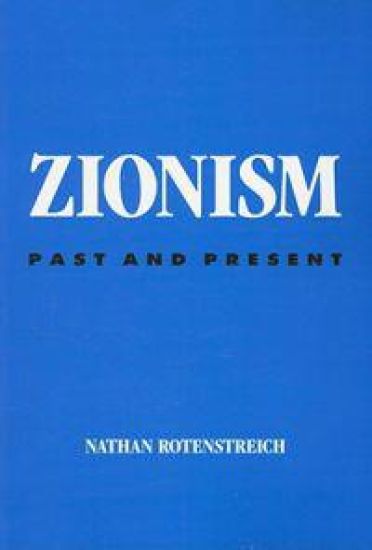
Zionism

Zionism

Nathan Rotenstreich

State University of New York Press
2008
pokkari
Traces the dialectical connections between Zionism's past and present.In Zionism, the late Nathan Rotenstreich traces the dialectical connections between Zionism's past and present based on his contention that the Jewish nation comprises both the State of Israel and the Diaspora. He also addresses relations between both Israel and the Diaspora, on the one hand, and Israel and the Arab world, on the other. Written a short time before Rotenstreich's death, Zionism can be regarded as his spiritual and ideological legacy.
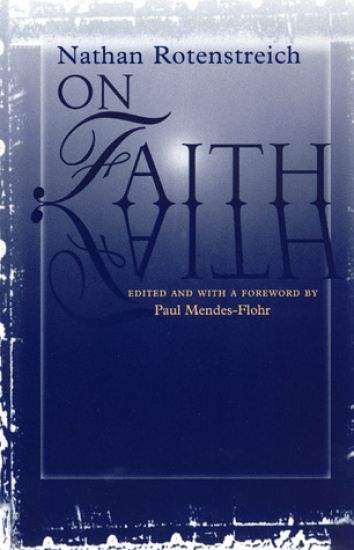
On Faith

On Faith

Nathan Rotenstreich

University of Chicago Press
1998
nidottu
This last work of Nathan Rotenstreich's attempts to detach the concept of faith from its religious underpinnings and consider it in its own right, as a human phenomenon and cognitive attitude. Faith, the author contends, should not be confused with its historical manifestations. By making faith a philosophical rather than a theological matter, he explores its essence as an awareness of how we relate within mundane reality to all that is beyond the human world. Arguing for the intentionality of faith, he shows how it structures a variety of relations that range from the experience of the holy to the nature of cults, traditional religion and the idea of servitude to God.
On Faith

On Faith

Nathan Rotenstreich

University of Chicago Press
1998
sidottu
This last work of Nathan Rotenstreich's attempts to detach the concept of faith from its religious underpinnings and consider it in its own right, as a human phenomenon and cognitive attitude. Faith, the author contends, should not be confused with its historical manifestations. By making faith a philosophical rather than a theological matter, he explores its essence as an awareness of how we relate within mundane reality to all that is beyond the human world. Arguing for the intentionality of faith, he shows how it structures a variety of relations that range from the experience of the holy to the nature of cults, traditional religion and the idea of servitude to God.
Synthesis and Intentional Objectivity

Synthesis and Intentional Objectivity

Nathan Rotenstreich

Springer
1998
sidottu
We shall be concemed in the following pages with some issues common to the systems of both Kant and Husserl. Given the structured nature of philosophical systems, however, the topics cannot be isolated from the systems in which they function, imbuing them in each case with a specific direction. An examination of the basic concept of Anschauung will indicate the difference between the two systems. To be sure, Anschauung points in both to the visual aspect of knowledge, an element inherent in the classical concept of theoria, which is related to the word horao, to see. In Kant, however, the visual aspect is not the highest component of cognition, since it is related to sensuality. Anschauung belongs to the synthesis and not the summit of knowledge. It is given before thinking, and is present in the ongoing search for relations between data. In Kant's understanding, pure reason can be related to data only through the medium of understanding. In this sense, we could say that Anschauung, being a variation of Schau, is that which can be perceived with the eyes. In Kant's system, it points to the presence of that which is given and thus to reception, whereas knowledge proper is a synthesis of reception and spontaneity .
Time and Meaning in History

Time and Meaning in History

Nathan Rotenstreich

Kluwer Academic Publishers
1987
sidottu
There are several characteristics of Nathan Rotenstreich's work which are striking: his thoughtful writings are both subtle and deep; they are steeped in his critical appreciation of other thinkers of this and preceding times, an appreciation which is formed by his learned understanding of the history of philosophy; and with all this, he has an original and independent intelligence. He has from time to time brought his skills to bear upon historical scholarship, most notably perhaps in his book Between Past and Present (1958, 2nd edition, 1973), his interpretive essays in the philosophy of history Philosophy, History and Politics (1976) and his scholarly work concerned with the influence of historical development upon modern Jewish thought, Tradition and Reality (1972). Related to these, and equally works of that philosophical humanity which Professor Rotenstreich embodies, are his Humanism in the Contemporary Era (1963), Spirit and Man: An Essay on Being and Value (1963) and Reflection and Action (1983). Rotenstreich combines both the naturalistic and the phenomenological attitudes in an interesting and illuminating way through the full spectrum of issues in the philosophy of history in this century. Surely he sets boundaries to any doubtful extrapolation. Not only would he bring the understanding of history back from those who claim it as only a positive science but equally would he prevent the transformation of that understanding into merely speculative inquiry.
Practice and Realization

Practice and Realization

Nathan Rotenstreich

Kluwer Academic Publishers
1979
sidottu
The present book is an exp]oration of some basic issues of Kant's moral phi­ losophy. The point of departure is the concept offreedom and the self-legisla­ tion of reason. Since self-Iegislation is expressed in the sphere of practice or morality, it is meant to overcome some of the vulnerable aspects of Kant's theoretical philosophy, namely that which Kant himself pointed to and called the 'lucky chance,' in so far as the application of reason to sensuous data is concerned. The book attempts to show that Kant's practical or moral philosophy faces questions which are parallel to those he faced in the sphere ofhis theore­ tical philosophy. The problematic situation of realization of practice is parallel to the problematic situation of application of theory. It is in the line of the problems emerging from Kant's practical philosophy that the present book deals with some of Kant's minor writings, or less-known ones, in­ cluding his writings in the sphere of politics, history and education. The limitations of self-Iegislation - this is the theme of the book. The book is parallel to the author's previous one on Kant: 'Experience and its Systema­ tization - Studies in Kant" (Nijhoff, 1965, 2nd edition 1973), as well as to: "From Substance to Subject -Studies in Hegel" (Nijhoff, 1974). Jerusalem 1978 ABBREVIATIONS As to the references to Kant's major works, the following procedme will be ob­ served: Kritik der reinen Vernunft will be quoted as Kr. d. r. V.
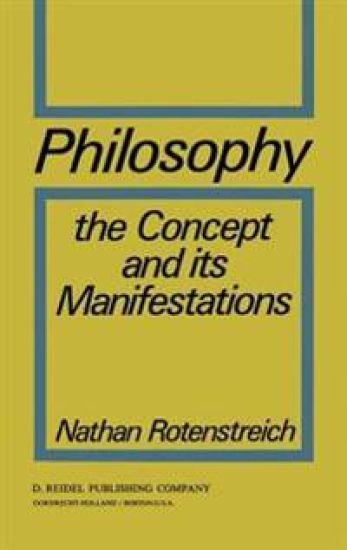
Philosophy

Philosophy

Nathan Rotenstreich

Kluwer Academic Publishers
1972
nidottu
The present book is concerned with the nature of philosophy and with the scope of philosophical interest. It combines an analysis of the major types of philosophical thinking as they emerged in the history of philosophical ideas with an attempt to examine problems which recurrent­ ly emerge in philosophical discourse. It is from this point of view that the historical and the systematic approaches are meant to be mutually reinforcing. I am grateful to my friends who helped me to formulate the line of thinking expressed in this book: Z. Bar-On, A. Margalit, E. I. I. Poznanski, Z. Werblovsky and E. Zemach. Some years ago when I visited the Center for the Study of Democratic Institutions in Santa Barbara, Dr. Robert M. Hutchins encouraged me to write the present book. I am dedicating the book to him not only because of that encouragement but more importantly because as an educational thinker Dr. Hutchins represents the position which assigns to the great ideas of the past validity and value in the analysis of topical problems of the present.
Philosophy

Philosophy

Nathan Rotenstreich

Kluwer Academic Publishers
1972
sidottu
The present book is concerned with the nature of philosophy and with the scope of philosophical interest. It combines an analysis of the major types of philosophical thinking as they emerged in the history of philosophical ideas with an attempt to examine problems which recurrent­ ly emerge in philosophical discourse. It is from this point of view that the historical and the systematic approaches are meant to be mutually reinforcing. I am grateful to my friends who helped me to formulate the line of thinking expressed in this book: Z. Bar-On, A. Margalit, E. I. I. Poznanski, Z. Werblovsky and E. Zemach. Some years ago when I visited the Center for the Study of Democratic Institutions in Santa Barbara, Dr. Robert M. Hutchins encouraged me to write the present book. I am dedicating the book to him not only because of that encouragement but more importantly because as an educational thinker Dr. Hutchins represents the position which assigns to the great ideas of the past validity and value in the analysis of topical problems of the present.