Kirjojen hintavertailu. Mukana 12 282 507 kirjaa ja 12 kauppaa.

Kirjailija

Nathan Sharon

Kirjat ja teokset yhdessä paikassa: 3 kirjaa, julkaisuja vuosilta 1989-2012, suosituimpien joukossa Lectins. Vertaile teosten hintoja ja tarkista saatavuus suomalaisista kirjakaupoista.

3 kirjaa

Kirjojen julkaisuhaarukka 1989-2012.

Lectins

Lectins

Nathan Sharon

Springer
2012
nidottu
A characteristic property of most, or perhaps all, proteins is their ability to combine specifically and reversibly with various substances. Well known examples are enzymes that bind substrates and inhibitors, and antibodies that bind antigens. This book deals with lectins, a class of proteins that bind carbohydrates. Another characteristic property of lectins is that they agglutinate cells or precipitate polysaccharides and glycoproteins. This is because lectins are polyvalent, i.e. each lectin molecule has at least two carbohydrate binding sites to allow crosslinking between cells (by combining with sugars on their surfaces) or between sugar containing macromolecules. The agglutinating and precipitating activities of lectins are very similar to those of antibodies. They can likewise be specifically inhibited by low molecular weight compounds (haptens), which in the case of lectins are sugars or sugar containing compounds (Fig. 1.1). Not surprisingly, therefore, many of the methods used in lectin research are based on immunochemical techniques. Nevertheless, lectins are different from antibodies in several important aspects. Many lectins are found in plants, microorganisms and viruses, which do not synthesize immunoglobulins. In fact, they are found in almost all living organisms (Table 1.1) and are not confined to specific organs or tissues. Another marked difference between the two classes of compound is that antibodies are structurally similar, whereas lectins are structurally diverse. In general, lectins are oligomeric proteins composed of subunits, usually with one sugar binding site per subunit.
Lectins

Lectins

Nathan Sharon; H. Lis

Springer-Verlag New York Inc.
2007
nidottu
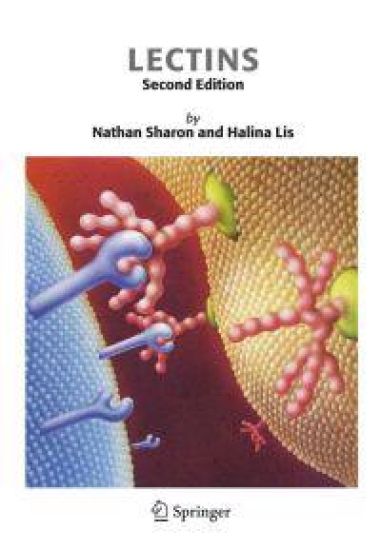
This is the second edition of our little red book Lectins published in 1989. In the intervening years well over 10,000 articles have appeared with lectins as the main subject, and more than twice as many in which they were touched upon, as well as around 20 books. In particular, great strides have been made in several areas of lectin research, about which little was known until the late 1980s. One prominent example is animal lectins, many of which have been discovered only during the last decade and the functions of several of which have been clarified, especially as to their key role in innate immunity. Another is the structure of lectins and of their combining sites. Thus, whereas at that time the three-dimensional structures of just three lectins and a few of their complexes with sugars had been elucidated, their numbers have increased to about 160 and over 200, respectively, and continue to grow unabated. Updating the information on these and other topics resulted in a marked expansion of the book, which is now nearly four times as long as the first edition, with 226 figures and 39 tables. Still, a few topics, such as carbohydrate-binding cytokines or bacterial toxins that are sometimes considered as lectins, have been dealt with only in passing. Similarly to the first edition, Lectins II starts with an overview of the history of lectin research.
Lectins

Lectins

Nathan Sharon; Halina Lis

CHAPMAN AND HALL
1989
sidottu
Lectins are an important group of proteins, which bind to carbohydrates and can agglutinate cells or precipitate polysaccharides and glycoproteins. These agglutinating and precipitating properties are very similar to those of antibodies, and hence many of the methods used in lectin research are based on immunochemical techniques. Lectins are however not of immune origin, and are found in almost all organisms, including plants and micro-organisms. Current interest in lectins derives particularly from their usefulness in detecting and studying carbohydrates in solution and on cell surfaces. Studies of lectin-carbohydrate interactions are providing information on the precise molecular details of the interactions between proteins and carbohydrates in general. Lectins also serve as valuable tools in biological and medical research, in areas as diverse as separation and characterization of glycoproteins and glycopeptides, typing of bacteria and fractionation of lymphocytes and of bone marrow cells. Their biological role is uncertain but is generally believed to be primarily as recognition determinants in mirco-organisms, plants and animals. The purpose of the book is to give an accessible overview of the properties of lectins, their possible roles and their applications in biology and biomedical research in biochemistry and cell biology. This book should be of interest to biochemists, biologists, microbiologists, pathologists, histologists, cancer researchers, immunologists and haematologists.