Kirjojen hintavertailu. Mukana 12 657 676 kirjaa ja 12 kauppaa.

Kirjailija

Neal I. Koblitz

Kirjat ja teokset yhdessä paikassa: 2 kirjaa, julkaisuja vuosilta 1993-2012, suosituimpien joukossa Introduction to Elliptic Curves and Modular Forms. Vertaile teosten hintoja ja tarkista saatavuus suomalaisista kirjakaupoista.

2 kirjaa

Kirjojen julkaisuhaarukka 1993-2012.

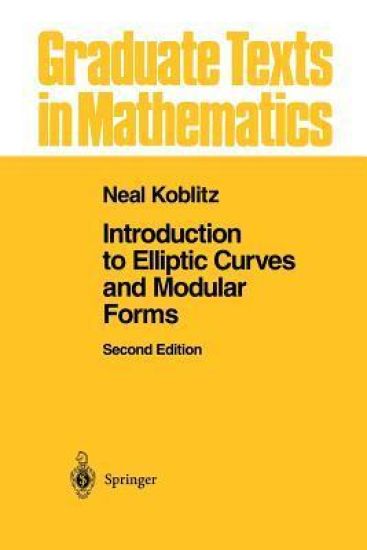
Introduction to Elliptic Curves and Modular Forms

Introduction to Elliptic Curves and Modular Forms

Neal I. Koblitz

Springer-Verlag New York Inc.
2012
nidottu
This textbook covers the basic properties of elliptic curves and modular forms, with emphasis on certain connections with number theory. The ancient "congruent number problem" is the central motivating example for most of the book. My purpose is to make the subject accessible to those who find it hard to read more advanced or more algebraically oriented treatments. At the same time I want to introduce topics which are at the forefront of current research. Down-to-earth examples are given in the text and exercises, with the aim of making the material readable and interesting to mathematicians in fields far removed from the subject of the book. With numerous exercises (and answers) included, the textbook is also intended for graduate students who have completed the standard first-year courses in real and complex analysis and algebra. Such students would learn applications of techniques from those courses. thereby solidifying their under­ standing of some basic tools used throughout mathematics. Graduate stu­ dents wanting to work in number theory or algebraic geometry would get a motivational, example-oriented introduction. In addition, advanced under­ graduates could use the book for independent study projects, senior theses, and seminar work.
Introduction to Elliptic Curves and Modular Forms

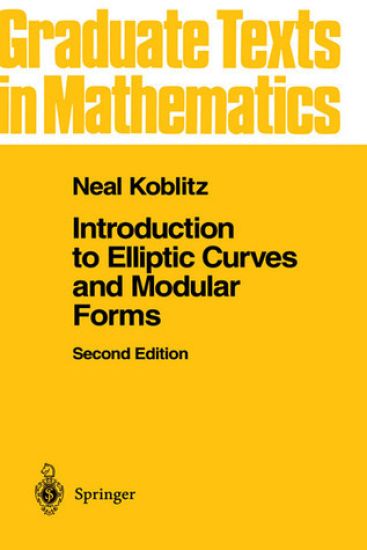
Introduction to Elliptic Curves and Modular Forms

Neal I. Koblitz

Springer-Verlag New York Inc.
1993
sidottu
This textbook covers the basic properties of elliptic curves and modular forms, with emphasis on certain connections with number theory. The ancient "congruent number problem" is the central motivating example for most of the book. My purpose is to make the subject accessible to those who find it hard to read more advanced or more algebraically oriented treatments. At the same time I want to introduce topics which are at the forefront of current research. Down-to-earth examples are given in the text and exercises, with the aim of making the material readable and interesting to mathematicians in fields far removed from the subject of the book. With numerous exercises (and answers) included, the textbook is also intended for graduate students who have completed the standard first-year courses in real and complex analysis and algebra. Such students would learn applications of techniques from those courses. thereby solidifying their under­ standing of some basic tools used throughout mathematics. Graduate stu­ dents wanting to work in number theory or algebraic geometry would get a motivational, example-oriented introduction. In addition, advanced under­ graduates could use the book for independent study projects, senior theses, and seminar work.