

Kirjailija
Neeraj Bhatia
Kirjat ja teokset yhdessä paikassa: 7 kirjaa, julkaisuja vuosilta 2013-2025, suosituimpien joukossa Grey. Vertaile teosten hintoja ja tarkista saatavuus suomalaisista kirjakaupoista.
7 kirjaa
Kirjojen julkaisuhaarukka 2013-2025.

It's a story about ordinary people who get together and do something extraordinary, Life hadn't treated them well, but they decide to take life in their own hands and not only do they manage to change their own lives, they take every common person in the world with them. They create a business model, which changed life of millions and in process they are offered billions, the big question in front of them was what was important? Billions of pounds or billions of people Veer Ajmera, a sales manager for an Insurance broking firm in one square mile, London meets Heidi Truman, an American freelance research journalist, who is part of the panel which independently adjudges the awardees for Insurance industry, where he is one of the nominees. She finds Veer the man she always had looked for and thought didn't exist. He finds her much more than what he had imagined his dream woman to be. After couple of meetings with him, she decides to back out of her wedding with a senior journalist Dirk, who she lives with in USA. While he is waiting one day at a station for Heidi, he comes across a homeless person Pukhraj Thapar, who was his biggest client in the past but had lost everything and had disappeared. Dirk is enraged because he loves Heidi even though she never did, and had helped her financially and somehow convinced her to marry him, but when she walks out of the relation, he makes it difficult to even go back and work in USA. Veer, while looking at news of Egypt, London riots, and Arab unrest combined with what Cheryl said. comes up with a unique business idea around creating a social networking site around the issues in the world which could connect people, where a local issue could have global audience, where people could express their opinion on things that matter. A platform where world could come together for a reason, unrest could be taken from streets and pressure could be increased by a global support to a cause. Unique point in his model was that unlike other sites, he had thought about immediate revenue stream for the site. He shared the idea with Pukhraj and Heidi, who got very excited by it, they also decide to get Jonathan, Cheryl and Pukhraj's ex Secretary Jackie, who had worked in city for 15 years in similar roles and was looking for a change as she was bored to death. All 6 of them meet up, discuss the idea and agree to work together on the project. Pukhraj comes up with a unique idea of raising the initial capital through micro financing unit model. The idea is to get it to a stage where it becomes attractive enough for big player to buy them off in 3 years' time. They decide to call the site GSM - Global Social Mission. They are able to raise some money and partner with an Indian IT company to get the site live and also partner with a small, but capable marketing company, which helps them to launch the site with very successful events in Goa, London, and New york. The site starts becoming very popular and in a year, they manage to make it a concept, which even governments can't ignore. Two major super powers decide to use this platform to reach out to people worldwide by helping them, instead of just aiding governments of developing countries in order to use their influence worldwide. Pukhraj also adds another dimension to the site. He realised that most of the issues are due to unemployment, lack of opportunity and corporate monopoly. He launches a global co-operative model, using micro finance model for initial capital, to set small units of unemployed literates coming together to start their own enterprise and also includes support of corporate world and government to it The site gains ground and crosses 200 million users. And finally the day comes when they are offered 6 billion for their exit. Would they exit?
![Bracket [On Sharing]](/covers/9781957183770.jpg)
Bracket [On Sharing] considers the historic roots of sharing and their relationship to contemporary models of sharing. Sharing is one of humanity’s most basic traits; we intrinsically recognise the benefits of pooling resources within a community in order take advantage of varied abilities and access in order to fulfill needs. The impact of sharing goes beyond simply satisfying the necessities for survival and extends itself into the social and cultural dimensions of our communities. In constructing an urban commons, composed of collectively managed and shared resources, we shape our physical, social, and cultural environments to achieve some degree of shareabilty — whether of goods, services, or experiences. These historic and evolved cultural roots ensure that sharing is inevitably part of our daily lives. Yet, its central role in how we organise and manage our cities is increasingly threatened. Within a context of increased emphasis on the individual and privatization of the commons, sharing holds much promise for re-evaluating our economic, political, and social relations to equitably distribute resources and services at the scale of both the individual and the collective.
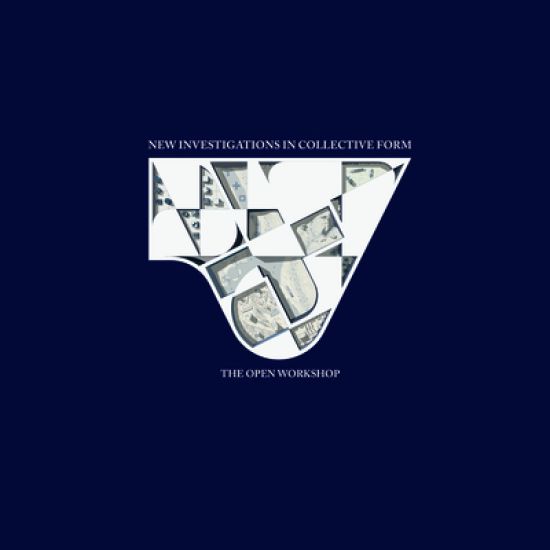
New Investigations in Collective Form presents a group of design experiments by the design-research office THE OPEN WORKSHOP, that test how architecture can empower the diverse voices that make up the public realm and the environments in which they exist. Today, society continues to face urban challenges — from economic inequality to a progressively fragile natural environment — that, in order to be addressed, require us to come together in a moment when what we collectively value is increasingly difficult to locate. Organised into five themes for producing collectively — Frameworks, Articulated Surfaces, the Living Archive, Re-Wiring States, and Commoning — the projects straddle the fine line between the individual and collective, informal, and formal, choice and control, impermanent and permanent.

The rise of several divisive leaders within contemporary politics, has once again brought action to the foreground. As a new generation makes their voices heard, they are also grappling to find effective platforms for action through design. The notion of action simultaneously evokes a discussion on what we are acting for and value. This is particularly important to consider at a moment when the authoritative systems - Governments and corporations - appear more divergent to the voices on the ground. At the same time, within an increasingly pluralistic society, what we collectively value is increasingly unclear, which presents a primary challenge on action. Bracket [Takes Action] is situated at a critical point in history where the who, what, where, and how of action need to be re-conceptualised to relate to who we are, how we live, and how we communicate today. The role of design and the agency of the designer are at stake in facilitating or stifling action. This book presents over 28 essays and 15 design projects that are structured into 6 sub-themes: ReAction, CounterAction, InterAction, FAction, InAction, and RetroAction. The intent of Bracket is to unpack the contemporary possibility of action through design.

![Bracket 2 [Goes Soft]](/covers/9788415391029.jpg)
From soft politics, soft power and soft spaces to fluid territories, software and soft programming, Bracket 2 unpacks the use and role of responsive, indeterminate, flexible, and immaterial systems in design. In an era of declared crises--economic, ecological and climatic, among others--the notion of soft systems has gained increasing traction as a counterpoint to permanent, static and hard systems. Acknowledging fluid and indeterminate situations with complex feedback loops that allow for reaction and adaption, the possibility of soft systems has reentered the domain of design. The examples displayed in "Bracket goes soft" are offered as nothing more than a short catalog of soft systems--some explicitly architectural, others geological, others entirely metaphorical. In all cases, these examples explore how the notion of going soft can be iterated across professions, disciplines, and fields of research. The book is divided into the themes "sensing/feedback"; "interfacing/ enveloping"; "subverting/hijacking"; "formatting/ distributing"; "contingency/ resilience"; "diffusing/generating." Bracket is a book series structured around an open call that highlights emerging critical issues at the juncture of architecture, environment, and digital culture. The editorial board and jury for Bracket 2 includes Benjamin Bratton, Julia Czerniak, Jeffrey Inaba, Geoff Manaugh, Philippe Rahm, Charles Renfro, as well as co-editors Neeraj Bhatia and Lola Sheppard. Bracket is a collaboration between InfraNet Lab and Archinect.