Kirjojen hintavertailu. Mukana 12 152 606 kirjaa ja 12 kauppaa.

Kirjailija

Neil Holbrook

Kirjat ja teokset yhdessä paikassa: 6 kirjaa, julkaisuja vuosilta 1991-2017, suosituimpien joukossa The Western Cemetery of Roman Cirencester. Vertaile teosten hintoja ja tarkista saatavuus suomalaisista kirjakaupoista.

6 kirjaa

Kirjojen julkaisuhaarukka 1991-2017.

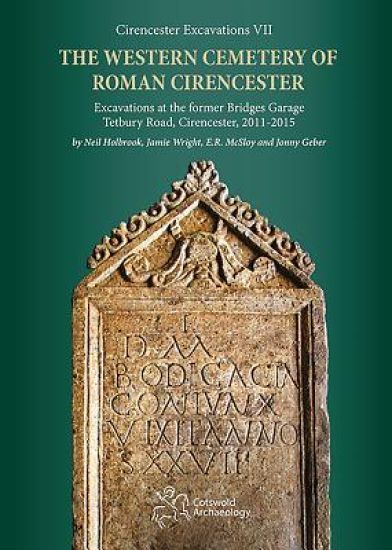
The Western Cemetery of Roman Cirencester

The Western Cemetery of Roman Cirencester

Neil Holbrook; Jamie Wright; E.R. McSloy; Jonny Geber

Cotswold Archaeological Trust Ltd
2017
sidottu
Excavations in 2011 to 2015 within the Western Cemetery of Roman Cirencester resulted in the discovery of 118 inhumation and 8 cremation burials, the largest investigation of a Roman cemetery in Cirencester since the Bath Gate excavations of the 1970s. A greater quantity of grave goods was recovered from this cemetery compared to the Bath Gate cemetery, testifying to the higher status of those buried here. Nine burials survived within a postulated walled cemetery. The pottery from the fills of these graves had a clear emphasis on amphorae, flagons and tazze, indicative of funerary ceremonies involving the consumption of wine, or the pouring of it as libations, and the burning of substances. Just outside the walled cemetery, the burial of a 2 to 3-year-old child contained a magnificent enamelled bronze figurine of a cockerel, dateable to the 2nd century AD. Such figurines are rare finds, with only four or five similar examples known from Britain. Burial activity continued into the 4th century AD. One unusual later grave had a reused sculpted and inscribed tombstone placed face down immediately over the coffin of an adult male. Only 15 inscribed tombstones have been previously recorded from Cirencester so this is a noteworthy discovery, made all the more important by its archaeological context. The tombstone is dedicated to a 27-year-old woman named Bodicacia and has a fine sculpted pediment containing a representation of the god Oceanus. Significantly the god’s face and claws were deliberately mutilated prior to its placement within the grave, which could be a very rare example of Christian iconoclasm from Roman Britain.
Iron Age and Romano-British Agriculture in the North Gloucestershire Severn Vale
Two reports are published in this volume: Prehistoric and Early Historic Activity, Settlement and Burial at Walton Cardiff, near Tewkesbury: Excavations at Rudgeway Lane 2004-2005 (by Jonathan Hart and E.R. McSloy), and Romano-British Agriculture at the former St James's Railway Station, Cheltenham: Excavations in 2000-2001 (by Laurent Coleman and Martin Watts). Significant remains from Rudgeway Lane include two Middle Bronze Age parallel ditches (the remains of an enclosure, or possibly a long barrow), and a Middle Iron Age enclosure superseded by 1st century AD unenclosed settlement, that was in turn replaced by a 2nd to late 3rd-century AD enclosed rectilinear settlement featuring a roundhouse, a well, several burials and an associated trackway. Two 6th-century burials, one with grave goods, were later made within the abandoned farmstead. At the St James's site in Cheltenham, excavation revealed a field system that was used and developed throughout the Roman period, together with a number of pits and postholes, with two late 4th century AD burials.
Cirencester Excavations VI

Cirencester Excavations VI

Neil Holbrook

Cotswold Archaeological Trust Ltd
2008
nidottu
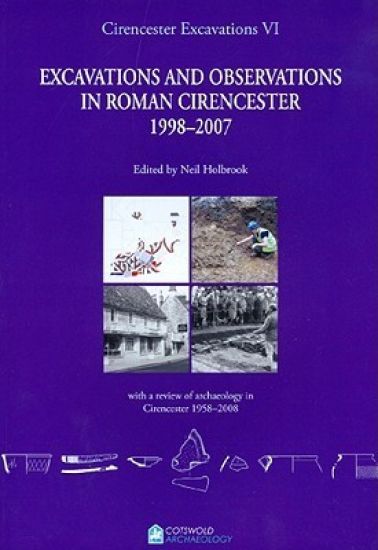
This volume presents the results of a number of excavations undertaken in Cirencester in the last decade which have examined houses, shops, public buildings (including the forum), town defences and cemeteries. Excavations within insula IX found a previously unrecorded corridor mosaic, while work within the western cemetery has revealed interesting evidence for early Roman cremation ritual, along with later Roman inhumation burials. The publication of this volume marks the fiftieth anniversary of the formation of the Cirencester Excavation Committee, and an introductory essay charts the changing circumstances in which archaeology has been practiced in the town over the last fifty years.
Later Prehistoric and Romano-British Burial and Settlement at Hucclecote, Gloucestershire

Later Prehistoric and Romano-British Burial and Settlement at Hucclecote, Gloucestershire

Alan Thomas; Neil Holbrook; Clifford Bateman

Cotswold Archaeological Trust Ltd
2003
nidottu
Excavations in advance of the construction of the Gloucester Business Park Link Road, Hucclecote, in 1998 revealed alluvium deposited by the Horsbere Brook, in places up to 2m deep. Radiocarbon dating demonstrates that the alluvium had been deposited by the 12th century BC. Three or four Middle Bronze Age cremation burials were probably part of a flat cemetery, the site subsequently occupied by a Late Bronze Age or Early Iron Age settlement which contained in excess of four post-built roundhouses. In the 1st century AD a settlement that contained a number of probable mass-walled roundhouses was constructed. It was extensively reorganised in the early 2nd century when a series of ditched enclosures were linked to Ermin Street by a 320m-long trackway. A small cemetery of 12 inhumations is noteworthy as it demonstrates that the Late Iron Age tradition of burial by crouched inhumation persisted into the 2nd century AD. Several of the burials were accompanied by grave goods, and one of the males suffered from a very rare form of dwarfism to his forearms, a condition that would have been obvious to his contemporaries. The settlement continued in use until the late 3rd or early 4th century, although the trackway ditches continued to accumulate material into the later 4th century. The trackway and enclosures appear to have survived as visible earthworks into the medieval period as their orientation influenced the alignment of medieval field systems.
Roman Finds From Exeter

Roman Finds From Exeter

Neil Holbrook; Paul T. Bidwell

UNIVERSITY OF EXETER PRESS
1991
nidottu
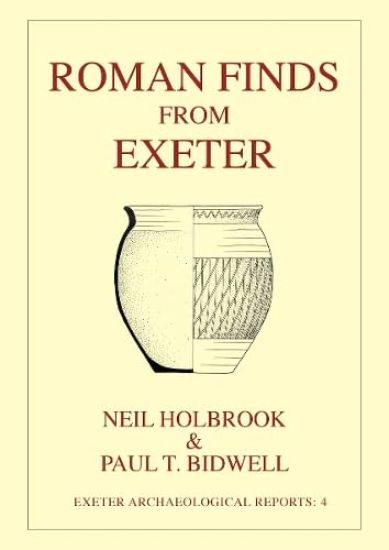
Exeter, fortress of the Second Augustan Legion and subsequently the capital of the civitas Dumnoniorum, played an important part in the history of Roman Britain. This comprehensive study of finds from Exeter throws new light on the economy of south-west England and its foreign trade in Roman times. There are extensive type-series of Roman pottery found in the South West, based not only on first-hand study of material from Exeter but also from throughout the region, and detailed catalogues of the many imports by K. Greene, K.Hartley, V. Rigby, V. Swan and others. Finds apart from pottery include Roman coins (R. Reece and N. Shiel) and small finds (L. Allason-Jones); the many alleged finds of Byzantine and other Eastern Mediterranean coins are shown to be spurious by G. Boon. Wide-ranging discussions assess the significance of the finds for the history of the Roman fortress and town and for the local economy.