Kirjojen hintavertailu. Mukana 12 595 353 kirjaa ja 12 kauppaa.

Kirjailija

Neil J. Salkind

Kirjat ja teokset yhdessä paikassa: 14 kirjaa, julkaisuja vuosilta 2004-2026, suosituimpien joukossa Tests & Measurement for People Who (Think They) Hate Tests & Measurement. Vertaile teosten hintoja ja tarkista saatavuus suomalaisista kirjakaupoista.

14 kirjaa

Kirjojen julkaisuhaarukka 2004-2026.

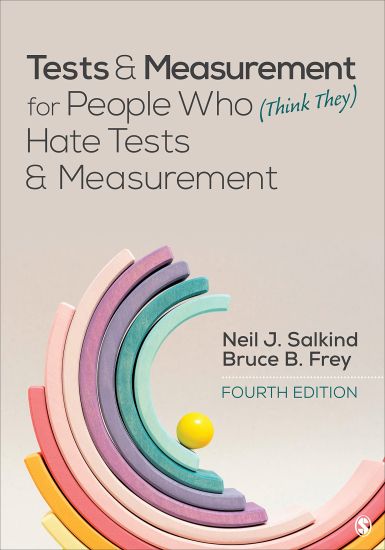
Tests & Measurement for People Who (Think They) Hate Tests & Measurement

Tests & Measurement for People Who (Think They) Hate Tests & Measurement

Neil J. Salkind; Bruce B. Frey

SAGE PUBLICATIONS INC
2022
nidottu
With a signature, conversational writing style and straightforward presentation, Neil J. Salkind’s best-selling Tests & Measurement for People Who (Think They) Hate Tests & Measurement guides readers through an overview of categories of tests, the design of tests, the use of tests, and some of the basic social, political, and legal issues that the process of testing involves. New co-author Bruce B. Frey has streamlined the table of contents for ease of use; added more content on validity and reliability throughout; more closely connected standardized tests to classroom instruction, adding more on classroom assessment; and added a chapter on surveys and scale development. An instructor website includes a test bank and PowerPoint slides.
Statistics for People Who (Think They) Hate Statistics

Statistics for People Who (Think They) Hate Statistics

Neil J. Salkind; Bruce B. Frey

Sage Publications Inc Ebooks
2026
nidottu
This Sixth Edition of Salkind and Frey's Statistics for People Who (Think They) Hate Statistics: Using Microsoft Excel, presents an often intimidating and difficult subject in a way that is clear, informative, and personable. This edition notably offers Excel 2025 for use in statistical analysis, including updated graphics and coverage of how to use functions and formulas.
Statistics for People Who (Think They) Hate Statistics

Statistics for People Who (Think They) Hate Statistics

Neil J. Salkind; Bruce B. Frey

SAGE PUBLICATIONS INC
2025
nidottu
The bestselling Statistics for People Who (Think They) Hate Statistics teaches an often intimidating and difficult subject in a way that is informative, personable, and clear. In the Eighth Edition, the authors take students through various statistical procedures, beginning with correlation and graphical representation of data and ending with inferential techniques and analysis of variance.
Statistics for People Who (Think They) Hate Statistics

Statistics for People Who (Think They) Hate Statistics

Neil J. Salkind; Bruce B. Frey

Sage Publications, Inc
2025
irtolehti
The bestselling Statistics for People Who (Think They) Hate Statistics teaches an often intimidating and difficult subject in a way that is informative, personable, and clear. The authors take students through various statistical procedures, beginning with correlation and graphical representation of data and ending with inferential techniques and analysis of variance. In addition, the text provides instruction in SPSS, and includes reviews of more advanced techniques, such as reliability, validity, introductory non-parametric statistics, and more. The text includes a key feature called "The Path to Wisdom and Knowledge" a flowchart in each of the main chapters showing readers how to select the appropriate test statistic. The Eighth Edition has combined and streamlined chapters so that there are now 14 chapters rather than 19, the end-of-chapter questions have been thoroughly revised, dozens of new research examples have been added, a new section on artificial intelligence chatbots for statistical analyses is provided, the SPSS appendix has been updated for the newest version of the software, and the glossary has been extensively revised and improved for clarity. The text is now available in full color, and available in Sage′s award-winning Vantage learning platform.
Study Guide for Psychology to Accompany Salkind and Frey's Statistics for People Who (Think They) Hate Statistics
This Study Guide for introductory statistics courses in psychology departments is designed to accompany Neil J. Salkind and Bruce B. Frey’s best-selling Statistics for People Who (Think They) Hate Statistics, Seventh Edition. Extra exercises; activities; and true/false, multiple choice, and essay questions (with answers to all questions) feature psychology-specific content to help further student mastery of text concepts. Two additional appendix items in this guide include: Practice with Real Data!, which outlines four experiments and provides students with the datasets to run the analyses, plus Writing Up Your Results – Guidelines based on APA style.
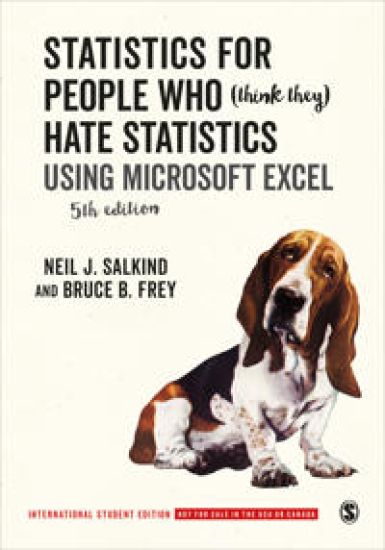
Statistics for People Who (Think They) Hate Statistics - International Student Edition
This Fifth Edition of Neil J. Salkind’s Statistics for People Who (Think They) Hate Statistics: Using Microsoft Excel, presents an often intimidating and difficult subject in a way that is clear, informative, and personable. Opening with an introduction to Excel, including coverage of how to use functions and formulas, this edition shows students how to install the Excel Data Analysis Tools option to access a host of useful analytical techniques. New to the Fifth Edition is new co-author Bruce Frey who has added a new feature on statisticians throughout history (with a focus on the contributions of women and people of color). He has updated the "Real-World Stats" feature, and added more on effect sizes, updated the discussions on hypotheses, measurement concepts like validity and reliability, and has more closely tied analytical choices to the level of measurement of variables.
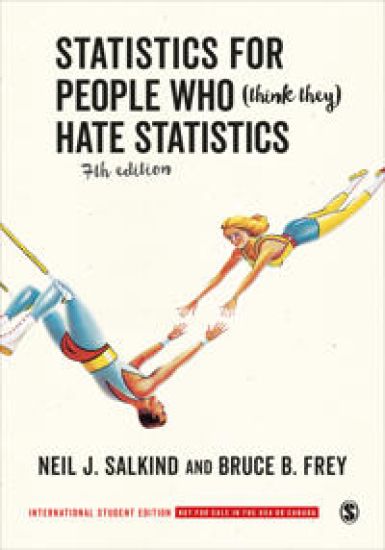
Statistics for People Who (Think They) Hate Statistics - International Student Edition
The bestselling Statistics for People Who (Think They) Hate Statistics is now in its Seventh Edition with new co-author Bruce B. Frey. This text teaches an often intimidating and difficult subject in a way that is informative, personable, and clear. The authors take students through various statistical procedures, beginning with correlation and graphical representation of data and ending with inferential techniques and analysis of variance. In addition, the text provides instruction in SPSS, and includes reviews of more advanced techniques, such as reliability, validity, introductory non-parametric statistics, and more. The text includes a key feature called "The Path to Wisdom and Knowledge": a flowchart in each of the main chapters showing readers how to select the appropriate test statistic. The new edition includes more on multiple regression, power and effect size, and a new feature on statisticians throughout history called "People Who Loved Statistics". Retaining the student-friendly tone and presentation that made this text an international bestseller, new co-author Bruce Frey has added new examples, and reworked or expanded the explanations of many concepts to provide extra clarity.
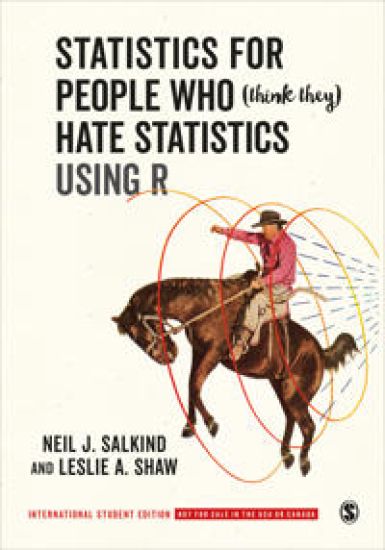
Statistics for People Who (Think They) Hate Statistics Using R - International Student Edition
Neil J. Salkind’s best-selling Statistics for People Who (Think They) Hate Statistics has been helping ease student anxiety around an often intimidating subject since it first published in 2000. Now the bestselling SPSS and Excel versions are joined by a first edition of the text for use with the R software. New co-author Leslie A. Shaw carries forward Neil’s signature humorous, personable, and informative approach. The text guides students through various statistical procedures, beginning with descriptive statistics, correlation, and graphical representation of data, and ending with inferential techniques and analysis of variance. Features and benefits: · Lots of support for getting started with R: Included are two introductory chapters on R and on R Studio, plus an appendix on other R packages and resource sites. · Step-by-step demonstrations of each statistical procedure in R: The authors show how to import the dataset, enter the syntax to run the test, and understand the output. · Additional resources make it easy to transition to this text, and to R: Code and datasets are available on an accompanying website, which also includes screencast R tutorial videos for students, and PowerPoint slides and additional test questions for instructors.
Statistics for People Who (Think They) Hate Statistics

Statistics for People Who (Think They) Hate Statistics

Neil J. Salkind; Bruce B. Frey

Sage Publications, Inc
2019
nidottu
Now in its Seventh Edition, Neil J. Salkind's bestselling Statistics for People Who (Think They) Hate Statistics with new co-author Bruce B. Frey teaches an often intimidating subject with a humorous, personable, and informative approach that reduces statistics anxiety. With instruction in SPSS(R), the authors guide students through basic and advanced statistical procedures, from correlation and graph creation to analysis of variance, regression, non-parametric tests, and more. The Seventh Edition includes new real-world examples, additional coverage on multiple regression and power and effect size, and a robust interactive eBook with video tutorials and animations of key concepts. In the end, students who (think they) hate statistics will understand how to explain the results of many statistical analyses and won't be intimidated by basic statistical tasks. A Complete Teaching & Learning Package accompanies the Seventh Edition Interactive eBook: Save when bundled with the Seventh Edition. Includes access to SAGE Premium Video, multimedia tools, and much more Use bundle ISBN: 978-1-5443-9339-1. SAGE Premium Video includes animated Core Concepts in Stats Videos, Lightboard Lecture Videos from Bruce B. Frey, and tutorial videos for end-of-chapter of SPSS problems. Only available in the Interactive eBook. SAGE edge: FREE online resources for students that make learning easier. SAGE coursepacks: FREE Easily import our quality instructor and student resource content into your school's learning management system (LMS) and save time. Study Guides: only $5 when bundled with Statistics for People Who (Think They) Hate Statistics, 7e. To order: Study Guide and Interactive eBook bundle (ISBN 978-1-5443-9752-8) Study Guide for Psychology and Interactive eBook bundle (ISBN 978-1-5443-9753-5) Study Guide for Education and Interactive eBook bundle (ISBN 978-1-5443-9754-2) Study Guide for Health & Nursing and Interactive eBook bundle (ISBN 978-1-5443-9755-9)
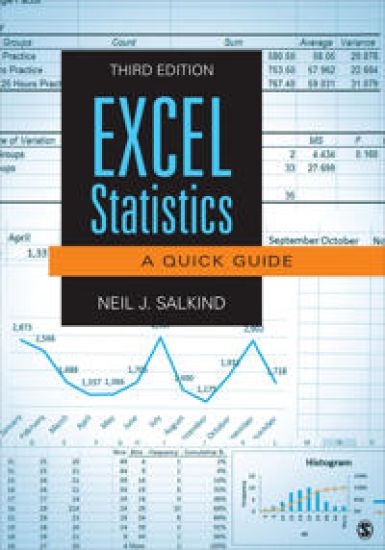
Excel Statistics

Excel Statistics

Neil J. Salkind

SAGE Publications Inc
2015
nidottu
Ideal for those already familiar with basic Excel features, this updated Third Edition of Neil J. Salkind’s Excel Statistics: A Quick Guide shows readers how to utilize Microsoft® Excel’s functions and Analysis ToolPak to answer simple and complex questions about data. Part I explores 35 Excel functions, while Part II contains 20 Analysis ToolPak tools. To make it easy to see what each function or tool looks like when applied, at-a-glance two-page spreads describe each function and its use with corresponding screenshots. In addition, actual data files used in the examples are readily available online at an open-access Student Study Site.
100 Questions (and Answers) About Statistics

100 Questions (and Answers) About Statistics

Neil J. Salkind

SAGE Publications Inc
2014
nidottu
In an increasingly data-driven world, it is more important than ever for students as well as professionals to better understand basic statistical concepts. 100 Questions (and Answers) About Statistics addresses the essential questions that students ask about statistics in a concise and accessible way. It is perfect for instructors, students, and practitioners as a supplement to more comprehensive materials, or as a desk reference with quick answers to the most frequently asked questions.
100 Questions (and Answers) About Research Methods

100 Questions (and Answers) About Research Methods

Neil J. Salkind

SAGE Publications Inc
2011
nidottu
"How do I create a good research hypothesis?""How do I know when my literature review is finished?""What is the difference between a sample and a population?""What is power and why is it important?"In an increasingly data-driven world, it is more important than ever for students as well as professionals to better understand the process of research. This invaluable guide answers the essential questions that students ask about research methods in a concise and accessible way.
Encyclopedia of Measurement and Statistics

Encyclopedia of Measurement and Statistics

Neil J. Salkind

SAGE Publications Inc
2006
muu
The study of measurement and statistics can be less than inviting. However, in fields as varying as education, politics, and health care, assessment and the use of measurement and statistics have become integral parts of almost every activity undertaken. These activities require the organization of ideas, the generation of hypotheses, the collection of data, and the interpretation, illustration, and analysis of data. No matter where educated people look, this critical analysis is more important than ever in an age where information—and lots of it—is readily available. The ideas and tools contained in the Encyclopedia of Measurement and Statistics are approachable and can be invaluable for understanding a very technical world and the increasing flow of information. Although there are references that cover statistics and assessment in depth, none provides as comprehensive a resource in as focused and accessible a manner as the three volumes of this Encyclopedia. Through approximately 500 contributions, experts provide an overview and an explanation of the major topics in these two areas. Key Features Covers every major facet of these two different, but highly integrated disciplines—from mean, mode, and median to reliability, validity, significance, correlation, and much more—all without overwhelming the informed reader Offers cross-disciplinary coverage, with contributions from and applications to the fields of Psychology, Education, Sociology, Human Development, Political Science, Business and Management, Public Health, and others Provides cross-reference terms, further readings, and Web site URLs following most entries, as well as an extensive set of appendices and an annotated list of organizations relevant to measurement and statisticsAppendices FeaturesAppendix A is a guide to basic statistics for those readers who might like an instructional step-by-step presentation of basic concepts in statistics and measurement Appendix B is a table of critical values used in hypothesis testing and an important part of any reference in this area Appendix C represents a collection of some important and useful measurement and statistics Internet sites A primary goal of creating this set of volumes is to open up the broad discipline of measurement and statistics to a wider and more general audience than usual. Edited by bestselling author Neil J. Salkind, this Encyclopedia is specifically designed to appeal to beginning and intermediate-level students, practitioners, researchers, and consumers of information. It is a welcome addition to any academic library.
An Introduction to Theories of Human Development

An Introduction to Theories of Human Development

Neil J. Salkind

SAGE Publications Inc
2004
nidottu
"The book is well written and the theorists and their respective work are well-presented and clearly explained. . . . As a text dealing with the historical overview of major theorists and their work in human development over the last century or so, it is extremely strong and could be widely used in a variety of both undergraduate and graduate courses." —Ann C. Diver-Stamnes, Humboldt State University "In general, I found the websites and references listed at the end of each chapter to be very interesting and useful for taking students beyond what is in the text." —Jane Ledingham, University of Ottawa "A fine choice for a classic theories course, and I believe that the level of presentation would be appropriate for advanced undergraduate or graduate students. . . . The up-to-date web sites at the end of each section are a definite plus. The choice of sites is excellent." —Cosby Steele Rogers, Virginia Tech An Introduction to Theories of Human Development examines the development process, looking at the series of changes that occur as a result of an interaction between biological and environmental factors. Why might our behavior as an adult be so different from when we were infants? Why and how does one stage of development follow the next? Are the changes that we experience abrupt in nature or smooth and predictable? Author Neil J. Salkind reflects on such critical questions to help readers understand what happens along the way as one develops from infancy through later life. This book provides a comprehensive view of the primary theoretical models of human development including those from the biological, psychoanalytic, behavioral, and cognitive developmental perspectives. Along with a brief discussion of a historical background for each of these approaches, An Introduction to Theories of Human Development examines the application of these theories to various aspects of human development, such as the effectiveness of early intervention, individual differences, adolescence, and sociobiology. Features of this text: A final, integrative chapter compares the various theories presented in the book using Murry Sidman's model of six criteria for judging a theory to help develop students' skills for critically assessing theory. Classic approaches to understanding human behavior across the lifespan are also examined. Pedagogical features such as chapter opening quotes, boxed highlights, key terms, a glossary, and websites for further reading enhance student understanding of everyday human behavior.An Introduction to Theories of Human Development is an accessible text for advanced undergraduate students in the social and behavioral sciences including such fields as psychology, education, human services, nursing, sociology, social welfare, and human development and family studies.