Kirjojen hintavertailu. Mukana 12 390 323 kirjaa ja 12 kauppaa.

Kirjailija

Nelson Goodman

Kirjat ja teokset yhdessä paikassa: 10 kirjaa, julkaisuja vuosilta 1976-2023, suosituimpien joukossa La Structure de L'Apparence. Vertaile teosten hintoja ja tarkista saatavuus suomalaisista kirjakaupoista.

10 kirjaa

Kirjojen julkaisuhaarukka 1976-2023.

Kunsti keeled. käsitlus sümbolite teooriast
"Kunsti keeled" on teedrajav käsitlus märgisüsteemidest, mida inimene kasutab oma maailma tunnetamiseks ja kujundamiseks. Lisaks igapäevasele asjaajamisele, teadusele ja tehnikale rakendatakse neid ka kunstides: maalis, skulptuuris, arhitektuuris, muusikas, tantsus, teatris, kinos ja kirjanduses. Nelson Goodman uurib, mille poolest erineb (visuaalne) kujutamine (verbaalsest) kirjeldamisest, miks perspektiiv ja realism on midagi harjumuslikku, millised tähistamisviisid on üldse võimalikud, mis on fiktsioon, metafoor ja väljendus, mille poolest erineb teose võltsing originaalist, millistele tingimustele peab vastama ideaalne märkimisviis ja kuidas eri kunstid nendele vastavad. Viimane peatükk esitab kognitiivse käsitluse kunstist kui maailma tunnetamise vahendist ning pakub välja mõned esteetilisuse sümptomid. Tõlkija saatesõna keskendub Goodmani teooriate radikaalsusele ja konventsionaalsusele.Nelson Goodman (1906-1998) oli üks 20. sajandi Ameerika tähtsamaid filosoofe ja loogikuid. Eesti keeles on ilmunud tema raamat "Kuidas tehakse maailmu" (EKSA, 2014).

La Structure de L'Apparence

La Structure de L'Apparence

Nelson Goodman

Librarie Philosophique J. Vrin
2005
nidottu
Dans La structure de l'apparence, Nelson Goodman met en place les principaux themes philosophiques qui feront de lui un penseur singulier: constructivisme, nominalisme, phenomenalisme et pluralisme s'entrecroisent ici dans l'elaboration d'une pensee aussi subtile que complexe. Ce livre propose une premiere traduction (inedite) d'un texte fondateur de la philosophie analytique.
Of Mind and Other Matters

Of Mind and Other Matters

Nelson Goodman

Harvard University Press
1987
nidottu
Of Mind and Other Matters displays perhaps more vividly than any one of Nelson Goodman’s previous books both the remarkable diversity of his concerns and the essential unity of his thought.Many new studies are incorporated in the book, along with material, often now augmented or significantly revised, that he has published during the last decade. As a whole the volume will serve as a concise introduction to Goodman’s thought for general readers, and will develop its more recent unfoldings for those philosophers and others who have grown wiser with his books over the years.Goodman transcends the narrow “scientism and humanism that set the sciences and the arts in opposition”; his insights derive from both formal philosophy and cognitive psychology. As Hilary Putnam has noted, Goodman “prefers concrete and partial progress to grand and ultimately empty visions”; and here are illuminating studies of topics ranging from science policy and museum administration and art education to narrative in literature and painting and the analysis of elusive aspects of literal and metaphorical reference. All these are ramifications of Goodman’s profound and often revolutionary philosophical work on the ways we understand and even make the worlds we live in.
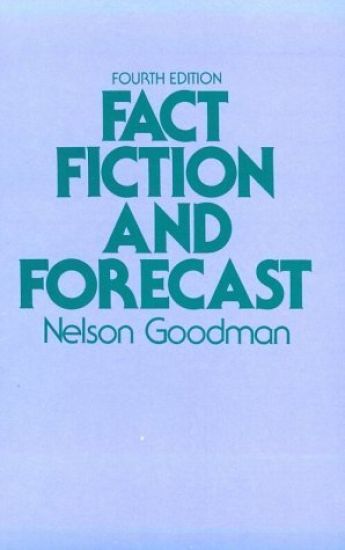
Fact, Fiction, and Forecast

Fact, Fiction, and Forecast

Nelson Goodman; Hilary Putnam

Harvard University Press
1983
nidottu
Here, in a new edition, is Nelson Goodman’s provocative philosophical classic—a book that, according to Science, “raised a storm of controversy” when it was first published in 1954, and one that remains on the front lines of philosophical debate.How is it that we feel confident in generalizing from experience in some ways but not in others? How are generalizations that are warranted to be distinguished from those that are not? Goodman shows that these questions resist formal solution and his demonstration has been taken by nativists like Chomsky and Fodor as proof that neither scientific induction nor ordinary learning can proceed without an a priori, or innate, ordering of hypotheses.In his new foreword to this edition, Hilary Putnam forcefully rejects these nativist claims. The controversy surrounding these unsolved problems is as relevant to the psychology of cognitive development as it is to the philosophy of science. No serious student of either discipline can afford to misunderstand Goodman’s classic argument.
The Structure of Appearance

The Structure of Appearance

Nelson Goodman

Kluwer Academic Publishers
1977
nidottu
With this third edition of Nelson Goodman's The Structure of Appear­ ance, we are pleased to make available once more one of the most in­ fluential and important works in the philosophy of our times. Professor Geoffrey Hellman's introduction gives a sustained analysis and appreciation of the major themes and the thrust of the book, as well as an account of the ways in which many of Goodman's problems and projects have been picked up and developed by others. Hellman also suggests how The Structure of Appearance introduces issues which Goodman later continues in his essays and in the Languages of Art. There remains the task of understanding Good­ man's project as a whole; to see the deep continuities of his thought, as it ranges from logic to epistemology, to science and art; to see it therefore as a complex yet coherent theory of human cognition and practice. What we can only hope to suggest, in this note, is the b. road Significance of Goodman's apparently technical work for philosophers, scientists and humanists. One may say of Nelson Goodman that his bite is worse than his bark. Behind what appears as a cool and methodical analysis of the conditions of the construction of systems, there lurks a radical and disturbing thesis: that the world is, in itself, no more one way than another, nor are we. It depends on the ways in which we take it, and on what we do.
The Structure of Appearance

The Structure of Appearance

Nelson Goodman

Kluwer Academic Publishers
1977
sidottu
With this third edition of Nelson Goodman's The Structure of Appear­ ance, we are pleased to make available once more one of the most in­ fluential and important works in the philosophy of our times. Professor Geoffrey Hellman's introduction gives a sustained analysis and appreciation of the major themes and the thrust of the book, as well as an account of the ways in which many of Goodman's problems and projects have been picked up and developed by others. Hellman also suggests how The Structure of Appearance introduces issues which Goodman later continues in his essays and in the Languages of Art. There remains the task of understanding Good­ man's project as a whole; to see the deep continuities of his thought, as it ranges from logic to epistemology, to science and art; to see it therefore as a complex yet coherent theory of human cognition and practice. What we can only hope to suggest, in this note, is the b. road Significance of Goodman's apparently technical work for philosophers, scientists and humanists. One may say of Nelson Goodman that his bite is worse than his bark. Behind what appears as a cool and methodical analysis of the conditions of the construction of systems, there lurks a radical and disturbing thesis: that the world is, in itself, no more one way than another, nor are we. It depends on the ways in which we take it, and on what we do.