Kirjojen hintavertailu. Mukana 12 595 353 kirjaa ja 12 kauppaa.
Kirjailija
Neng Ye
Kirjat ja teokset yhdessä paikassa: 5 kirjaa, julkaisuja vuosilta 2022-2025, suosituimpien joukossa Multiple Access Technology Towards Ubiquitous Networks. Vertaile teosten hintoja ja tarkista saatavuus suomalaisista kirjakaupoista.
This book investigates the multiuser communication and its key technology—multiple access technology, as well as transceiving design methods. Multiple access methods toward B5G and 6G currently allows the superposition transmissions of multiuser signals with controllable mutual interference. By deploying advanced multiuser detector, current technology significantly enhances the connectivity, improves the spectral efficiency and simplifies the signaling interactions. Considering that the major challenge of current multiple access technology is the design of transceiver due to the overlapped and distorted signals from multiple users, we analyze the promising candidate multiple access schemes and then develop some sights on how to formulate the transmit signals and how to achieve efficient symbol recovery. Specifically, the incorporation of constellation rotation, rate splitting and deep learning techniques in enhancing the transmission efficiency of multiple access technology are considered.
This book investigates the multiuser communication and its key technology—multiple access technology, as well as transceiving design methods. Multiple access methods toward B5G and 6G currently allows the superposition transmissions of multiuser signals with controllable mutual interference. By deploying advanced multiuser detector, current technology significantly enhances the connectivity, improves the spectral efficiency and simplifies the signaling interactions. Considering that the major challenge of current multiple access technology is the design of transceiver due to the overlapped and distorted signals from multiple users, we analyze the promising candidate multiple access schemes and then develop some sights on how to formulate the transmit signals and how to achieve efficient symbol recovery. Specifically, the incorporation of constellation rotation, rate splitting and deep learning techniques in enhancing the transmission efficiency of multiple access technology are considered.
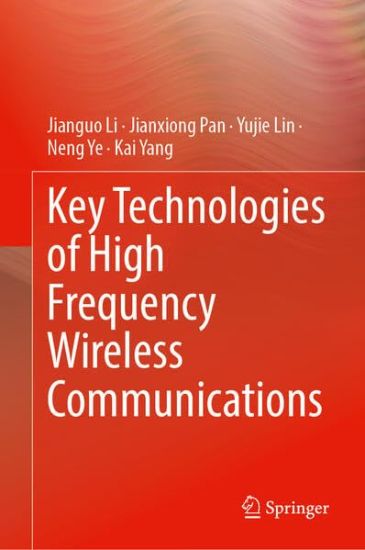
This book provides solutions to some of the issues present in the physical layer of current high-frequency wireless communication systems. It reviews the development history of high-frequency wireless communication systems, pinpoints certain existing problems in contemporary high-frequency communication systems, and proposes solutions. The 6th Generation Mobile Networks (6G) is based on terrestrial cellular networks and integrates satellite communication, drone communication, and marine communication to form an integrated air-ground-sea network, providing comprehensive coverage, high speed, high security, and multifunctional communication solutions. High-frequency wireless communication, represented by millimeter-wave and terahertz communications, offers a wide available spectrum and high transmission rates, making it a highly promising broadband wireless access technology in 6G. To achieve higher transmission rates (Tbps level), lower transmission latency (millisecond level), higher security performance (physical layer security), and stronger hardware integration (communication-sensing integration), high-frequency wireless transmission faces many challenges due to characteristics such as short wavelengths, high path loss, and weak components. These challenges include: Large link attenuation and poor coverage in high-frequency wireless communication systems, resulting in low spectrum efficiency for edge users.Low output power, poor linearity, and low efficiency of high-frequency power amplifiers, making it difficult to achieve long-distance transmission of wideband signals.High sidelobe energy in high-frequency multi-user secure transmission, leading to unfocused spatial regions and low transmission efficiency.Independent design functions and high information processing delay in high-frequency communication and sensing, causing wastage of spectrum resources and hardware resources.To address these challenges, the author has conducted innovative work aimed at improving the spectrum efficiency, power amplifier efficiency, transmission efficiency, and processing efficiency of high-frequency wireless transmission. The research findings have been published in high-impact journals such as IEEE Transactions on Vehicular Technology, Microwave Theory and Techniques, Broadcasting, IEEE Sensors Journal, and IEEE Wireless Communications Letters. Based on these foundations, this book is dedicated to discussing efficient transmission technology for high-frequency wireless communications with a focus on 6G. The book addresses fields such as signal processing, spectrum management, and high-efficiency sustainable communications. It is highly recommended for academic researchers, students, and engineers in wireless communication, terahertz communication, and electronic information fields.
This book discusses the architecture of future wireless networks, reliable communications between different nodes, and energy-efficient resource allocations for achieving sustainable wireless communications. To meet the increasing demands of wireless communication networks and achieve sustainable wireless communications, various promising technologies in this book have been investigated and developed. This book is to present cutting-edge research results on achieving sustainable wireless communications.In particular, the sustainable ultra-dense heterogeneous networks and the sustainability issues of non-orthogonal multiple access are investigated, the performances of cooperative networks with space-time network coding under different scenarios are evaluated, the dynamic estimation for a unified laser telemetry, tracking, and command system is discussed, and the energy-efficient resource allocation schemes are developed for future wireless communication networks. Webelieve that the results in this book can provide useful insights for the design of future wireless communication networks and achieving sustainable wireless communications. Graduate students, researchers, and engineers in the field of wireless communications can benefit from the book.
This book discusses the architecture of future wireless networks, reliable communications between different nodes, and energy-efficient resource allocations for achieving sustainable wireless communications. To meet the increasing demands of wireless communication networks and achieve sustainable wireless communications, various promising technologies in this book have been investigated and developed. This book is to present cutting-edge research results on achieving sustainable wireless communications.In particular, the sustainable ultra-dense heterogeneous networks and the sustainability issues of non-orthogonal multiple access are investigated, the performances of cooperative networks with space-time network coding under different scenarios are evaluated, the dynamic estimation for a unified laser telemetry, tracking, and command system is discussed, and the energy-efficient resource allocation schemes are developed for future wireless communication networks. Webelieve that the results in this book can provide useful insights for the design of future wireless communication networks and achieving sustainable wireless communications. Graduate students, researchers, and engineers in the field of wireless communications can benefit from the book.