Kirjojen hintavertailu. Mukana 12 591 765 kirjaa ja 12 kauppaa.

Kirjailija

Niall Rudd

Kirjat ja teokset yhdessä paikassa: 6 kirjaa, julkaisuja vuosilta 1994-2007, suosituimpien joukossa The Common Spring. Vertaile teosten hintoja ja tarkista saatavuus suomalaisista kirjakaupoista.

6 kirjaa

Kirjojen julkaisuhaarukka 1994-2007.

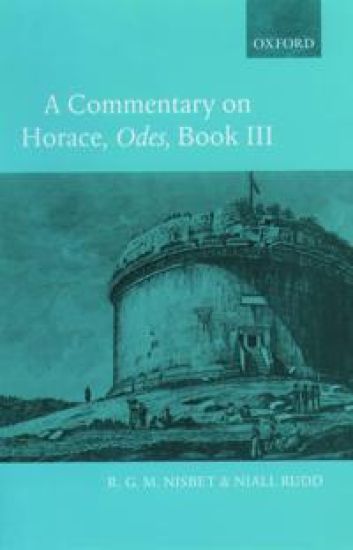
A Commentary on Horace: Odes Book III

A Commentary on Horace: Odes Book III

R. G. M. Nisbet; Niall Rudd

Oxford University Press
2007
nidottu
This book is a successor to the commentaries by Nisbet and Hubbard on Odes I and II, but it takes critical note of the abundant recent writing on Horace. It starts from the precise interpretation of the Latin; attention is paid to the nuances implied by the word-order; parallel passages are quoted, not to depreciate the poet's originality but to elucidate his meaning and to show how he adapted his predecessors; sometimes major English poets are cited to exemplify his influence on the tradition. In expounding the so-called Roman Odes the editors reject not only uncritical acceptance of Augustan ideology but also more recent attempts to find subversion in a court-poet. They show how Greek moralizing, particularly by the Epicureans, is applied to contemporary social situations. Poems on country festivals are treated sympathetically in the belief that the tolerant and inclusive religion of the Romans can easily be misunderstood. The poet's wit is emphasized in his addresses both to eminent Romans and to women with Greek names; the latter poems are taken as reflecting his general experience rather than particular occasions. Though Horace's ironic self-presentation must not be understood too literally, the editors reject the modern tendency to treat the author as unknowable. Although the text of the Odes is not printed separately, the headings to the notes provide a continuous text. The editors put forward a number of conjectures, most of them necessarily tentative, and in the few cases where they disagree, both opinions are summarized.
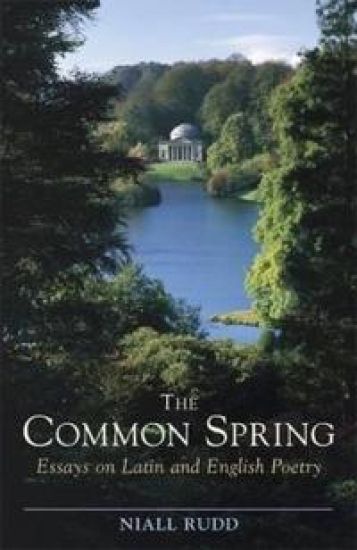
The Common Spring

The Common Spring

Niall Rudd

Bristol Phoenix Press
2005
sidottu
This collection aims to bring out the continuity between major poets in Latin and English, presenting to a wider audience papers previously published only in academic periodicals along with a number of unpublished pieces. It contains essays on Virgil, Horace, Ovid and Juvenal, which are intended for the reader with a genuine but not necessarily specialised interest in Latin poetry. Corresponding papers on English poets, including Shakespeare, Milton, Dryden, Pope, Swift and Tennyson, emphasise the debt owed to their Roman predecessors. Two more general pieces, on the poetry of romantic love and on classical humanism, further underline the continuity between past and present.
Lines of Enquiry

Lines of Enquiry

Niall Rudd

Cambridge University Press
2005
pokkari
In these studies of Latin poetry Niall Rudd demonstrates a variety of critical methods and approaches. He shows how it can be fruitful at different times to consider the historical background of a poem, its language or structure, its place in a literary tradition, the role of critical paradigms, and so on. But if no single approach has special and invariable authority this does not imply critical anarchy. Each has its own validity for different purposes, its own strengths and limitations. The reader must be versatile and sensitive to a range of possibilities, but not doctrinaire.
A Commentary on Horace: Odes Book III

A Commentary on Horace: Odes Book III

R. G. M. Nisbet; Niall Rudd

Oxford University Press
2004
sidottu
This book is a successor to the commentaries by Nisbet and Hubbard on Odes I and II, but it takes critical note of the abundant recent writing on Horace. It starts from the precise interpretation of the Latin; attention is paid to the nuances implied by the word-order; parallel passages are quoted, not to depreciate the poet's originality but to elucidate his meaning and to show how he adapted his predecessors; sometimes major English poets are cited to exemplify his influence on the tradition. In expounding the so-called Roman Odes the editors reject not only uncritical acceptance of Augustan ideology but also more recent attempts to find subversion in a court-poet. They show how Greek moralizing, particularly by the Epicureans, is applied to contemporary social situations. Poems on country festivals are treated sympathetically in the belief that the tolerant and inclusive religion of the Romans can easily be misunderstood. The poet's wit is emphasized in his addresses both to eminent Romans and to women with Greek names; the latter poems are taken as reflecting his general experience rather than particular occasions. Though Horace's ironic self-presentation must not be understood too literally, the editors reject the modern tendency to treat the author as unknowable. Although the text of the Odes is not printed separately, the headings to the notes provide a continuous text. The editors put forward a number of conjectures, most of them necessarily tentative, and in the few cases where they disagree, both opinions are summarized.
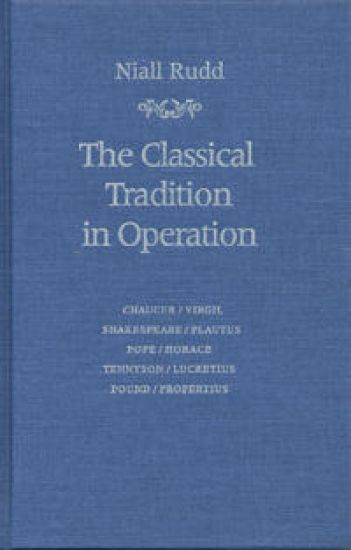
Classical Tradition in Operation

Classical Tradition in Operation

Niall Rudd

University of Toronto Press
1994
sidottu
In these five essays Niall Rudd presents an eclectic set of comparisons between certain ancient authors and later English writers ranging from Chaucer to Pound. He shows how five English writers consciously used and adapted classical works, and in so doing he illuminates both the classical authors and their English imitators and admirers. Readable translations and summaries of the Latin sources make these stimulating studies accessible even to scholars and students with little or no Latin. The first essay compares Chaucer's treatment of Dido in The House of Fame and The Legend of Good Women with Virgil's presentation of Dido in the Aeneid, and Ovid's in Heroides 7. The second essay, comparing Shakespeare's The Comedy of Errors with Plautus' Menaechmi, demonstrates how Shakespeare, weaving Roman farce into the framework of Hellenistic romance, developed both genres into something richer and more complex. The third essay on Pope's Epistle to Augustus shows his conversion of Horace's praise of Augustus into an anti-royalist attack on George II. In the fourth essay, Rudd discusses how much of Tennyson's Lucretius is invented and imported by Tennyson as a way of externalizing the inner conflicts he experienced in the age of doubt. The final essay, on Pound and Propertius, looks at Pound's representation of the Latin poet in Homage to Sextus Propertius, specifically in the areas of imperial politics, love, and language. In his preface Rudd writes: 'Everyone knows of the Classical Tradition - comprehending it is another matter.' This book brings it closer to our understanding.
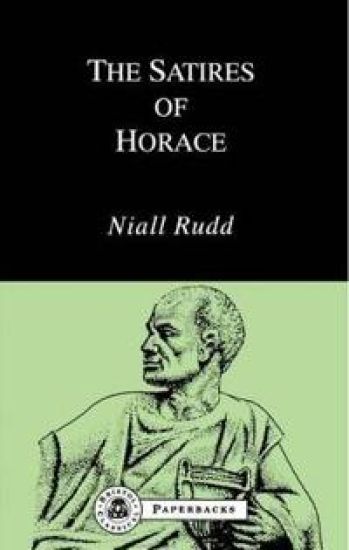
The Satires of Horace

The Satires of Horace

Niall Rudd

Bristol Classical Press
1994
pokkari
'A systematic study of all the Satires, [this book includes] for each Satire an exposition of argument and structure illustrated by pieces of either idiomatic translation of paraphrase, a description ofhistorical and social background, and comments on the quality of the poem ... this happy blend of historical scholarship and literary criticism is aimed at a wide audience.' Michael Coffey, Classical Review