Kirjojen hintavertailu. Mukana 12 595 353 kirjaa ja 12 kauppaa.

Kirjailija

Nicholas C. Burbules

Kirjat ja teokset yhdessä paikassa: 11 kirjaa, julkaisuja vuosilta 2000-2013, suosituimpien joukossa Postpositivism and Educational Research. Vertaile teosten hintoja ja tarkista saatavuus suomalaisista kirjakaupoista.

Mukana myös kirjoitusasut: Nicholas C Burbules

11 kirjaa

Kirjojen julkaisuhaarukka 2000-2013.

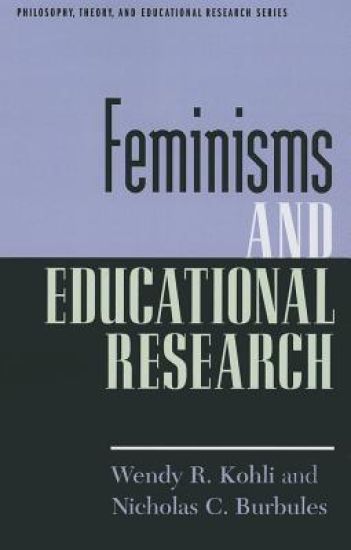
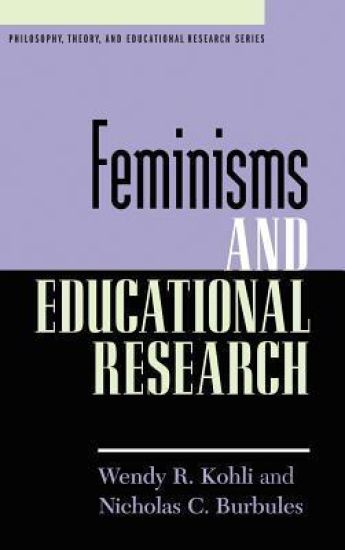
Feminisms and Educational Research

Feminisms and Educational Research

Wendy R. Kohli; Nicholas C. Burbules

Rowman Littlefield Education
2013
nidottu
Feminist theory has come a long way from its nascent beginnings—no longer can it be classified as “liberal,” “socialist,” or “radical.” It has shaped and evolved to take on multiple meanings and forms, each distinct in its own perspective and theory. In Feminisms and Educational Research, the authors explore the various forms of feminisms, tracing their history and their relation to gendered knowledge and identity. Unlike other books on feminism, the authors do not attempt to push that a particular theory is more correct than another, but rather they give a complete overview of each of the forms of feminism. The authors then couple the philosophical and theoretical ideas of western feminisms with the aims and conduct of educational research, exploring how they interact and influence each other. Focusing on more recent feminists, both in education and related disciplines, the book highlights illustrative examples from research to form a basis of understanding how the different feminisms have changed education.
Feminisms and Educational Research

Feminisms and Educational Research

Wendy R. Kohli; Nicholas C. Burbules

Rowman Littlefield
2011
sidottu
Feminist theory has come a long way from its nascent beginnings—no longer can it be classified as “liberal,” “socialist,” or “radical.” It has shaped and evolved to take on multiple meanings and forms, each distinct in its own perspective and theory. In Feminisms and Educational Research, the authors explore the various forms of feminisms, tracing their history and their relation to gendered knowledge and identity. Unlike other books on feminism, the authors do not attempt to push that a particular theory is more correct than another, but rather they give a complete overview of each of the forms of feminism. The authors then couple the philosophical and theoretical ideas of western feminisms with the aims and conduct of educational research, exploring how they interact and influence each other. Focusing on more recent feminists, both in education and related disciplines, the book highlights illustrative examples from research to form a basis of understanding how the different feminisms have changed education.
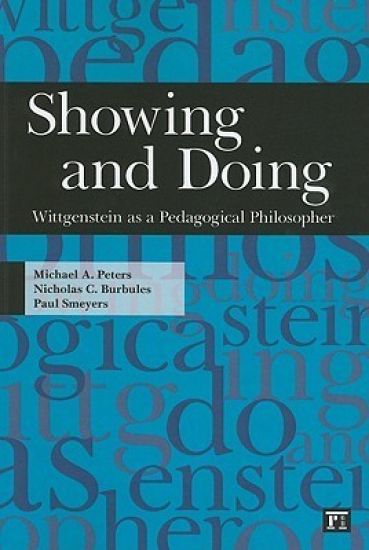
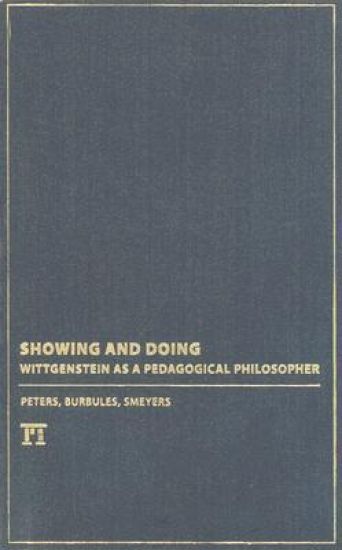
Showing and Doing

Showing and Doing

Michael A. Peters; Nicholas C. Burbules; Paul Smeyers

Paradigm
2010
nidottu
Three prominent Wittgenstein scholars introduce the broad educational significance of Ludwig Wittgenstein's work to a wider audience of educational researchers and practitioners through provocative, innovative, and playful readings of his work. They vividly demonstrate the influence of his thinking and its centrality to understanding our contemporary condition. Wittgenstein fundamentally shaped contemporary theories of language, representation, cognition, and learning. The book also traces the "pedagogical turn" of his thinking during the period from 1920 to 1926. What is most radical about Wittgenstein's later work is that it suggests learning and initiation into practices are fundamental to understanding his philosophy. The book not only provides a new and fresh interpretation of Wittgenstein's thought but also explores a new way of thinking about education as a way of revealing the educational dimension of philosophical problems.
Showing and Doing

Showing and Doing

Michael A. Peters; Nicholas C. Burbules; Paul Smeyers

Paradigm
2008
sidottu
Three prominent Wittgenstein scholars introduce the broad educational significance of Ludwig Wittgenstein's work to a wider audience of educational researchers and practitioners through provocative, innovative, and playful readings of his work. They vividly demonstrate the influence of his thinking and its centrality to understanding our contemporary condition. Wittgenstein fundamentally shaped contemporary theories of language, representation, cognition, and learning. The book also traces the "pedagogical turn" of his thinking during the period from 1920 to 1926. What is most radical about Wittgenstein's later work is that it suggests learning and initiation into practices are fundamental to understanding his philosophy. The book not only provides a new and fresh interpretation of Wittgenstein's thought but also explores a new way of thinking about education as a way of revealing the educational dimension of philosophical problems.
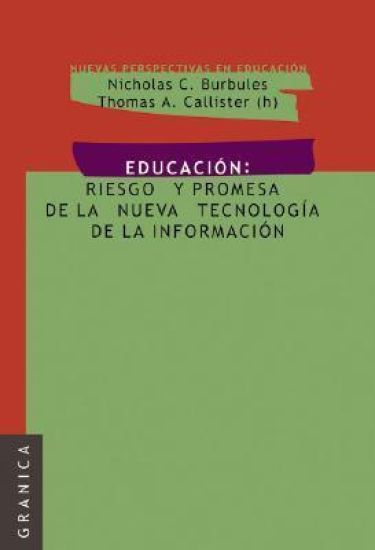
Educación

Educación

Nicholas C Burbules

Ediciones Granica, S.A.
2006
pokkari
No es necesario preguntarse sobre la utilidad de la tecnolog a en la escuela, tal como no se nos ocurrir a cuestionar la de los libros o las pizarras. Como instrumentos de informaci n y comunicaci n, el ordenador, Internet, las enciclopedias interactivas digitales o la televisi n son tan buenos o malos auxiliares del proceso ense anza-aprendizaje como los tradicionales. Lo esencial es saber c mo se los usa, qui n los usa y con qu fines. Tampoco cabe duda acerca de si debe incluirse o no en el equipo de recursos pedag gicos, pues ya forma parte del mismo desde que forma parte de la vida de las personas.Este libro expone una nueva manera de pensar sobre la inform tica vinculada a la educaci n, a la cual ni salvar ni destruir por s misma, aunque contiene tantas promesascomo riesgos, tantas ventajas como limitaciones. Los autores exploran aqu una serie de controversias actuales en torno del tema (la accesibilidad, la credibilidad, el hipertexto, la lectura cr tica de la Web, la censura, la confidencialidad, la comercializaci n y la comunidad inform tica) con el prop sito de encauzar la reflexi n cr tica hacia las premisas y consecuencias de determinadas pr cticas en los establecimientos educativos de todos los niveles.
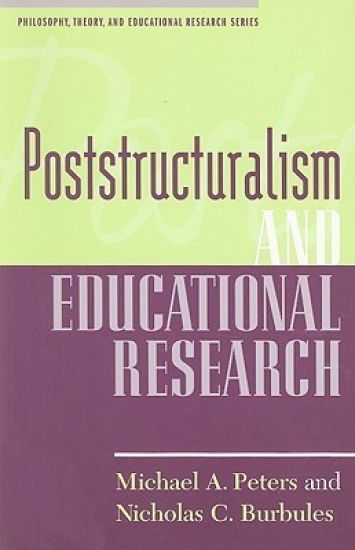
Poststructuralism and Educational Research

Poststructuralism and Educational Research

Michael A. Peters; Nicholas C. Burbules

Rowman Littlefield
2004
sidottu
Poststructuralism, and its implications for something called "postmodernism," is a major topic of discussion in social theory and research generally, including educational research. The works of the major authors in this tradition (Foucault, Lyotard, Cixous, Derrida, Haraway, to name a few) are challenging and difficult. Yet more and more theorists and researchers in educational scholarship use this term to describe their work. What does poststructuralism mean for these authors, and what significance does it have for educational inquiry? This book takes on these central questions and explores the impact of poststructuralism in language that makes the basic issues at stake accessible for a broad readership. Michael Peters and Nicholas C. Burbules highlight the implications of a poststructuralist stance for the conception of the research subject and examine its standards of validity and methods of investigation. They also lay out the distinguishing characteristics of this approach to educational inquiry, using as examples the particular ways in which writers (including Giroux, McLaren, Lather, and Ball) have tried to incorporate the poststructuralist perspective into their investigations of educational issues. The emphasis throughout this book will be on making these complex theoretical issues tangible and salient for the educational researcher.
Poststructuralism and Educational Research

Poststructuralism and Educational Research

Michael A. Peters; Nicholas C. Burbules

Rowman Littlefield
2004
nidottu
Poststructuralism, and its implications for something called 'postmodernism,' is a major topic of discussion in social theory and research generally, including educational research. The works of the major authors in this tradition (Foucault, Lyotard, Cixous, Derrida, Haraway, to name a few) are challenging and difficult. Yet more and more theorists and researchers in educational scholarship use this term to describe their work. What does poststructuralism mean for these authors, and what significance does it have for educational inquiry? This book takes on these central questions and explores the impact of poststructuralism in language that makes the basic issues at stake accessible for a broad readership. Michael Peters and Nicholas C. Burbules highlight the implications of a poststructuralist stance for the conception of the research subject and examine its standards of validity and methods of investigation. They also lay out the distinguishing characteristics of this approach to educational inquiry, using as examples the particular ways in which writers (including Giroux, McLaren, Lather, and Ball) have tried to incorporate the poststructuralist perspective into their investigations of educational issues. The emphasis throughout this book will be on making these complex theoretical issues tangible and salient for the educational researcher.
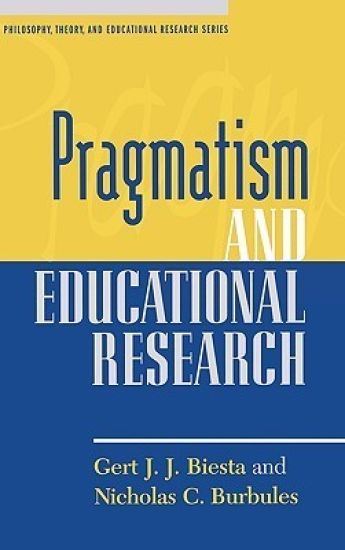
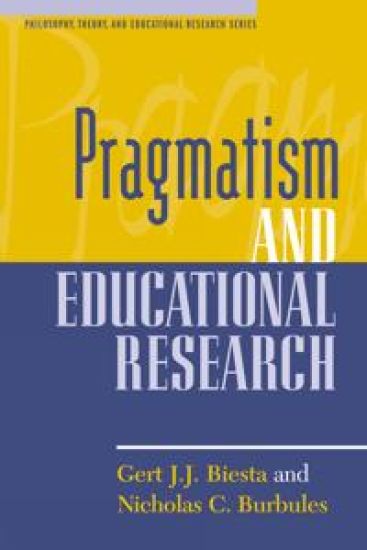
Pragmatism and Educational Research

Pragmatism and Educational Research

Gert J. J. Biesta; Nicholas C. Burbules

Rowman Littlefield
2003
sidottu
This volume offers an overview of the pragmatic understanding of knowledge and the acquisition of knowledge, and its implications for the conduct of educational research. Pragmatism and Educational Research focuses primarily on the work of John Dewey, and examines the relationship between pragmatism and educational research both in relation to research methodology and to a pragmatic educational theory. Biesta and Burbules provide examples of characteristic research questions and research methods and approaches, as informed by a pragmatist outlook. Further, they argue that the major benefit of a pragmatic approach to educational research lies in the possibility of promoting intelligent and reflective action by educational practitioners.
Pragmatism and Educational Research

Pragmatism and Educational Research

Gert J. J. Biesta; Nicholas C. Burbules

Rowman Littlefield
2003
nidottu
This volume offers an overview of the pragmatic understanding of knowledge and the acquisition of knowledge, and its implications for the conduct of educational research. Pragmatism and Educational Research focuses primarily on the work of John Dewey, and examines the relationship between pragmatism and educational research both in relation to research methodology and to a pragmatic educational theory. Biesta and Burbules provide examples of characteristic research questions and research methods and approaches, as informed by a pragmatist outlook. Further, they argue that the major benefit of a pragmatic approach to educational research lies in the possibility of promoting intelligent and reflective action by educational practitioners.
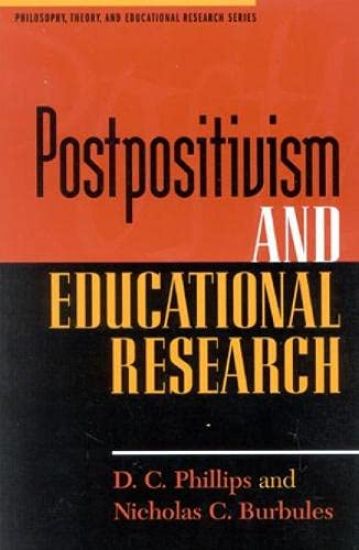
Postpositivism and Educational Research

Postpositivism and Educational Research

D. C. Phillips; Nicholas C. Burbules

Rowman Littlefield
2000
sidottu
This volume presents in a forthright and lively way, an account of the philosophical position generally identified as 'Postpositivistic' that undergirds much of mainstream research in education and the related social sciences. The discussion throughout is informed by recent developments in philosophy of science. Authors D. C. Phillips and Nicholas C. Burbules cite a number of interesting examples from the educational research and evaluation literature to illustrate the value of a scientific approach. Many educational researchers aspire to carry out rigorous or disciplined inquiry aimed at producing accurate (and generally 'truthful') accounts of educational phenomena and the causal psychological or social processes that lay behind them. However, many recent critics have argued that it is a mistake to believe that research can yield theories, or advance claims that are true, objective, and value-neutral. In other words, that researchers always work within frameworks that embody important (and often questionable) assumptions about values and the nature of human knowledge. This book argues that , while there is much to be learned from recent critiques, traditional scientific values and assumptions are not outmoded. The authors show students how to implement and benefit from the scientific method in ways that take into account recent critiques.
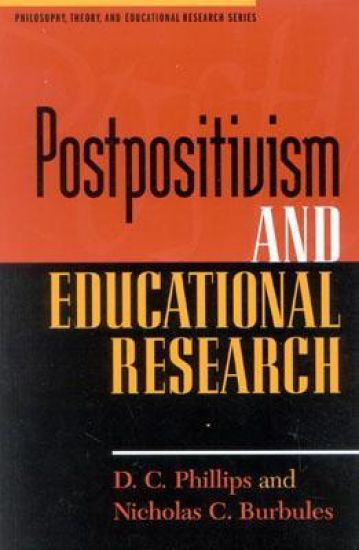
Postpositivism and Educational Research

Postpositivism and Educational Research

D. C. Phillips; Nicholas C. Burbules

Rowman Littlefield
2000
nidottu
This volume presents in a forthright and lively way, an account of the philosophical position generally identified as 'Postpositivistic' that undergirds much of mainstream research in education and the related social sciences. The discussion throughout is informed by recent developments in philosophy of science. Authors D. C. Phillips and Nicholas C. Burbules cite a number of interesting examples from the educational research and evaluation literature to illustrate the value of a scientific approach. Many educational researchers aspire to carry out rigorous or disciplined inquiry aimed at producing accurate (and generally 'truthful') accounts of educational phenomena and the causal psychological or social processes that lay behind them. However, many recent critics have argued that it is a mistake to believe that research can yield theories, or advance claims that are true, objective, and value-neutral. In other words, that researchers always work within frameworks that embody important (and often questionable) assumptions about values and the nature of human knowledge. This book argues that , while there is much to be learned from recent critiques, traditional scientific values and assumptions are not outmoded. The authors show students how to implement and benefit from the scientific method in ways that take into account recent critiques.