Kirjojen hintavertailu. Mukana 12 595 353 kirjaa ja 12 kauppaa.

Kirjailija

Nicholas Diakopoulos

Kirjat ja teokset yhdessä paikassa: 3 kirjaa, julkaisuja vuosilta 2016-2019, suosituimpien joukossa Designing the User Interface: Strategies for Effective Human-Computer Interaction, Global Edition. Vertaile teosten hintoja ja tarkista saatavuus suomalaisista kirjakaupoista.

3 kirjaa

Kirjojen julkaisuhaarukka 2016-2019.

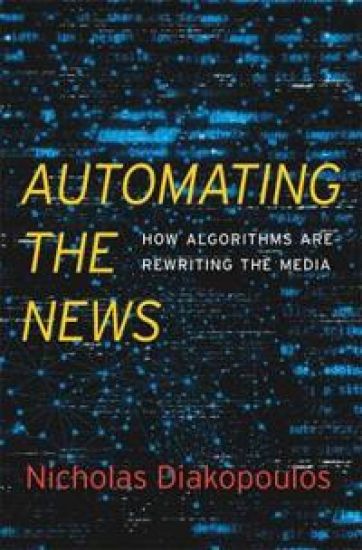
Automating the News

Automating the News

Nicholas Diakopoulos

Harvard University Press
2019
sidottu
From hidden connections in big data to bots spreading fake news, journalism is increasingly computer-generated. An expert in computer science and media explains the present and future of a world in which news is created by algorithm.Amid the push for self-driving cars and the roboticization of industrial economies, automation has proven one of the biggest news stories of our time. Yet the wide-scale automation of the news itself has largely escaped attention. In this lively exposé of that rapidly shifting terrain, Nicholas Diakopoulos focuses on the people who tell the stories—increasingly with the help of computer algorithms that are fundamentally changing the creation, dissemination, and reception of the news.Diakopoulos reveals how machine learning and data mining have transformed investigative journalism. Newsbots converse with social media audiences, distributing stories and receiving feedback. Online media has become a platform for A/B testing of content, helping journalists to better understand what moves audiences. Algorithms can even draft certain kinds of stories. These techniques enable media organizations to take advantage of experiments and economies of scale, enhancing the sustainability of the fourth estate. But they also place pressure on editorial decision-making, because they allow journalists to produce more stories, sometimes better ones, but rarely both.Automating the News responds to hype and fears surrounding journalistic algorithms by exploring the human influence embedded in automation. Though the effects of automation are deep, Diakopoulos shows that journalists are at little risk of being displaced. With algorithms at their fingertips, they may work differently and tell different stories than they otherwise would, but their values remain the driving force behind the news. The human–algorithm hybrid thus emerges as the latest embodiment of an age-old tension between commercial imperatives and journalistic principles.

Designing the User Interface: Strategies for Effective Human-Computer Interaction, Global Edition

Designing the User Interface: Strategies for Effective Human-Computer Interaction, Global Edition

Ben Shneiderman; Catherine Plaisant; Maxine Cohen; Steven Jacobs; Niklas Elmqvist; Nicholas Diakopoulos

Pearson Education Limited
2017
muu
For courses in Human-Computer Interaction The Sixth Edition of Designing the User Interface provides a comprehensive, authoritative, and up-to-date introduction to the dynamic field of human-computer interaction (HCI) and user experience (UX) design. This classic book has defined and charted the astonishing evolution of user interfaces for three decades. Students and professionals learn practical principles and guidelines needed to develop high quality interface designs that users can understand, predict, and control. The book covers theoretical foundations and design processes such as expert reviews and usability testing. By presenting current research and innovations in human-computer interaction, the authors strive to inspire students, guide designers, and provoke researchers to seek solutions that improve the experiences of novice and expert users, while achieving universal usability. The authors also provide balanced presentations on controversial topics such as augmented and virtual reality, voice and natural language interfaces, and information visualisation. Updates include current HCI design methods, new design examples, and totally revamped coverage of social media, search and voice interaction. Major revisions were made to EVERY chapter, changing almost every figure (170 new colour figures) and substantially updating the references.
Designing the User Interface

Designing the User Interface

Ben Shneiderman; Catherine Plaisant; Maxine Cohen; Steven Jacobs; Niklas Elmqvist; Nicholas Diakopoulos

Pearson
2016
sidottu
For courses in Human-Computer Interaction The Sixth Edition of Designing the User Interface provides a comprehensive, authoritative, and up-to-date introduction to the dynamic field of human-computer interaction (HCI) and user experience (UX) design. This classic book has defined and charted the astonishing evolution of user interfaces for three decades. Students and professionals learn practical principles and guidelines needed to develop high quality interface designs that users can understand, predict, and control. The book covers theoretical foundations and design processes such as expert reviews and usability testing. By presenting current research and innovations in human-computer interaction, the authors strive to inspire students, guide designers, and provoke researchers to seek solutions that improve the experiences of novice and expert users, while achieving universal usability. The authors also provide balanced presentations on controversial topics such as augmented and virtual reality, voice and natural language interfaces, and information visualization. Updates include current HCI design methods, new design examples, and totally revamped coverage of social media, search and voice interaction. Major revisions were made to EVERY chapter, changing almost every figure (170 new color figures) and substantially updating the references.