Kirjojen hintavertailu. Mukana 12 595 353 kirjaa ja 12 kauppaa.

Kirjailija

Nicholas Dorn

Kirjat ja teokset yhdessä paikassa: 6 kirjaa, julkaisuja vuosilta 1991-2025, suosituimpien joukossa Democracy and Diversity in Financial Market Regulation. Vertaile teosten hintoja ja tarkista saatavuus suomalaisista kirjakaupoista.

6 kirjaa

Kirjojen julkaisuhaarukka 1991-2025.

Alcohol, Youth and the State

Alcohol, Youth and the State

Nicholas Dorn

TAYLOR FRANCIS LTD
2025
nidottu
In the early 1980s teenage drinking had become one of the many foci for expressions of concern about young peoples’ morals, health and discipline. Yet we knew very little about how most young people drink – the qualitative aspects of youthful drinking. The research emphasis had hitherto been upon the level of drinking, neglecting the social forms, styles and associated meanings of specific drinking practices such as round-buying.Originally published in 1983, the core of this book reports upon an ethnographic study of the circumstances, cultures and drinking practices of one particular stratum of youth. The service sector had become an increasingly important area of employment, but little was known about service sector youth cultures. The author shows how mixed-sex round buying arises in such a culture and how it differs from the drinking practices of other groups.The study goes on to develop a general model for understanding drinking practices in diverse strata of youth, and draws out implications for health and social education. Drink education is related to the increasingly important, and contentious, area of education about ‘working life’ and to sexual divisions in society. Introducing these sections is a review of the historical origins of concern about public drinking. Originating in yearly Vagrancy Acts and elaborated over 500 years, the state’s policies about production, distribution, and consumption of alcohol are an integral part of its general economic and social policies, and will continue to be framed by them.

Alcohol, Youth and the State

Alcohol, Youth and the State

Nicholas Dorn

TAYLOR FRANCIS LTD
2023
sidottu
In the early 1980s teenage drinking had become one of the many foci for expressions of concern about young peoples’ morals, health and discipline. Yet we knew very little about how most young people drink – the qualitative aspects of youthful drinking. The research emphasis had hitherto been upon the level of drinking, neglecting the social forms, styles and associated meanings of specific drinking practices such as round-buying.Originally published in 1983, the core of this book reports upon an ethnographic study of the circumstances, cultures and drinking practices of one particular stratum of youth. The service sector had become an increasingly important area of employment, but little was known about service sector youth cultures. The author shows how mixed-sex round buying arises in such a culture and how it differs from the drinking practices of other groups.The study goes on to develop a general model for understanding drinking practices in diverse strata of youth, and draws out implications for health and social education. Drink education is related to the increasingly important, and contentious, area of education about ‘working life’ and to sexual divisions in society. Introducing these sections is a review of the historical origins of concern about public drinking. Originating in yearly Vagrancy Acts and elaborated over 500 years, the state’s policies about production, distribution, and consumption of alcohol are an integral part of its general economic and social policies, and will continue to be framed by them.

Democracy and Diversity in Financial Market Regulation
Financial markets have become acknowledged as a source of crisis, and discussion of them has shifted from economics, through legal and regulatory studies, to politics. Events from 2008 onwards raise important, cross-disciplinary questions: must financial markets drive states into political and existential crisis, must public finances take over private losses, must citizens endure austerity? This book argues that there is an alternative. If the financial system were less 'connected', contagion within the market would be reduced and crises would become more localised and intermittent, less global and pervasive. The question then becomes how to reduce connectedness within financial markets. This book argues that the democratic direction of financial market policies can deliver this. Politicising financial market policies – taking discussion of these issues out of the sphere of the 'technical' and putting it into the same democratically contested space as, for example, health and welfare policies – would encourage differing policies to emerge in different countries. Diversity of regulatory regimes would result in some business models being attracted to some jurisdictions, others to others. The resulting heterogeneity, when viewed from a global perspective, would be a reversal of recent and current tendencies towards one single/global 'level playing field', within which all financial firms and sectors have become closely connected and across which contagion inevitably reigns. No doubt the democratisation of financial market policy would be opposed by big firms – their interests being served by regulatory convergence – and considered macabre by some financial regulators and central bankers, who are coalescing into an elite community. However, everyone else, Nicholas Dorn argues here, would be better off in a financial world characterised by greater diversity.
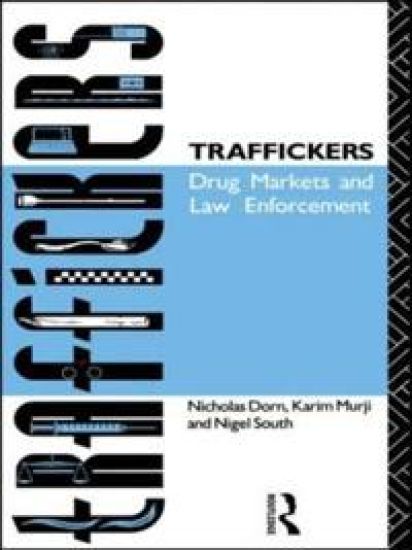
Traffickers

Traffickers

Nicholas Dorn; Karim Murji; Nigel South

Routledge
2015
sidottu
Traffickers presents new findings into the most mythologised and least understood area of crime and law enforcement. The chamelion reality of the world of drug trafficking is described in the words of traffickers and detectives. Drug enforcement combines the banal and spectacular in surveillance, covert operations and criminal intelligence. The war on drugs is a harbinger of wider changes in the organisation of policing and international cooperation. Traffickers explores the struggle that transforms policing and punishment as it stimulates the imagination.
Democracy and Diversity in Financial Market Regulation
Financial markets have become acknowledged as a source of crisis, and discussion of them has shifted from economics, through legal and regulatory studies, to politics. Events from 2008 onwards raise important, cross-disciplinary questions: must financial markets drive states into political and existential crisis, must public finances take over private losses, must citizens endure austerity? This book argues that there is an alternative. If the financial system were less 'connected', contagion within the market would be reduced and crises would become more localised and intermittent, less global and pervasive. The question then becomes how to reduce connectedness within financial markets. This book argues that the democratic direction of financial market policies can deliver this. Politicising financial market policies – taking discussion of these issues out of the sphere of the 'technical' and putting it into the same democratically contested space as, for example, health and welfare policies – would encourage differing policies to emerge in different countries. Diversity of regulatory regimes would result in some business models being attracted to some jurisdictions, others to others. The resulting heterogeneity, when viewed from a global perspective, would be a reversal of recent and current tendencies towards one single/global 'level playing field', within which all financial firms and sectors have become closely connected and across which contagion inevitably reigns. No doubt the democratisation of financial market policy would be opposed by big firms – their interests being served by regulatory convergence – and considered macabre by some financial regulators and central bankers, who are coalescing into an elite community. However, everyone else, Nicholas Dorn argues here, would be better off in a financial world characterised by greater diversity.
Traffickers

Traffickers

Nicholas Dorn; Karim Murji; Nigel South

Routledge
1991
nidottu
Traffickers presents new findings into the most mythologised and least understood area of crime and law enforcement. The chamelion reality of the world of drug trafficking is described in the words of traffickers and detectives. Drug enforcement combines the banal and spectacular in surveillance, covert operations and criminal intelligence. The war on drugs is a harbinger of wider changes in the organisation of policing and international cooperation. Traffickers explores the struggle that transforms policing and punishment as it stimulates the imagination.