Kirjojen hintavertailu. Mukana 12 390 323 kirjaa ja 12 kauppaa.

Kirjailija

Nicholas Freeman

Kirjat ja teokset yhdessä paikassa: 2 kirjaa, julkaisuja vuosilta 2007-2014, suosituimpien joukossa 1895. Vertaile teosten hintoja ja tarkista saatavuus suomalaisista kirjakaupoista.

2 kirjaa

Kirjojen julkaisuhaarukka 2007-2014.

1895

1895

Nicholas Freeman

Edinburgh University Press
2014
nidottu
This book explores the lasting cultural and political impact of the events of this remarkable year. Oscar Wilde's disastrous libel suit against the Marquess of Queensberry dominated British newspapers during the spring of 1895. Now, Nicholas Freeman shows that the Wilde scandal was just one of many events to capture the public's imagination that year. Had Jack the Ripper returned? Did the Prime Minister have a dreadful secret? Were Aubrey Beardsley's drawings corrupting the nation? Were overpaid foreign players ruining English football? Could cricket save a nation from moral ruin? Freak weather, flu, a General Election, industrial unrest, New Women, fraud, accidents, anarchists, balloons and bicycles all stirred up interest and alarm. 1895 shows how this turbulent year is at the same time far removed from our own day and strangely familiar. It interweaves literature, politics and historical biography with topics such as crime, the weather, sport, visual art and journalism to give an overarching view of everyday life in 1895. It draws on strikingly diverse primary sources, from the Aberdeen Weekly Journal to the Women's Signal Budget, and from the Illustrated Police News to The Yellow Book. It is eclectically illustrated with stills from plays and reproductions of newspaper front pages to bring Victorian culture to life.
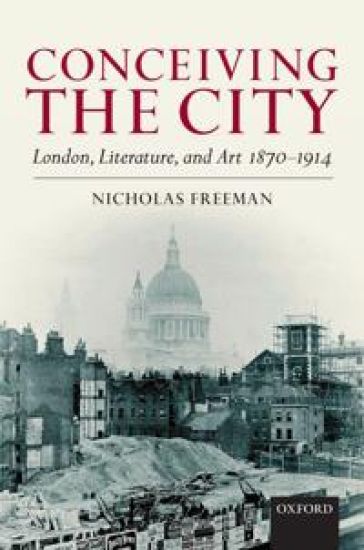
Conceiving the City

Conceiving the City

Nicholas Freeman

Oxford University Press
2007
sidottu
Conceiving the City is an innovative study of the ways in which a generation of late-Victorian novelists, poets, painters, and theoreticians attempted to represent London in literature and art. Breaking away from the language and style of Dickens and the static panorama paintings of William Powell Frith, major figures such as Henry James and J. M. Whistler, and, crucially, less-celebrated authors such as Arthur Machen, Edwin Pugh, and George Egerton bent realism into exciting new shapes. In the naturalism of George Gissing and Arthur Morrison, the fragmentary impressions of Ford Madox Ford, and the brooding mystery of Alvin Langdon Coburn's photogravures, London emerged as a focus for dynamic, explicitly modern art. Although many of these insights would be dismissed or at least downplayed by subsequent generations, the ideas evolved during the period from 1870 to 1914 anticipate not only the work of high modernists such as Eliot and Woolf, but also that of later urban theorists such as Foucault and de Certeau, and the novels and travelogues of contemporary London writers Peter Ackroyd and Iain Sinclair. Nicholas Freeman recovers a sense of late-Victorian London as a subject for dynamic theoretical and aesthetic experiments, and shows, in stimulating analyses of Conan Doyle, H. G. Wells, Arthur Symons, and others how much of our understanding of urban space we owe to eminent (and not so eminent) Victorian figures. Written in a clear and accessible style, the book restores a much-needed historical perspective to our engagement with the metropolis.