Kirjojen hintavertailu. Mukana 12 595 353 kirjaa ja 12 kauppaa.

Kirjailija

Nicholas Hagger

Kirjat ja teokset yhdessä paikassa: 47 kirjaa, julkaisuja vuosilta 2003-2025, suosituimpien joukossa Fools' Gold. Vertaile teosten hintoja ja tarkista saatavuus suomalaisista kirjakaupoista.

47 kirjaa

Kirjojen julkaisuhaarukka 2003-2025.

World Constitution – Constitution for the United Federation of the World
In World State Nicholas Hagger followed Truman, Einstein, Churchill, Eisenhower and others in calling for a democratic, partly-federal World State with sufficient authority to abolish war, enforce disarmament, combat famine, disease and poverty, and solve the world’s ?nancial and environmental problems. Its lower house, a World Parliamentary Assembly, would initially be based in the UN General Assembly and eventually replace the UN. In this companion volume he sets out a Constitution for a United Federation of the World (UF). In 14 chapters and 145 Articles he details the UF’s structure and institutions at inter-national and supranational levels, and the rights and freedoms world citizens would be guaranteed. He lists the 26 precedents and 204 existing constitutions he consulted (including the UN Charter and the US and EU constitutional documents) and the sources on which the Articles are based. This comprehensive and authoritative Constitution sets out with great clarity and concision how the whole world can be governed, and can be laid before the UN General Assembly. As a blueprint for a World State that can bring universal peace and prosperity it may come to be regarded as one of the most remarkable feats of statecraft of our time.

First Dazzling Chill of Winter, The – Collected Stories
Nicholas Hagger's Collected Stories covered five volumes containing 1,001 very short stories detailing five decades (from the 1960s to the 2000s) in the life of Philip Rawley, whose demise was misleadingly announced at the end of the fifth volume. This sixth volume contains 201 stories and deals with the chill of winter, impending old age. These mini-stores present a wide range of characters, and their follies and flaws. They offer a complete literary experience in a page or two, and their combination of opposites derives its inspiration from the 17th century: Dr Johnson's description in his 'Life of Cowley' of the wit of the Metaphysical poets as "a combination of dissimilar images" in which "the most heterogeneous ideas are yoked by violence together". They are verbal paintings that present an image in action and reveal a poet's eye for significant detail. Hagger's stories are innovatory in their brevity. They are imagistic, economical and vivid, and cumulatively reflect the Age. They are ideal for short concentration spans: reading on journeys or in bed. Individual stories drop into the consciousness like a stone into a well, leaving the mind to reflect on the ripples. These imaginative stories in clean prose make excellent reading and contain memorable images and studies of character.
Life Cycle and Other New Poems 2006 – 2016

Life Cycle and Other New Poems 2006 – 2016

Nicholas Hagger

John Hunt Publishing
2016
nidottu
Nicholas Hagger's Collected Poems contained 30 volumes of his poems that reflect his quest for the One. Life Cycle and Other New Poems contains volumes 31-34 and presents the vision of unity to which his quest has led. 'Life Cycle' is a reflection on the path and pattern in our lives, and on twelve seven-year ages from infancy to advanced old age. 'In Harmony with the Universe' presents poems on the soul's harmony and oneness with Nature. 'An Unsung Laureate' focuses on public events and the conflicts within Western society. 'Adventures in Paradise' recounts journeys to remote places that have echoes of Paradise, including the Galapagos Islands and Antarctica - and reflections on evolution and global warming. Hagger derives his inspiration from the 17th-century Metaphysical poets and seeks to unite the later Augustan and Romantic traditions. These poems reconcile the soul's harmony with the universe and the conflicts in public life, and are within the poetic tradition of Wordsworth and Tennyson. They add significantly to Collected Poems, Classical Odes and Hagger's two poetic epics, Overlord and Armageddon, also published by O-Books (the manuscripts and papers for which are held in the Albert Sloman Library at the University of Essex). They carry forward his Universalist approach to poetry which unveils an ordered universe behind the apparent chaos of world events.
The Secret American Destiny

The Secret American Destiny

Nicholas Hagger

Watkins Publishing
2016
pokkari
At present religious adherents outnumber non-religious by nearly 6 to 1 and world culture is divided between traditional and modern outlooks. In each of world culture's seven disciplines there are conflicting metaphysical and secular approaches. A unified world culture is essential if there is to be a World State, and The Secret American Destiny shows how America can heal this division by reviving science's view of the order in the universe, the experience of the common essence of all religions (the ordering Light), and the traditional view of order in each of the seven disciplines.In this accessible, thought-provoking and highly informed work, which carries forward his thinking in his widely discussed and acclaimed The Secret Founding of America and The Secret American Dream and in his studies of civilizations and cultures, Nicholas Hagger shows how Universalism, the study of the whole of humankind's activities, is in line to be the next American philosophy and how American Universalism can * challenge the secular, social approach that denies the traditional metaphysical perspective and regards the universe as an accident; * reconcile the traditional and modern approaches on their common regard for order; and * champion the prospect of world unity under a coming democratic World State based on the UN General Assembly. Hagger shows how restoring the metaphysical vision of order in Nature, the sciences and the seven disciplines will enable America to unify world culture and humankind, and fulfill America's destiny to bring to birth a World State that will transcend all nation-states and export the American Dream of freedom and prosperity to all humankind.
The Secret Founding of America

The Secret Founding of America

Nicholas Hagger

Watkins Publishing
2016
pokkari
The widely accepted story of the founding of America is that The Mayflower delivered the first settlers from Plymouth to the New World in 1620. Yet in reality, the Jamestown settlers had already become the first English-speaking outpost thirteen years earlier in 1607."The Secret Founding of America"introduces these two groups of founders - the Planting Fathers, who established the earliest settlements along essentially Christian lines, and the Founding Fathers, who unified the colonies with the Declaration of Independence and the Constitution - and it argues that the new nation, conceived in liberty, was the Freemasons' first step towards a new world order. Drawing on original findings and an in-depth understanding of the political and philosophical realities of the time, historianNicholas Haggercharts the connections between Gosnold and Smith, Templars and Jacobites, and secret societies and libertarian ideals. He also explains how the influence of German Illuminati worked on the constructors of the new republic, and shows the hand of Freemasonry at work at every turning point in America's history, from Civil War to today's global struggles for democracy."
Selected Stories: Follies and Vices of the Modern Elizabethan Age
These stories serve as an introduction to Nicholas Hagger's five volumes totalling 1,001 stories (an echo of The Thousand and One Nights, or Arabian Nights). They are grouped in two parts which reflect the two aspects of the fundamental theme of world literature outlined in his A New Philosophy of Literature: 'Follies and Vices' and 'Quest for the One'. These stories condemn follies and vices in relation to an implied virtue - more than 150 vices are listed in a Preface - and present moments of heightened consciousness in which the universe is perceived as a unity.
Selected Poems: Quest for the One

Selected Poems: Quest for the One

Nicholas Hagger

John Hunt Publishing
2015
nidottu
These poems serve as an introduction to Nicholas Hagger's poetic works, which include nearly 1,500 poems, more than 300 classical odes, two poetic epics and five verse plays. They are grouped in two parts which reflect the two aspects of the fundamental theme of world literature outlined in his A New Philosophy of Literature: 'Quest for the One' and 'Follies and Vices'. They present a quest for Reality along with moments of heightened consciousness in which the universe is seen as a unity, and condemn social follies and over 220 vices in terms of an implied virtue. This selection of poems combines image and statement in the reconciling Universalist manner, and in different poems blends Romantic search and organic form with classical social attitudes, verbal precision and architectural structure. The poems cover five decades and include extracts from 'The Silence', which describes Freeman's quest for Reality in Modernist style, 'Archangel' (a reflection on Communism following visits to China and the Soviet Union), poems written during a Dark Night of the Soul, glimpses of illumination and poems of social satire. There are also extracts from Hagger's verse plays. As can be seen from his 'A Metaphysical in Marvell's Garden' Hagger derives his inspiration from the 17th-century Metaphysical poets and seeks to unite the later Augustan and Romantic traditions. This selection offers a chance to reappraise a poet whose material, accomplished technique and reconciling sensibility places him in the forefront of poets writing today.
Dream of Europa, The – The Triumph of Peace

Dream of Europa, The – The Triumph of Peace

Nicholas Hagger

John Hunt Publishing
2015
nidottu
In The Dream of Europa, following the tradition of celebratory court masques in verse by Ben Jonson and more recently William Empson, Nicholas Hagger celebrates the court of the leaders of the European Union. Through a chorus of 50 representatives of European states he presents the growth and expansion of what became the EU in an epic sweep that takes us from 1945 to 2015 and incorporates the five elements (prologue, antimasque, masque, revels, epilogue) and blend of mythology and history found in all masques. Zeus asks Europa, the goddess of Europe, to sort out the chaos and disorder that devastated Europe in 1945. Europa presides over the growing unification of a European Union of 28 states with 22 more expected to join. Celebratory revels acclaim the Treaty of Lisbon but there is a discordant note, and Churchill has strong words for the UK representative. Finally Europa hands the EU back to Zeus. The dream of Europa is that one day the EU will turn into a United States of Europe consisting of 50 states (see front cover) like the USA, and will bring in a Universalist World State. As a court entertainment for European leaders celebrating Europe's progress from disorder to order, The Dream of Europa cries out to be performed in Brussels. It heralds the triumph of peace during the 70 years following 1945 and calls for a strengthening of European unity in the face of an expanding Russia that still regards Eastern Europe as being within its sphere of influence. This masque and its informative appendix on European states and rights will appeal to all generations in the 50 European states and to all beyond who value a peaceful Europe in our troubled time.
My Double Life 2 – A Rainbow Over the Hills

My Double Life 2 – A Rainbow Over the Hills

Nicholas Hagger

John Hunt Publishing
2015
nidottu
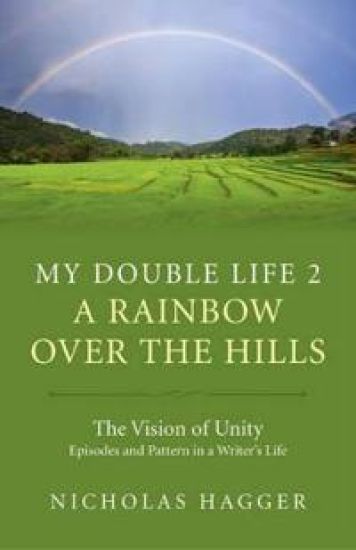
In My Double Life 1 Nicholas Hagger told of his four years' service and double life as an undercover British intelligence agent during the Cold War (there revealed for the first time). Lost in a dark wood like Dante following his encounters with Gaddafi's Libya and the African liberation movements, he found Reality on a 'Mystic Way' of loss, purgation and illumination, perceived the universe as a unity and had 16 experiences of the metaphysical Light. In My Double Life 2 he continues the story. He received new powers, coped with fresh ordeals, acquired three schools, renovated a historic house, and had 76 further experiences of the metaphysical Light. He founded a new philosophy of Universalism and new approaches to contemporary history, international statecraft and world literature. He produced nearly 1,500 poems, over 300 classical odes, five verse plays, two poetic epics, over a thousand short stories - and 40 books that include innovative literary, historical and philosophical works. His vision of Universalism in seven disciplines is like a rainbow with seven bands overarching seven hills. He produced nearly 1,500 poems, over 300 classical odes, five verse plays, two poetic epics, over a thousand short stories - and 40 books that include innovative literary, historical and philosophical works. His vision of Universalism in seven disciplines is like a rainbow with seven bands overarching seven hills.
My Double Life 1 – This Dark Wood

My Double Life 1 – This Dark Wood

Nicholas Hagger

John Hunt Publishing
2015
nidottu
Lost in a dark wood like Dante, Nicholas Hagger tells the story of his search for meaning, purpose and truth that took him to Iraq and Japan, and encounters with Zen and China's Cultural Revolution, which he was the first to discover. In Libya, then a Cold-War battleground, he began four years' service and a double life as an undercover British intelligence agent (here revealed for the first time). He witnessed Gaddafi's Egyptian/Soviet-backed coup, and its terrifying aftermath tore into his personal life, plunged him into a Dark Night of the Soul and faced him with execution. He went on to serve in London as Prime Minister Edward Heath's "unofficial Ambassador" to the African liberation movements at the height of Soviet and Chinese expansion in Africa during the Cold War. Despite being routinely followed by surveillance squads he found Reality on a 'Mystic Way' of loss, purgation and illumination. He now perceived the universe as a unity, and had 16 experiences of the metaphysical Light.
The Secret Founding of America [16 Pt Large Print Edition]
The widely accepted story of the founding of America is that The Mayflower delivered the first settlers from Plymouth to the New World in 1620. Yet thirteen years earlier, in 1607, the Jamestown settlers became the first English - speaking outpost to survive. And it is from this date that the USA is celebrating its 400th anniversary. The Secret ...
View of Epping Forest, A

View of Epping Forest, A

Nicholas Hagger

John Hunt Publishing
2012
nidottu
Epping Forest was given to the public in 1878. It has many historical and literary associations involving, for example, Harold II, Henry VIII, Elizabeth I, Shakespeare, Tennyson, Clare and Churchill. Nicholas Hagger came to Epping Forest during the war. As a boy he knew Sir William Addison, long recognised as an authority on the Forest, and saw Churchill speak in his village in 1945. He grew up against the background of the Forest and visited it regularly when he was living elsewhere. The Forest has come into many of his poems and other works. In Part One of this book he conveys the history of Epping Forest in the times of the Celts and Romans, Anglo-Saxons and Normans, Medievals and Tudors, and enclosers and loppers. In Part Two he shows how history has shaped the Forest places he grew up with: Loughton, Chigwell, Woodford, Buckhurst Hill, Waltham Abbey, High Beach, Upshire, Epping, the Theydons and Chingford Plain. An Appendix contains some of his poems about these places. His blending of history, recollection and poetic reflection presents a rounded view of the Forest. Using a technique of objective narrative he developed in other works and drawing on personal experience to give the flavour of a personal memoir, he evokes the spirit of the Forest through its best-loved places and wildlife, and brings the Forest alive through his historical perspective, evocation of Nature and vivid writing.
New Philosophy of Literature, A – The Fundamental Theme and Unity of World Literature: the Vision of the Infinite and the Universalist  Literary Tra
In The New Philosophy of Universalism Nicholas Hagger outlined a new philosophy that restates the order within the universe, the oneness of humankind and an infinite Reality perceived as Light; and its applications in many disciplines, including literature. In this work of literary Universalism which carries forward the thinking in T.S. Eliot's 'Tradition and the Individual Talent' and other essays, Hagger traces the fundamental theme of world literature, which has alternating metaphysical and secular aspects: a quest for Reality and immortality; and condemnation of social vices in relation to an implied virtue. Since classical times these two antithetical traditions have periodically been synthesised by Universalists. Hagger sets out the world Universalist literary tradition: the writers who from ancient times have based their work on the fundamental Universalist theme. These can be found in the Graeco-Roman world, the Middle Ages and Renaissance, in the Baroque Age, in the Neoclassical, Romantic Victorian and Modernist periods, and in the modern time. He demonstrates that the Universalist sensibility is a synthesis of the metaphysical and secular traditions, and a combination of the Romantic inspired imagination (the inner faculty by which Romantic poets approached the Light) and the Neoclassical imitative approach to literature which emphasizes social order and proportion, a combination found in the Baroque time of the Metaphysical poets, and in Victorian and Modernist literature. Universalists express their cross-disciplinary sensibility in literary epic, as did Homer, Virgil, Dante and Milton, and in a number of genres within literature - and in history and philosophy. Universalist historians claim that every civilisation is nourished by a metaphysical vision that is expressed in its art, and when it declines secular, materialist writings lose contact with its central vision. As Universalist literary works restate the order within the universe, reveal metaphysical Being and restore the vision of Reality, Hagger excitingly argues that the Universalist sensibility renews Western civilisation's health. Literary Universalism is a movement that revives the metaphysical outlook and combines it with the secular, materialistic approach to literature that has predominated in recent times. It can carry out a revolution in thought and culture and offer a new direction in contemporary literature. This work conveys Universalism's impact on literature, and should be read by all who have concerns about the sickness and decline of contemporary European/Western culture.
World Government, The – A Blueprint for a Universal World State
In The New Philosophy of Universalism Nicholas Hagger outlined a new philosophy that focuses on the oneness of the universe and humankind, and its applications for many disciplines, including international relations. In this work of political Universalism Hagger presents the long-yearned-for human dream of world government and a World State that would enforce peace. In the hands of conquerors or self-interested elites concerned to loot the Earth's resources to enrich themselves, this could be disastrous. But in the hands of a philanthropic body of experts and elected representatives this could benefit humankind by legislating to abolish war, famine, disease and poverty. This is an accessible and innovative work of modern statecraft that offers a blueprint for a democratic World State with legal authority to end wars, famines, disease and poverty while monitoring self-interested elites and allowing civilizations and nation-states to continue their development with local, regional autonomy. It can bring prosperity for all humankind from savings and herald a new Golden Age. A challenging philosophical vision of a better future in the tradition of Plato and Kant, this is required reading for all interested in improving the structures of global governance.
Armageddon

Armageddon

Nicholas Hagger

John Hunt Publishing
2010
nidottu
Armageddon is a contemporary epic poem about the major event of our own time. Written in blank verse, it narrates the defining event for civilisation today: the American President Bush's struggle against the Islamic extremism of Osama bin Laden and al-Qaeda, in the course of which Bush transforms himself, the US and the world. It follows the War on Terror from September 11, 2001 through the wars in Afghanistan and Iraq, which some believe were illegally waged for reasons of oil. Covertly supported by Iran, bin Laden is shown as possessing at least 20 nuclear suitcase bombs (a purchase confirmed by Hans Blix of the IAEA in 2004), some of which he plans to explode simultaneously in 10 American cities - hence the title. The poem presents all sides of the War on Terror and makes sense of the first decade of the 21st century. Armageddon is Nicholas Hagger's second poetic epic. It is the successor to his Overlord, which was the first major poetic epic in the English language since Milton's Paradise Lost. Overlord was about the Second World War from D-Day to the dropping of the atomic bomb and also followed an American hero, Eisenhower. Like Overlord, Armageddon is also in the tradition of Homer's Iliad and Virgil's Aeneid, and its epic sweep includes higher and lower worlds in the Universalist manner. Both qualify as American epics, though written by an English poet. The only other poet to have written two major poetic epics is Homer.
Libyan Revolution, The – Its Origins and Legacy

Libyan Revolution, The – Its Origins and Legacy

Nicholas Hagger

John Hunt Publishing
2009
nidottu
Forty years after Col. Gaddafi's Libyan Revolution cut Libya off from the outside world, scrubbed out Western lettering and turned the country against the US, Libya has changed its outlook, renounced nuclear weapons and reopened itself to Western cruise ships and tourists. Gaddafi is still in power. Nicholas Hagger, an eyewitness of the events of the 1969 Revolution and plans for a rival coup, predicted at the time that Gaddafi would still be in power 40 years later. He narrates the story of the first year of the Revolution, identifies its aims and considers if they have been achieved. Before the Revolution he wrote a weekly two-page feature in a Libyan English-language newspaper under the byline the Barbary Gipsy. His timeless and poetic views of Libya's sea, sand and Roman ruins in these articles are reprinted in an Appendix. This is a memoir and a portrait of western Libya. The places visited have changed little as a return visit in 2001 established. This book is required reading for all visitors to Libya today.
New Philosophy of Universalism, The – The Infinite and the Law of Order
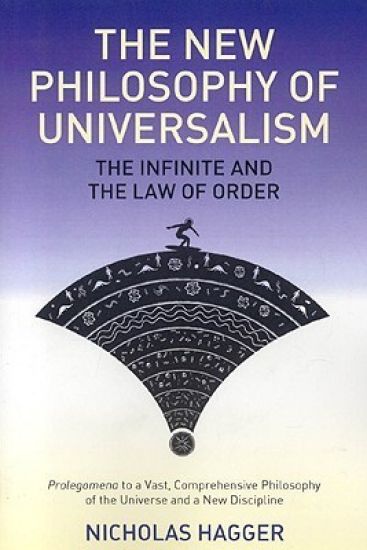
In "The New Philosophy of Universalism", Nicholas Hagger presents a new philosophy focusing on an up-to-date view of the universe and its bio-friendly, orderly rather than random, structure. At the origin of Western civilization, philosophy reflected the One universe and man's position in it. The last 350 years of increasing materialism and reductionism have fragmented the universe. In the 20th century philosophy preferred to focus on logic and language and has become increasingly irrelevant. Now a new philosophy, Universalism, takes philosophy back to its original aim: focus on the universe - the universe known to contemporary cosmologists, astrophysicists, physicists, biologists and geologists, who identify systems of order as well as randomness.Reflecting the most up-to-date scientific evidence for what the universe is, "Universalism" focuses on cosmological bio-friendliness and the universal principle of order, and reconnects philosophy to the metaphysical tradition rejected by the Vienna Circle. A systematic philosophy of the expanding universe, Nature and man, "Universalism" identifies a Law of Order that counterbalances a Law of Randomness and offers a new philosophy that has global applications.
Rise and Fall of Civilizations, The – Why civilizations rise and fall and what happens when they end
"The Rise and Fall of Civilizations" is a sequel to "The Light of Civilization", the most monumental study of the history of civilizations for several generations, where Nicholas Hagger describes religion as the basis for civilization rather than one element in its cultural expression. Saints, mystics, gurus, prophets, religious founders - it is these that drive history rather than kings and politicians. Here, he outlines the patterns of the civilizations themselves, providing a unique interpretation of the dynamics of their origin, rise and collapse, and how one civilization leads into the next. Essential reading for students of history, it will interest all seeking to understand historical patterns and where our civilization is headed today.
Last Tourist in Iran, The – From Persepolis to Nuclear Natanz
This is the first book on Iran to combine travelogue with in-depth historical reflection/getting to the heart of the Iranian Islamic mind. This is a reflective look at the cultural heritage and present nuclear crisis in Iran. Iran's cultural and spiritual heritage is now threatened by policies that may trigger international intervention. A source of Western civilization, it may be destroyed by its main beneficiary, Western civilization.This travelogue is a tour of Iran and explores the rich history of this pivotal country: the Achaemenians (Cyrus/Darius/Xerxes), the Sasanians, the Zoroastrian religion of 2,500 years ago; the Islamic period, the Safavids, and the Revolution which dethroned the Shah and made Iran an Islamic Republic. The Islamic idea is caught by observations of the well of the Hidden Imam and of its expression through the architecture, tiles and calligraphy of historical mosques. The Revolution is brought to life by visits to Ayatollah Khomeini's living rooms in Qom and Tehran, and to the Shah's White Palace. And the confrontational policy of contemporary Iran that threatens to engulf Iran's cultural heritage in the same way that Saddam's policy wreaked havoc on Iraq's cultural legacy is caught in a drive past the nuclear site at Natanz, which has many anti-aircraft guns round it.
Collected Verse Plays

Collected Verse Plays

Nicholas Hagger

John Hunt Publishing
2007
nidottu
Three and a half centuries after the form declined c.1640, Nicholas Hagger revives verse drama with "The Warlords", a panoramic two-part drama which focuses on the fortunes of General Montgomery after D-Day, and his conflict with Eisenhower. Like Tolstoy before him, Hagger is concerned to understand the role of war in the metaphysical cosmos, exploring the universal theme of the relationship between power and good in contemporary history. The second drama, "The Tragedy of Prince Tudor", tells the story of the Prince's heroic attempt to preserve the culture and identity of his disintegrating kingdom. He dramatizes what is set to become the burning issue of the 21st century-Britain's fight to preserve her national sovereignty. "The Rise of Oliver Cromwell" is an innovative play which explores the reasons for Cromwell's extraordinary rise to dictatorship. With uncanny resonances for modern audiences, it sheds light on the ancient spiritual conflicts that drive contemporary politics.